QUESTION IMAGE
Question
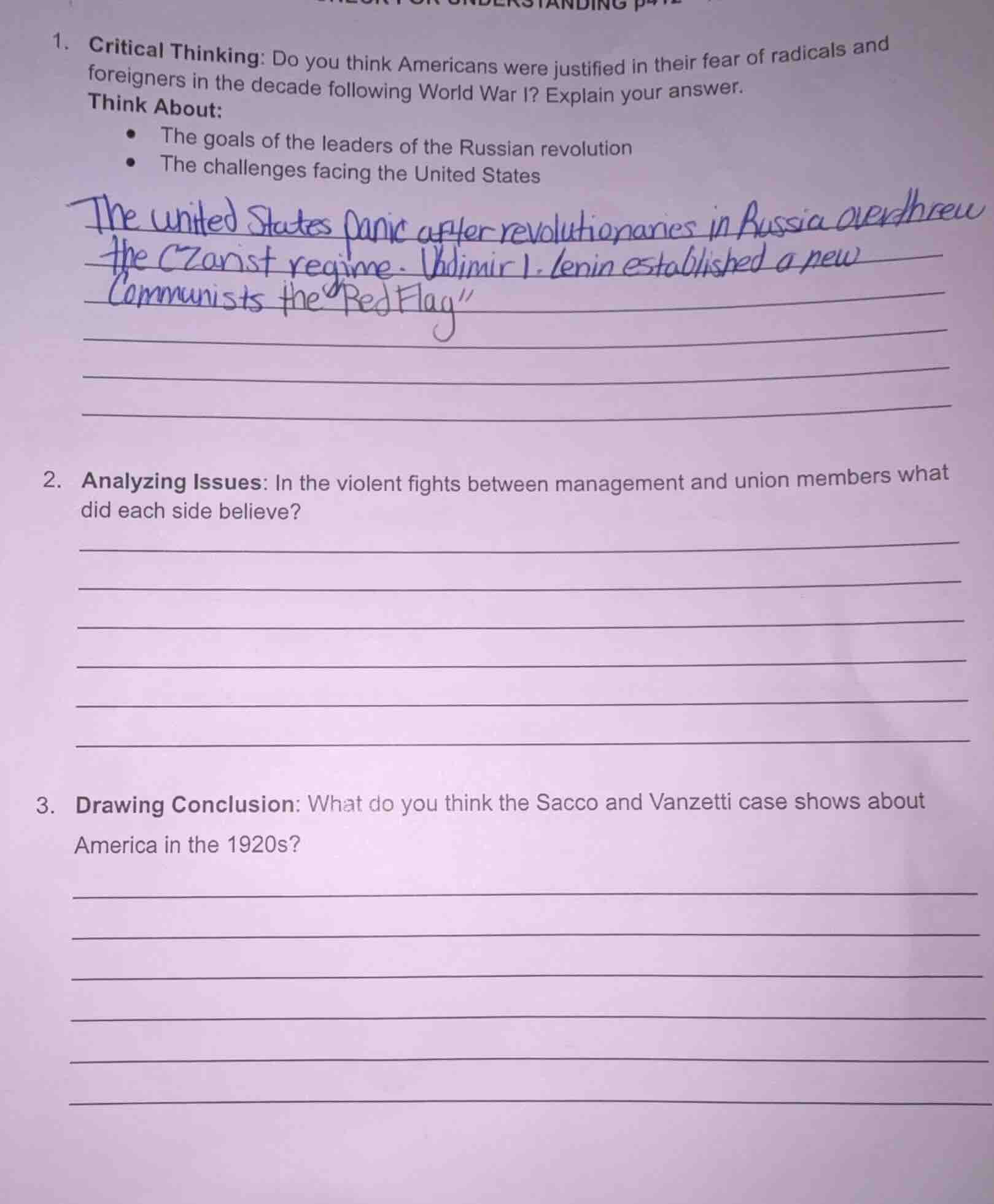
- critical thinking: do you think americans were justified in their fear of radicals and foreigners in the decade following world war i? explain your answer. think about: - the goals of the leaders of the russian revolution - the challenges facing the united states 2. analyzing issues: in the violent fights between management and union members what did each side believe? 3. drawing conclusion: what do you think the sacco and vanzetti case shows about america in the 1920s?
Brief Explanations
- For question 1: Americans' fear stemmed from the 1917 Russian Revolution, where Lenin's communist government promoted overthrowing capitalist systems. Post-WWI, the U.S. faced economic unrest, labor strikes, and bombings linked to radicals, making many fear foreign radicals would replicate the revolution. However, the fear was overstated as most immigrants/radicals did not pose an existential threat to the U.S. system.
- For question 2: Management believed unions threatened their right to control business operations, set wages, and would harm profitability and productivity. They framed union actions as radical, un-American disruptions. Union members believed they deserved fair wages, safe working conditions, job security, and that collective bargaining was the only way to counter exploitative management practices.
- For question 3: The case revealed widespread nativism, anti-immigrant sentiment, and anti-radical bias in 1920s America. Sacco and Vanzetti, Italian immigrant anarchists, were convicted of murder with weak evidence. Their trial and execution reflected how fear of foreigners and radicals could override due process, showing deep divisions between native-born, conservative Americans and immigrant, progressive groups.

Snap & solve any problem in the app
Get step-by-step solutions on Sovi AI
Photo-based solutions with guided steps
Explore more problems and detailed explanations
- Americans' fear had some contextual basis but was largely unjustified. The Russian Revolution sparked fears of communist takeover, and post-WWI unrest fueled anxiety, but most radicals/immigrants did not seek to overthrow the U.S. government, making the widespread panic and repression (like the Palmer Raids) disproportionate.
- Management: Unions threatened business control, profits, and order.
Union members: They needed collective action to secure fair pay, safe conditions, and dignity at work.
- The Sacco and Vanzetti case exposes the prevalence of nativism, anti-immigrant prejudice, and anti-radical hysteria in 1920s America, demonstrating that fear and bias could undermine the principles of due process and fair justice.