QUESTION IMAGE
Question
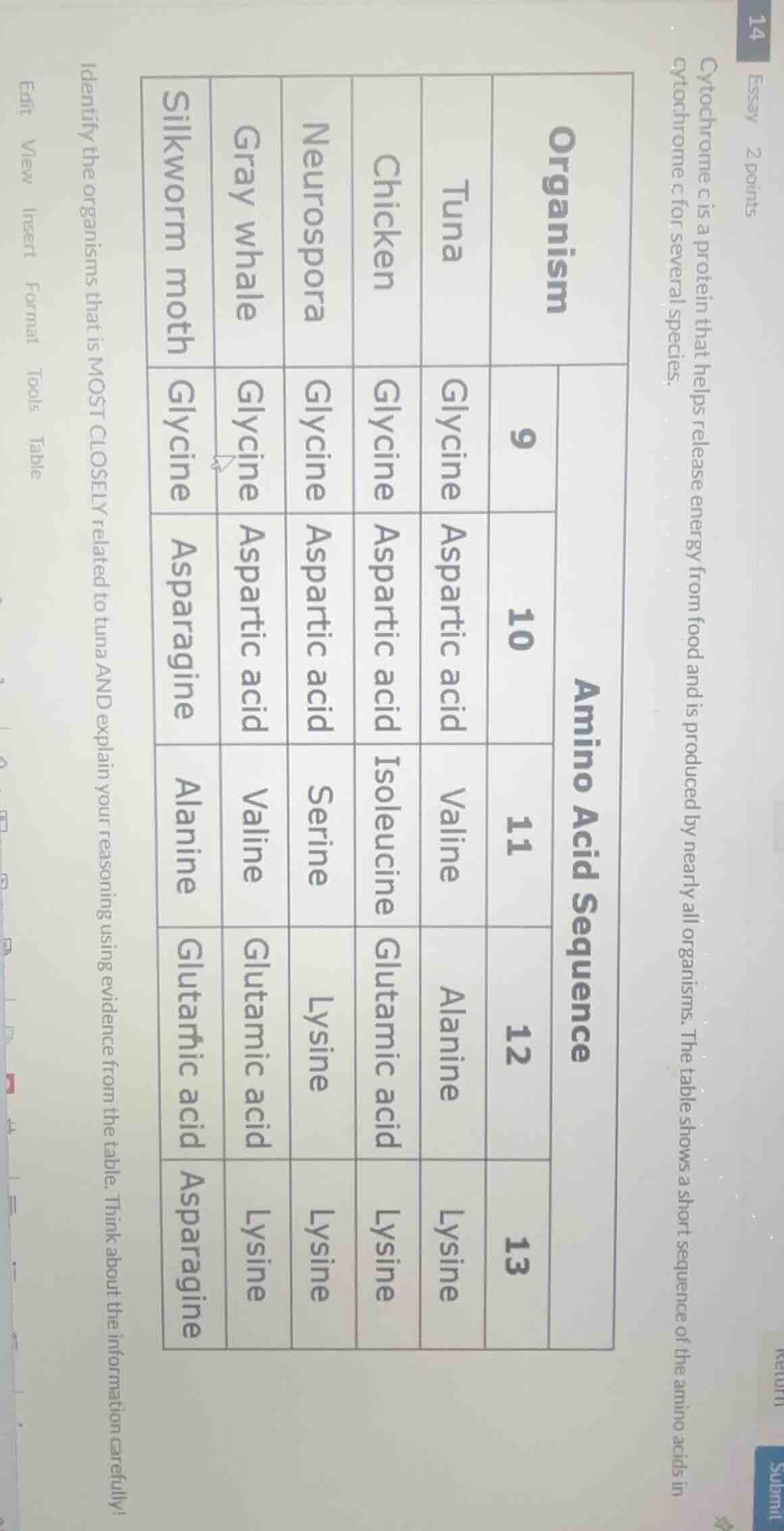
cytochrome c is a protein that helps release energy from food and is produced by nearly all organisms. the table shows a short sequence of the amino acids in cytochrome c for several species.
identify the organisms that is most closely related to tuna and explain your reasoning using evidence from the table. think about the information carefully!
To determine the organism most closely related to tuna, we compare the amino acid sequences of cytochrome c. The more identical amino acids in the sequence, the closer the evolutionary relationship (since fewer mutations imply a more recent common ancestor).
- Tuna's sequence: Glycine (9), Aspartic acid (10), Valine (11), Alanine (12), Lysine (13).
- Chicken: Glycine (9), Aspartic acid (10), Isoleucine (11) – different at position 11.
- Neurospora: Glycine (9), Aspartic acid (10), Serine (11) – different at 11; Lysine (12) – different at 12.
- Gray whale: Glycine (9), Aspartic acid (10), Valine (11), Glutamic acid (12) – different at 12; Lysine (13) – same as tuna at 13, but 12 differs. Wait, re - check: Tuna (12: Alanine), Gray whale (12: Glutamic acid) – different. Wait, no, let's re - list each position (9 - 13) for each organism vs tuna:
- Tuna: 9 = Gly, 10 = Asp, 11 = Val, 12 = Ala, 13 = Lys.
- Chicken: 9 = Gly, 10 = Asp, 11 = Ile (diff), 12 = Glu (diff), 13 = Lys.
- Neurospora: 9 = Gly, 10 = Asp, 11 = Ser (diff), 12 = Lys (diff), 13 = Lys.
- Gray whale: 9 = Gly, 10 = Asp, 11 = Val (same), 12 = Glu (diff), 13 = Lys (same).
- Silkworm moth: 9 = Gly, 10 = Asp (wait, no: Silkworm moth 10 is Asparagine? Wait, no, the table: Tuna 10: Aspartic acid; Silkworm moth 10: Asparagine – different. Wait, I misread earlier. Let's correct:
Tuna:
9: Glycine
10: Aspartic acid
11: Valine
12: Alanine
13: Lysine
Gray whale:
9: Glycine (same as tuna)
10: Aspartic acid (same as tuna)
11: Valine (same as tuna)
12: Glutamic acid (different from tuna's Alanine)
13: Lysine (same as tuna)
Chicken:
9: Glycine (same)
10: Aspartic acid (same)
11: Isoleucine (different from Valine)
12: Glutamic acid (different from Alanine)
13: Lysine (same)
Wait, no, maybe I messed up the silkworm moth. Wait, Silkworm moth: 9: Glycine (same), 10: Asparagine (different from Aspartic acid) – so position 10 differs.
Wait, another approach: count the number of matching amino acids at positions 9 - 13.
- Tuna vs Gray whale: Positions 9 (Gly - Gly: match), 10 (Asp - Asp: match), 11 (Val - Val: match), 12 (Ala - Glu: no), 13 (Lys - Lys: match). So 4 matches.
- Tuna vs Chicken: 9 (match), 10 (match), 11 (no), 12 (no), 13 (match). 3 matches.
- Tuna vs Neurospora: 9 (match), 10 (match), 11 (no), 12 (no), 13 (match). 3 matches.
- Tuna vs Silkworm moth: 9 (match), 10 (no, Asp vs Asparagine), 11 (no, Val vs Alanine), 12 (no, Ala vs Glutamic acid), 13 (no, Lys vs Asparagine). Wait, no, Silkworm moth 13: Asparagine – different from Lys. So fewer matches.
Wait, I think I made a mistake earlier. Let's re - extract the table correctly (assuming the columns are Organism, 9,10,11,12,13):
| Organism | 9 | 10 | 11 | 12 | 13 |
|---|---|---|---|---|---|
| Chicken | Glycine | Aspartic acid | Isoleucine | Glutamic acid | Lysine |
| Neurospora | Glycine | Aspartic acid | Serine | Lysine | Lysine |
| Gray whale | Glycine | Aspartic acid | Valine | Glutamic acid | Lysine |
| Silkworm moth | Glycine | Asparagine | Alanine | Glutamic acid | Asparagine |
Now, compare each to Tuna:
- Tuna: [Gly, Asp, Val, Ala, Lys]
- Chicken: [Gly, Asp, Ile, Glu, Lys] → differences at 11,12 → 3 matches (9,10,13).
- Neurospora: [Gly, Asp, Ser, Lys, Lys] → differences at 11,12 → 3 matches (9,10,13).
- Gray whale: [Gly, Asp, Val, Glu, Lys] → differences at 12 → 4 matches (9,10,11,13).
- Silkworm moth: [Gly, Asn, Ala, Glu, Asn] → differences at…

Snap & solve any problem in the app
Get step-by-step solutions on Sovi AI
Photo-based solutions with guided steps
Explore more problems and detailed explanations
Gray whale. The amino acid sequence of cytochrome c in Gray whale has the most matches with Tuna's sequence (4 out of 5 positions: 9,10,11,13 are identical; only position 12 differs), indicating a closer evolutionary relationship (fewer mutations, more recent common ancestor) compared to other organisms (Chicken: 3 matches, Neurospora: 3 matches, Silkworm moth: 1 match).