QUESTION IMAGE
Question
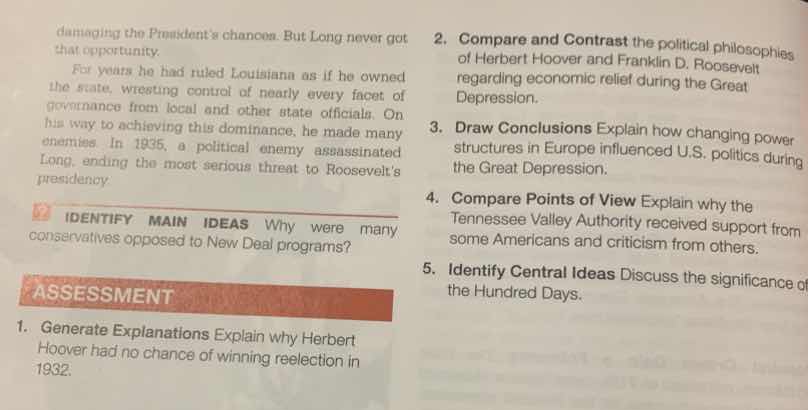
damaging the president’s chances. but long never got that opportunity. for years he had ruled louisiana as if he owned the state, wresting control of nearly every facet of governance from local and other state officials. on his way to achieving this dominance, he made many enemies. in 1935, a political enemy assassinated long, ending the most serious threat to roosevelt’s presidency.
identify main ideas why were many conservatives opposed to new deal programs?
assessment
- generate explanations explain why herbert hoover had no chance of winning reelection in 1932.
- compare and contrast the political philosophies of herbert hoover and franklin d. roosevelt regarding economic relief during the great depression.
- draw conclusions explain how changing power structures in europe influenced u.s. politics during the great depression.
- compare points of view explain why the tennessee valley authority received support from some americans and criticism from others.
- identify central ideas discuss the significance of the hundred days.
Question 1
Hoover favored limited government intervention, relying on voluntary business cooperation and local relief efforts that failed to stop mass unemployment, bank failures, and poverty. Voters blamed him for the crisis and turned to Franklin D. Roosevelt, who promised aggressive, direct federal action via the New Deal.
---
Question 2
- Hoover: Believed in "rugged individualism" and voluntary private-sector action. He opposed direct federal aid to individuals, instead supporting loans to businesses and local governments, arguing this would indirectly stimulate recovery.
- Roosevelt: Launched the New Deal, a series of federal programs that provided direct relief (e.g., FERA), created jobs (e.g., CCC), and regulated the economy (e.g., FDIC) to address the Great Depression's root causes and ease suffering.
---
Question 3
- Trade collapse: European economies shattered by war and depression cut demand for U.S. goods, worsening American unemployment and economic hardship.
- Isolationism: The failure of post-WWI European governments led many Americans to oppose U.S. involvement in European conflicts, shaping neutrality laws in the 1930s.
- Rising fascism: As Nazi Germany expanded, fears of global instability pushed some U.S. leaders to support limited aid to allies, laying groundwork for post-1940 intervention.
---
Question 4

Snap & solve any problem in the app
Get step-by-step solutions on Sovi AI
Photo-based solutions with guided steps
Explore more problems and detailed explanations
Herbert Hoover had no chance of winning reelection in 1932 because his failure to address the Great Depression's widespread economic suffering made him deeply unpopular with voters.