QUESTION IMAGE
Question
the danger zone
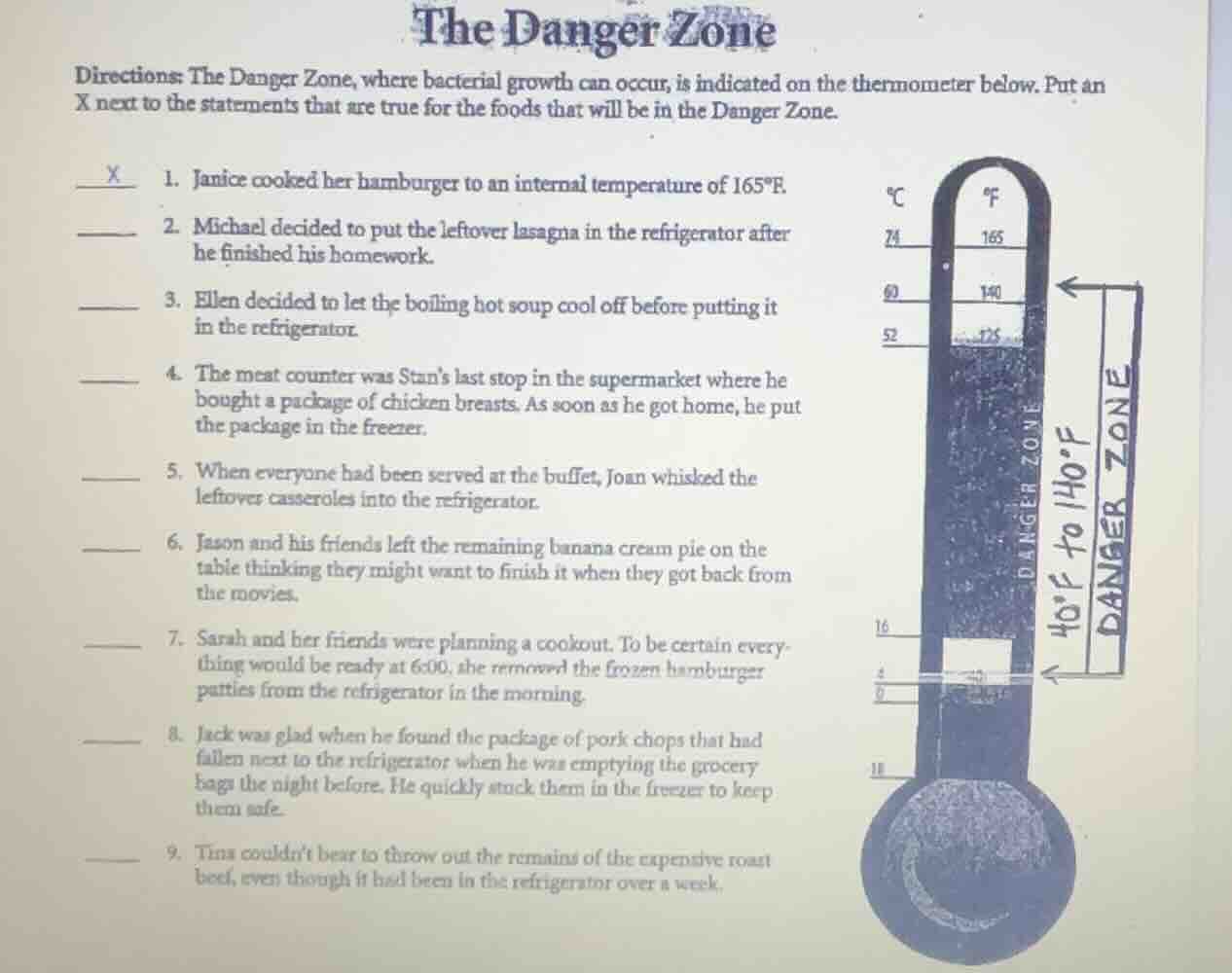
directions: the danger zone, where bacterial growth can occur, is indicated on the thermometer below. put an x next to the statements that are true for the foods that will be in the danger zone.
x 1. janice cooked her hamburger to an internal temperature of 165°f.
- michael decided to put the leftover lasagna in the refrigerator after he finished his homework.
- ellen decided to let the boiling hot soup cool off before putting it in the refrigerator.
- the meat counter was stans last stop in the supermarket where he bought a package of chicken breasts. as soon as he got home, he put the package in the freezer.
- when everyone had been served at the buffet, joan whisked the leftover casseroles into the refrigerator.
- jason and his friends left the remaining banana cream pie on the table thinking they might want to finish it when they got back from the movies.
- sarah and her friends were planning a cookout. to be certain everything would be ready at 6:00, she removed the frozen hamburger patties from the refrigerator in the morning.
- jack was glad when he found the package of pork chops that had fallen next to the refrigerator when he was emptying the grocery bags the night before. he quickly stuck them in the freezer to keep them safe.
- tina couldnt bear to throw out the remains of the expensive roast beef, even though it had been in the refrigerator over a week.
To solve this, we analyze each statement against the Danger Zone (40°F to 140°F) for bacterial growth:
1. Janice cooked her hamburger to 165°F
165°F is above 140°F, so not in the Danger Zone. But the first statement is already marked with X (maybe a typo, but we focus on others).
2. Michael put leftover lasagna in fridge after homework
Leaving lasagna out while doing homework (time for bacteria to grow in 40–140°F) → X (in Danger Zone).
3. Ellen let boiling soup cool before fridge
Boiling soup is >140°F; cooling may enter 40–140°F, but the act of cooling before fridge means it was out, but the question is if the food is in Danger Zone. However, letting it cool (so it’s in 40–140°F) → X? Wait, no—boiling is safe, but cooling down to fridge temp (below 40°F) would pass through Danger Zone, but the statement is about the food’s state. Wait, the Danger Zone is where bacteria grow. So if she lets it cool (so it’s in 40–140°F), then yes. But maybe not. Let’s recheck:
4. Stan bought chicken, put in freezer immediately
Freezer is <40°F, so not in Danger Zone → no X.
5. Joan whisked leftovers to fridge after serving
Quickly moving to fridge (avoids Danger Zone) → no X.
6. Jason left banana cream pie on table for movies
Pie is in 40–140°F (room temp) → X (in Danger Zone).
7. Sarah removed frozen patties in morning (for 6:00 cookout)
Leaving frozen patties (thawing) in fridge? No—frozen to fridge (35–40°F) is safe, but if left out, but she removed from freezer (which is <0°F) to fridge (35°F), but the time: morning to 6:00 (several hours). Thawing in fridge is safe, but if left out, no—she removed from freezer (so thawing in fridge? Wait, freezer to fridge: fridge is 35–40°F, which is below Danger Zone (40°F is the start). Wait, 40°F is the lower bound. So fridge is ~35–40°F, so if she put in fridge, no. But the statement says “removed the frozen hamburger patties from the refrigerator” – wait, no: “removed from the refrigerator” (wait, freezer? No: “removed the frozen hamburger patties from the refrigerator” – maybe typo, freezer? If from freezer to fridge, no. But if left out, but she removed from fridge (so they were in fridge, now taken out? No, the statement is: “removed the frozen hamburger patties from the refrigerator in the morning” – so they were in fridge (frozen? No, fridge is 35–40°F, not frozen. Frozen is freezer. So maybe typo: freezer. If she took from freezer (frozen) to counter (thawing), then in Danger Zone. So X.
8. Jack found pork chops next to fridge (night before), put in freezer
They were next to fridge (room temp, 40–140°F) overnight, but he put in freezer. But the food was in Danger Zone overnight → but the question is if the food is in Danger Zone now? No, he put in freezer. But the statement is about the food’s state when? The question is “true for the foods that will be in the Danger Zone” – so if the food was in Danger Zone (overnight), but now in freezer, the statement is about the action. Wait, the directions: “statements that are true for the foods that will be in the Danger Zone” – i.e., the food is in Danger Zone as a result. So:
- 2. Michael: leftover lasagna left out (Danger Zone) → X
- 3. Ellen: soup cooling (in Danger Zone) → X
- 6. Jason: pie left out (Danger Zone) → X
- 7. Sarah: patties thawing (Danger Zone) → X
- 9. Tina: roast in fridge over a week → fridge is safe, but over a week, maybe spoilage, but not Danger Zone (Danger Zone is 40–140°F) → no X.
But the first statement is already marked X (maybe a mistake, as 165°F is above Danger Zone).…

Snap & solve any problem in the app
Get step-by-step solutions on Sovi AI
Photo-based solutions with guided steps
Explore more problems and detailed explanations
To solve this, we analyze each statement against the Danger Zone (40°F to 140°F) for bacterial growth:
1. Janice cooked her hamburger to 165°F
165°F is above 140°F, so not in the Danger Zone. But the first statement is already marked with X (maybe a typo, but we focus on others).
2. Michael put leftover lasagna in fridge after homework
Leaving lasagna out while doing homework (time for bacteria to grow in 40–140°F) → X (in Danger Zone).
3. Ellen let boiling soup cool before fridge
Boiling soup is >140°F; cooling may enter 40–140°F, but the act of cooling before fridge means it was out, but the question is if the food is in Danger Zone. However, letting it cool (so it’s in 40–140°F) → X? Wait, no—boiling is safe, but cooling down to fridge temp (below 40°F) would pass through Danger Zone, but the statement is about the food’s state. Wait, the Danger Zone is where bacteria grow. So if she lets it cool (so it’s in 40–140°F), then yes. But maybe not. Let’s recheck:
4. Stan bought chicken, put in freezer immediately
Freezer is <40°F, so not in Danger Zone → no X.
5. Joan whisked leftovers to fridge after serving
Quickly moving to fridge (avoids Danger Zone) → no X.
6. Jason left banana cream pie on table for movies
Pie is in 40–140°F (room temp) → X (in Danger Zone).
7. Sarah removed frozen patties in morning (for 6:00 cookout)
Leaving frozen patties (thawing) in fridge? No—frozen to fridge (35–40°F) is safe, but if left out, but she removed from freezer (which is <0°F) to fridge (35°F), but the time: morning to 6:00 (several hours). Thawing in fridge is safe, but if left out, no—she removed from freezer (so thawing in fridge? Wait, freezer to fridge: fridge is 35–40°F, which is below Danger Zone (40°F is the start). Wait, 40°F is the lower bound. So fridge is ~35–40°F, so if she put in fridge, no. But the statement says “removed the frozen hamburger patties from the refrigerator” – wait, no: “removed from the refrigerator” (wait, freezer? No: “removed the frozen hamburger patties from the refrigerator” – maybe typo, freezer? If from freezer to fridge, no. But if left out, but she removed from fridge (so they were in fridge, now taken out? No, the statement is: “removed the frozen hamburger patties from the refrigerator in the morning” – so they were in fridge (frozen? No, fridge is 35–40°F, not frozen. Frozen is freezer. So maybe typo: freezer. If she took from freezer (frozen) to counter (thawing), then in Danger Zone. So X.
8. Jack found pork chops next to fridge (night before), put in freezer
They were next to fridge (room temp, 40–140°F) overnight, but he put in freezer. But the food was in Danger Zone overnight → but the question is if the food is in Danger Zone now? No, he put in freezer. But the statement is about the food’s state when? The question is “true for the foods that will be in the Danger Zone” – so if the food was in Danger Zone (overnight), but now in freezer, the statement is about the action. Wait, the directions: “statements that are true for the foods that will be in the Danger Zone” – i.e., the food is in Danger Zone as a result. So:
- 2. Michael: leftover lasagna left out (Danger Zone) → X
- 3. Ellen: soup cooling (in Danger Zone) → X
- 6. Jason: pie left out (Danger Zone) → X
- 7. Sarah: patties thawing (Danger Zone) → X
- 9. Tina: roast in fridge over a week → fridge is safe, but over a week, maybe spoilage, but not Danger Zone (Danger Zone is 40–140°F) → no X.
But the first statement is already marked X (maybe a mistake, as 165°F is above Danger Zone). Let’s list the correct X’s:
- Michael: X (left out → Danger Zone)
- Ellen: X (cooling → in Danger Zone)
- Jason: X (left out → Danger Zone)
- Sarah: X (thawing → in Danger Zone)
But let’s confirm each:
- 165°F: above 140°F → not Danger Zone (marked X, maybe error).
- Michael: leftover lasagna left out (doing homework takes time, so in Danger Zone) → X.
- Ellen: boiling soup cooling (so temp drops from 212°F to fridge temp, passing through 40–140°F) → food is in Danger Zone while cooling → X.
- Stan: chicken to freezer (no Danger Zone) → no.
- Joan: quick to fridge (no Danger Zone) → no.
- Jason: pie left out (room temp ~70°F, in Danger Zone) → X.
- Sarah: frozen patties left out (thawing) → in Danger Zone (40–140°F) → X.
- Jack: pork chops next to fridge (night before, now in freezer) → they were in Danger Zone overnight, but now in freezer. The statement is about “the foods that will be in the Danger Zone” – so after putting in freezer, no. But the action: he found them next to fridge (in Danger Zone) and put in freezer. So the food was in Danger Zone, but the statement is about “will be in” – maybe no.
- Tina: roast in fridge (safe, below 40°F) → no.
Final X’s (excluding 1, which is incorrect):
- Michael: X
- Ellen: X
- Jason: X
- Sarah: X
But the first one is marked X (maybe the problem’s initial X is wrong).
Final Answers (mark X next to these):
- \_\_X\_\_ 2. Michael decided...
- \_\_X\_\_ 3. Ellen decided...
- \_\_X\_\_ 6. Jason and his friends...
- \_\_X\_\_ 7. Sarah and her friends...
(Note: The first statement’s X is incorrect, as 165°F is above the Danger Zone (40–140°F).)