QUESTION IMAGE
Question
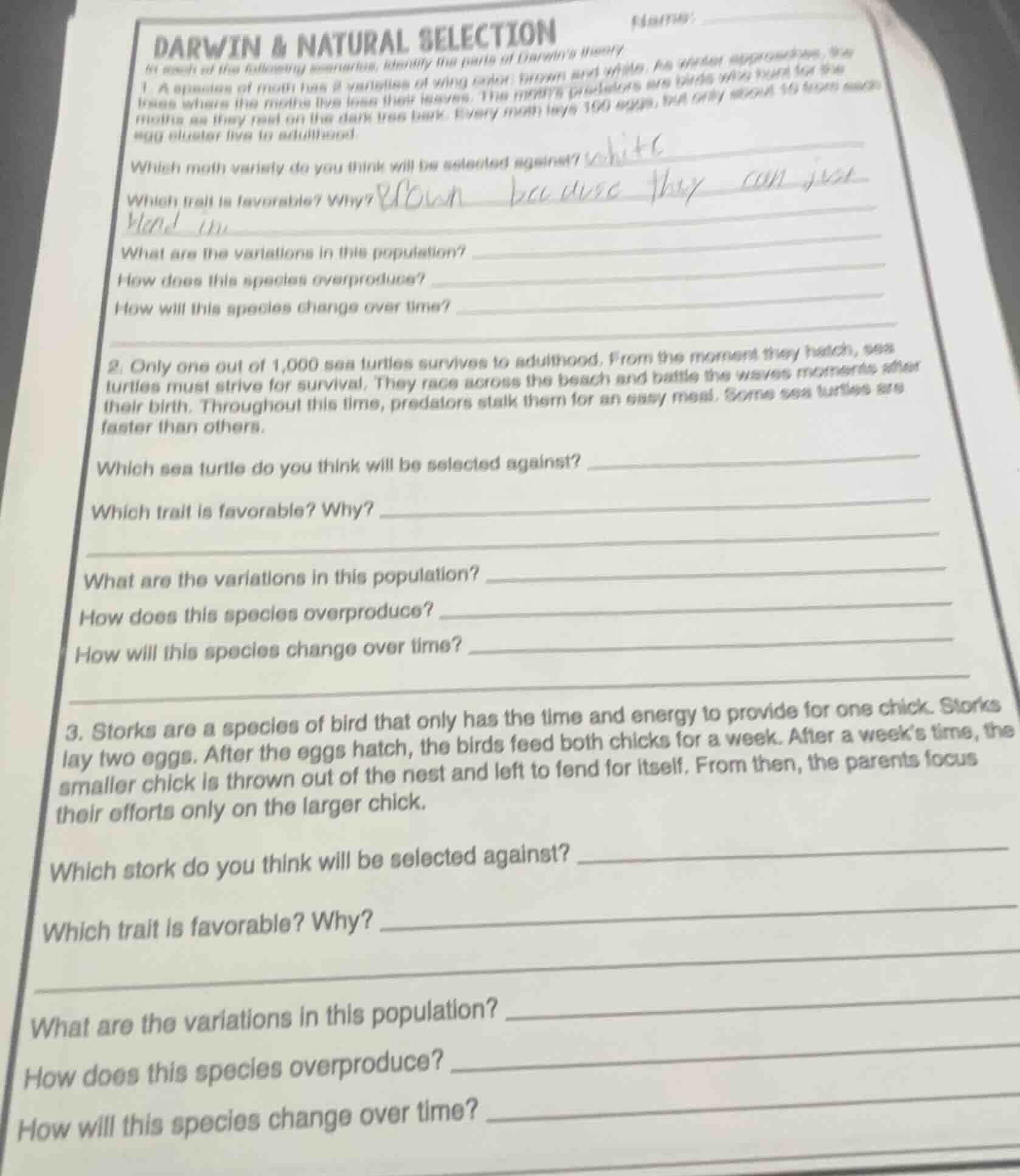
darwin & natural selection
in each of the following scenarios, identify the parts of darwins theory
- a species of moth has a variation of wing color: brown and white. as winter approaches, the trees where the moths live lose their leaves. the main predators are birds who hunt for the moths as they rest on the dark tree bark. every moth lays 100 eggs, but only about 10 from each egg cluster live to adulthood.
which moth variety do you think will be selected against?
which trait is favorable? why?
what are the variations in this population?
how does this species overproduce?
how will this species change over time?
- only one out of 1,000 sea turtles survives to adulthood. from the moment they hatch, sea turtles must strive for survival. they race across the beach and battle the waves moments after their birth. throughout this time, predators stalk them for an easy meal. some sea turtles are faster than others.
which sea turtle do you think will be selected against?
which trait is favorable? why?
what are the variations in this population?
how does this species overproduce?
how will this species change over time?
- storks are a species of bird that only has the time and energy to provide for one chick. storks lay two eggs. after the eggs hatch, the birds feed both chicks for a week. after a week’s time, the smaller chick is thrown out of the nest and left to fend for itself. from then, the parents focus their efforts only on the larger chick.
which stork do you think will be selected against?
which trait is favorable? why?
what are the variations in this population?
how does this species overproduce?
how will this species change over time?
Scenario 1: Moths
- Selected Against: White moths are more visible on dark tree bark, so birds (predators) will easily spot and eat them.
- Favorable Trait: Brown color. It helps moths camouflage on dark tree bark, reducing predation.
- Variations: Wing color (brown and white).
- Overproduction: Each moth lays 100 eggs, but only ~10 survive to adulthood.
- Change Over Time: The proportion of brown moths will increase as white moths are selected against (more likely to be eaten), so brown moths have a higher chance to reproduce and pass on their color trait.
- Selected Against: Slower sea turtles. They are less likely to escape predators or reach the ocean quickly.
- Favorable Trait: Faster speed. Helps turtles outrun predators and survive the journey to the ocean.
- Variations: Speed (some are faster, some slower).
- Overproduction: Only 1 out of 1,000 survives to adulthood (many hatch, few live).
- Change Over Time: Faster turtles will be more likely to survive and reproduce, so the population will evolve to have more faster turtles over generations.
- Selected Against: Smaller stork chicks. They are thrown out of the nest and left to fend for themselves, reducing their survival chances.
- Favorable Trait: Larger size. Parents focus on larger chicks, so they get more resources and are more likely to survive.
- Variations: Size (smaller/larger chicks).
- Overproduction: Storks lay 2 eggs, but can only provide for 1 chick long - term.
- Change Over Time: Larger chicks will be more likely to survive and reproduce (if the trait is heritable), so the population may evolve to have more chicks with a tendency to be larger, or parents may favor larger chicks more strongly over time.

Snap & solve any problem in the app
Get step-by-step solutions on Sovi AI
Photo-based solutions with guided steps
Explore more problems and detailed explanations
- Selected Against: White moths
- Favorable Trait: Brown color (camouflages on dark bark, avoids predation)
- Variations: Wing color (brown, white)
- Overproduction: Lays 100 eggs, few survive
- Change Over Time: More brown moths (white moths decline due to predation)