QUESTION IMAGE
Question
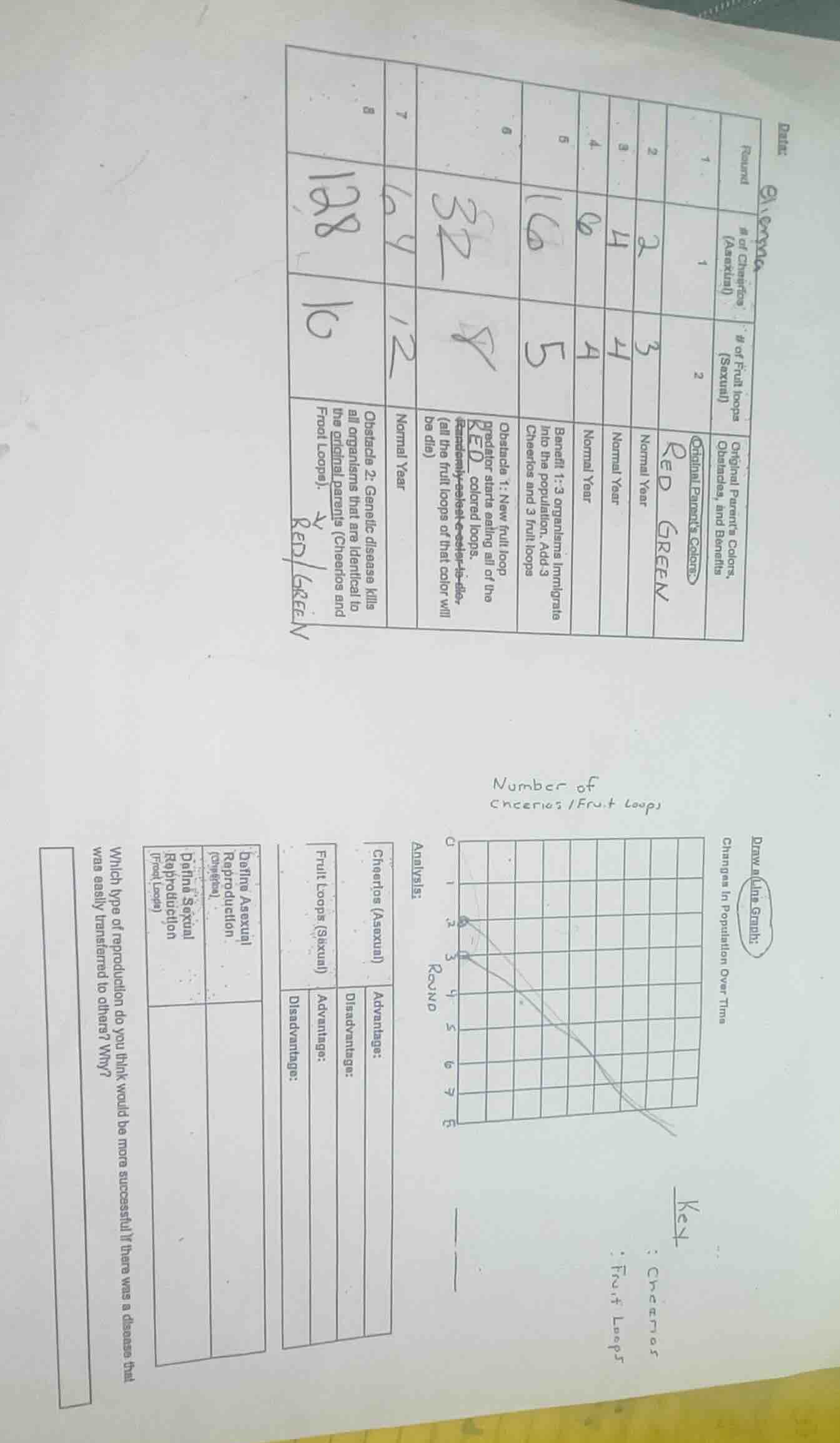
data:| round | # of cheerios (asexual) | # of fruit loops (sexual) | original parents colors, obstacles, and benefits || ---- | ---- | ---- | ---- || 1 | 1 | 2 | original parents colors: red green || 2 | 2 | 3 | normal year || 3 | 4 | 4 | normal year || 4 | 8 | 4 | normal year || 5 | 16 | 5 | benefit 1:3 organisms immigrate into the population. add 3 cheerios and 3 fruit loops || 6 | 32 | 8 | obstacle 1: new fruit loop predator starts eating all of the red colored loops. (randomly select a color to die, all the fruit loops of that color will be die) || 7 | 64 | 12 | normal year || 8 | 128 | 10 | obstacle 2: genetic disease kills all organisms that are identical to the original parents (cheerios and fruit loops). red/green |draw a line graph:changes in population over timenumber of cheerios/fruit loopskey: cheerios: fruit loopsanalysis:cheerios (asexual)advantage:disadvantage:fruit loops (sexual)advantage:disadvantage:define asexual (cheerio) reproductiondefine sexual (fruit loops) reproductionwhich type of reproduction do you think would be more successful if there was a disease that was easily transferred to others? why?
Step1: Define asexual reproduction
Asexual reproduction (Cheerios): Offspring are genetically identical to a single parent, created via mitosis or binary fission, with no genetic recombination.
Step2: Define sexual reproduction
Sexual reproduction (Fruit Loops): Offspring inherit genetic material from two parents, created via meiosis and fertilization, leading to genetic variation.
Step3: Asexual (Cheerios) pros/cons
Advantage: Rapid population growth
No need to find mates; Expression: Fast reproduction rate
Disadvantage: No genetic variation
All offspring are clones; Expression: Uniform genotype
Step4: Sexual (Fruit Loops) pros/cons
Advantage: Genetic diversity
Offspring have unique gene combinations; Expression: Increased phenotypic variation
Disadvantage: Slower population growth
Requires mate finding and gamete fusion; Expression: Lower reproductive speed
Step5: Disease resistance analysis
Sexual reproduction (Fruit Loops) is more successful against easily transmitted diseases. Genetic variation means some individuals may have alleles that confer resistance, allowing the population to survive. Asexual populations (Cheerios) are all identical; if the parent is susceptible, all offspring will be susceptible, leading to potential population collapse.
Step6: Complete line graph
Plot Cheerios (asexual) data:
Round 1: 1; Round 2: 2; Round 3: 4; Round 4: 8; Round 5: 16; Round 6: 32; Round 7: 64; Round 8: 128
Plot Fruit Loops (sexual) data:
Round 1: 2; Round 2: 3; Round 3: 4; Round 4: 4; Round 5: 5; Round 6: 8; Round 7: 12; Round 8: 10
Use the key to assign lines, with the x-axis as "Round" and y-axis as "Number of Organisms".

Snap & solve any problem in the app
Get step-by-step solutions on Sovi AI
Photo-based solutions with guided steps
Explore more problems and detailed explanations
Definitions:
- Asexual Reproduction (Cheerios): Reproduction requiring only one parent, producing genetically identical offspring.
- Sexual Reproduction (Fruit Loops): Reproduction requiring two parents, producing genetically diverse offspring via genetic recombination.
Analysis:
- Cheerios (Asexual)
Advantage: Fast, efficient population growth
Disadvantage: No genetic variation, vulnerable to threats
- Fruit Loops (Sexual)
Advantage: Genetic diversity aids survival against threats
Disadvantage: Slower population growth due to mate requirements
Disease Resistance Conclusion:
Sexual reproduction (Fruit Loops) would be more successful. Its genetic variation means some individuals may carry disease-resistant traits, allowing the population to persist, while the genetically uniform asexual (Cheerios) population would be entirely susceptible to the easily transmitted disease.
Line Graph Summary:
The line graph will show the asexual Cheerios population growing exponentially until round 8, while the sexual Fruit Loops population grows more slowly, with a slight decline in round 8 due to the genetic disease obstacle.