QUESTION IMAGE
Question
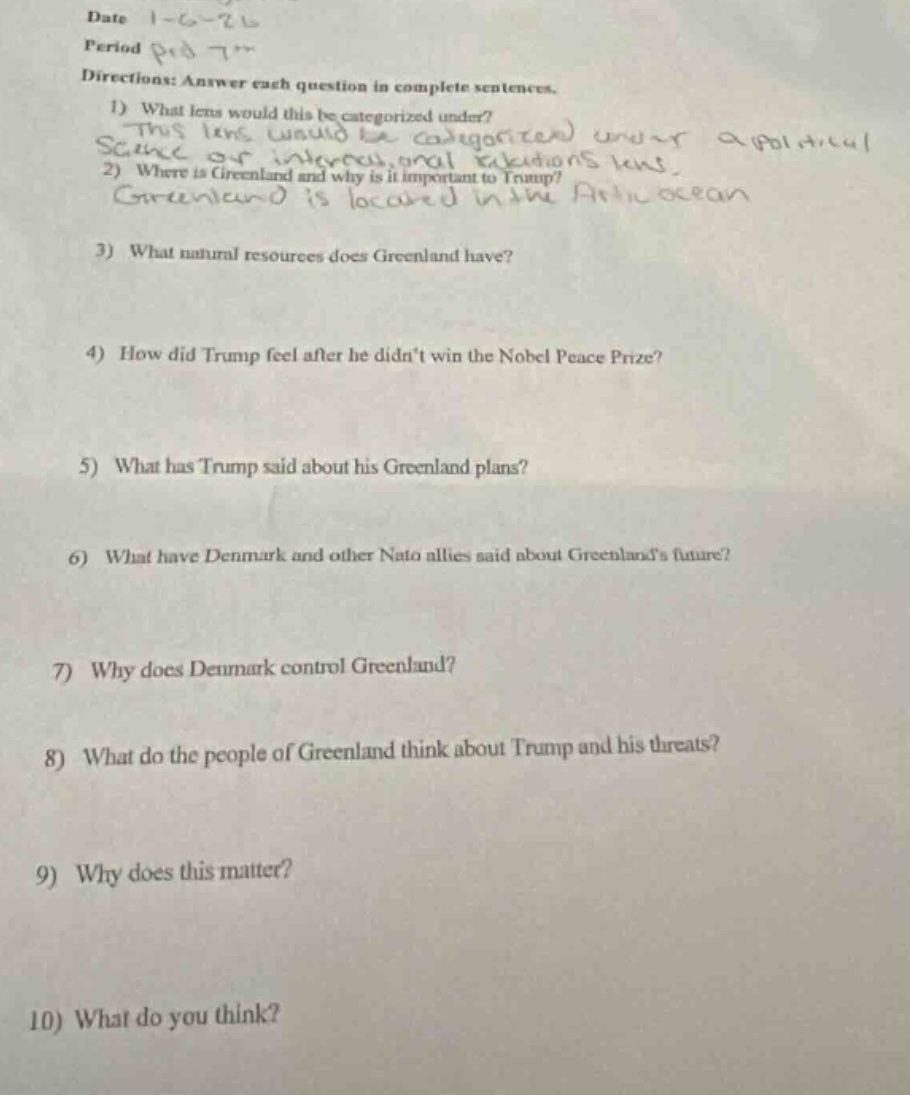
date 1-6-26
period red 7
directions: answer each question in complete sentences.
- what lens would this be categorized under?
- where is greenland and why is it important to trump?
- what natural resources does greenland have?
- how did trump feel after he didnt win the nobel peace prize?
- what has trump said about his greenland plans?
- what have denmark and other nato allies said about greenlands future?
- why does denmark control greenland?
- what do the people of greenland think about trump and his threats?
- why does this matter?
- what do you think?
Brief Explanations
- This question set relates to international political dynamics, so it falls under a political lens (a subset of international relations/politics).
- Greenland is an autonomous territory within the Kingdom of Denmark, located between the Arctic and Atlantic Oceans, north of mainland North America. It was relevant to Trump due to its strategic Arctic military position, vast natural resources, and potential for trade routes as Arctic ice melts.
- Greenland has significant untapped natural resources including rare earth minerals, uranium, iron ore, zinc, gold, and offshore oil and gas reserves.
- After not winning the Nobel Peace Prize, Trump publicly criticized the award, calling it a "joke" and claiming he had been "robbed" of the honor.
- Trump publicly floated the idea of the United States purchasing Greenland in 2019, framing it as a "big real estate deal" that would benefit both the U.S. and Greenland, though he later downplayed the proposal after backlash.
- Denmark rejected Trump's proposal outright, stating Greenland is not for sale. Other NATO allies largely viewed the proposal as unfeasible and a distraction from more pressing alliance priorities, emphasizing respect for Greenland's autonomy and Denmark's sovereignty.
- Denmark controls Greenland through a long historical relationship: Greenland was a Danish colony from the 18th century until 1953, when it became an integral part of Denmark; it gained home rule in 1979 and expanded self-governance in 2009, but Denmark still handles foreign affairs, defense, and monetary policy.
- Polls and public statements showed the vast majority of Greenlanders opposed Trump's purchase proposal, viewing it as a disregard for their autonomy and self-determination. Many saw the idea as insulting and a threat to their identity.
- This matters because it highlighted tensions over Arctic sovereignty, resource competition, and the role of NATO allies in the region. It also raised questions about U.S. foreign policy priorities and respect for the self-determination of Indigenous and autonomous communities.
- (Subjective example) I think the incident underscored the need for respectful diplomatic engagement on Arctic issues, centered on the self-determination of Greenlanders and collaborative governance among Arctic nations rather than unilateral, transactional proposals.

Snap & solve any problem in the app
Get step-by-step solutions on Sovi AI
Photo-based solutions with guided steps
Explore more problems and detailed explanations
- This lens would be categorized under a political/international relations lens.
- Greenland is an autonomous Danish territory located between the Arctic and Atlantic Oceans, north of mainland North America. It was important to Trump for its strategic Arctic military position, vast untapped natural resources, and potential new trade routes as Arctic ice melts.
- Greenland has significant untapped natural resources including rare earth minerals, uranium, iron ore, zinc, gold, and offshore oil and gas reserves.
- After not winning the Nobel Peace Prize, Trump publicly criticized the award as a "joke" and claimed he had been unfairly passed over for the honor.
- In 2019, Trump publicly proposed that the United States purchase Greenland, describing it as a major "real estate deal" that would benefit both the U.S. and Greenland, before downplaying the idea after widespread backlash.
- Denmark immediately rejected Trump's purchase proposal, stating Greenland is not for sale. Other NATO allies largely dismissed the idea as unworkable, emphasizing respect for Greenland's autonomy and Denmark's sovereignty over the territory.
- Denmark controls Greenland through a historical colonial relationship: Greenland was a Danish colony until 1953, when it became an official part of Denmark; it gained home rule in 1979 and expanded self-governance in 2009, but Denmark retains authority over foreign affairs, defense, and monetary policy.
- The vast majority of Greenlanders opposed Trump's purchase proposal, viewing it as an insult to their autonomy, self-determination, and cultural identity.
- This matters because it highlighted growing competition over Arctic resources and trade routes, tensions over sovereignty in the region, and questions about U.S. respect for the self-determination of autonomous and Indigenous communities.
- (Subjective example) I think the incident showed the importance of prioritizing respectful, collaborative diplomacy in the Arctic, centered on the voices and self-determination of Greenlanders rather than unilateral, transactional political proposals.