QUESTION IMAGE
Question
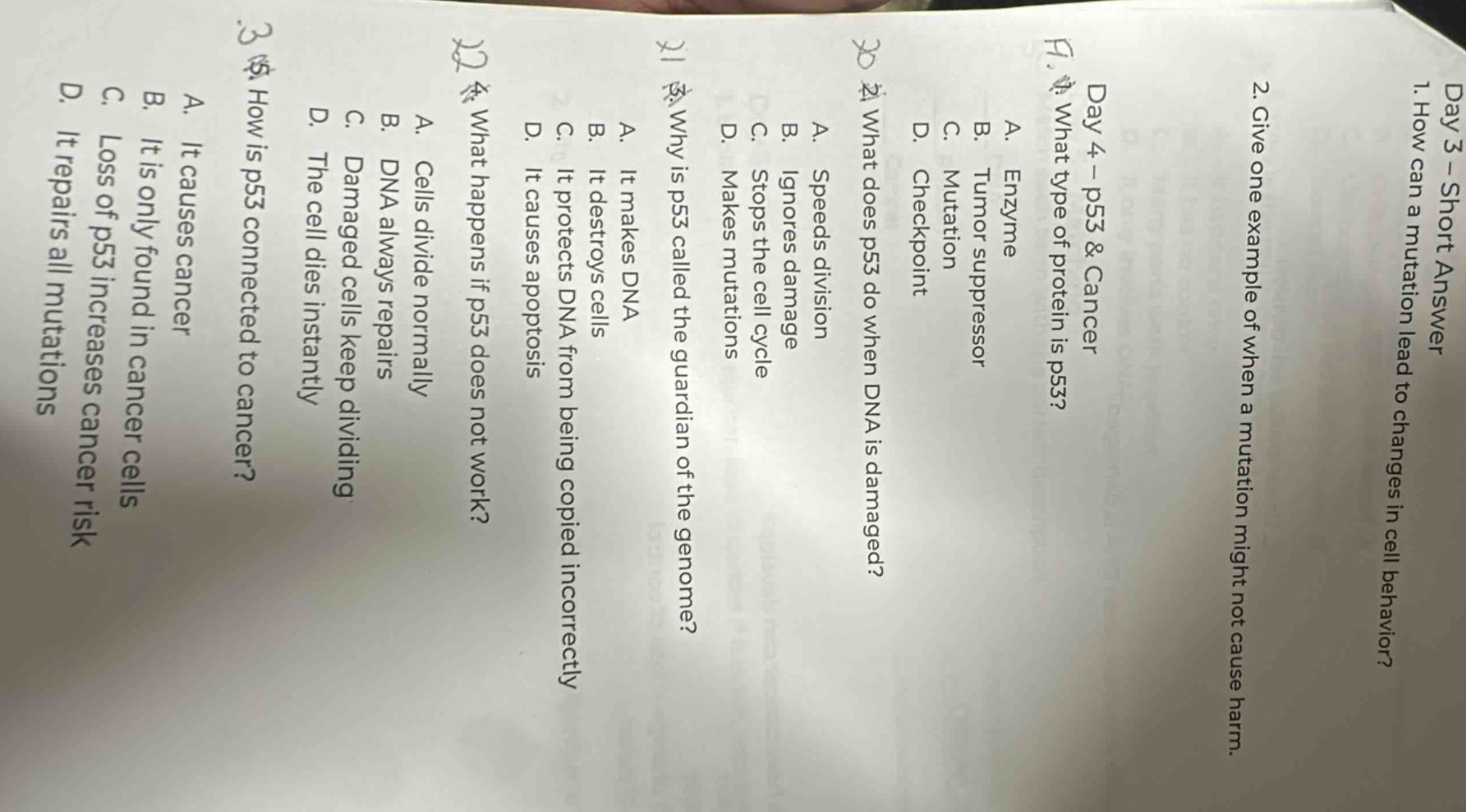
day 3 – short answer
- how can a mutation lead to changes in cell behavior?
- give one example of when a mutation might not cause harm.
day 4 – p53 & cancer
- what type of protein is p53?
a. enzyme
b. tumor suppressor
c. mutation
d. checkpoint
- what does p53 do when dna is damaged?
a. speeds division
b. ignores damage
c. stops the cell cycle
d. makes mutations
- why is p53 called the guardian of the genome?
a. it makes dna
b. it destroys cells
c. it protects dna from being copied incorrectly
d. it causes apoptosis
- what happens if p53 does not work?
a. cells divide normally
b. dna always repairs
c. damaged cells keep dividing
d. the cell dies instantly
- how is p53 connected to cancer?
a. it causes cancer
b. it is only found in cancer cells
c. loss of p53 increases cancer risk
d. it repairs all mutations
Brief Explanations
- A mutation can alter a protein's structure/function, changing cell signaling, growth, or division. For example, a mutation that overactivates a growth-promoting protein can cause unregulated cell division.
- A silent mutation (change in DNA that codes for the same amino acid) does not alter the protein's structure/function, so it causes no harm to cell behavior.
---
Brief Explanations
- p53 is a protein that regulates cell cycle and prevents tumor formation.
- When DNA is damaged, p53 halts the cell cycle to allow repair or triggers cell death if damage is irreversible.
- p53 is called this because it protects the genome by preventing mutated DNA from being passed to daughter cells.
- Non-functional p53 allows damaged cells to divide, passing on mutations.
- Loss of functional p53 removes a key barrier to unregulated cell division, increasing cancer risk.
---

Snap & solve any problem in the app
Get step-by-step solutions on Sovi AI
Photo-based solutions with guided steps
Explore more problems and detailed explanations
- For example, a mutation in a gene that produces a cell growth signaling protein can make the protein constantly active, leading to uncontrolled cell division (a hallmark of cancer).
- A silent point mutation, where the DNA sequence change results in the same amino acid being incorporated into the protein, so the protein's function remains unchanged and there is no harmful effect on cell behavior.
---