QUESTION IMAGE
Question
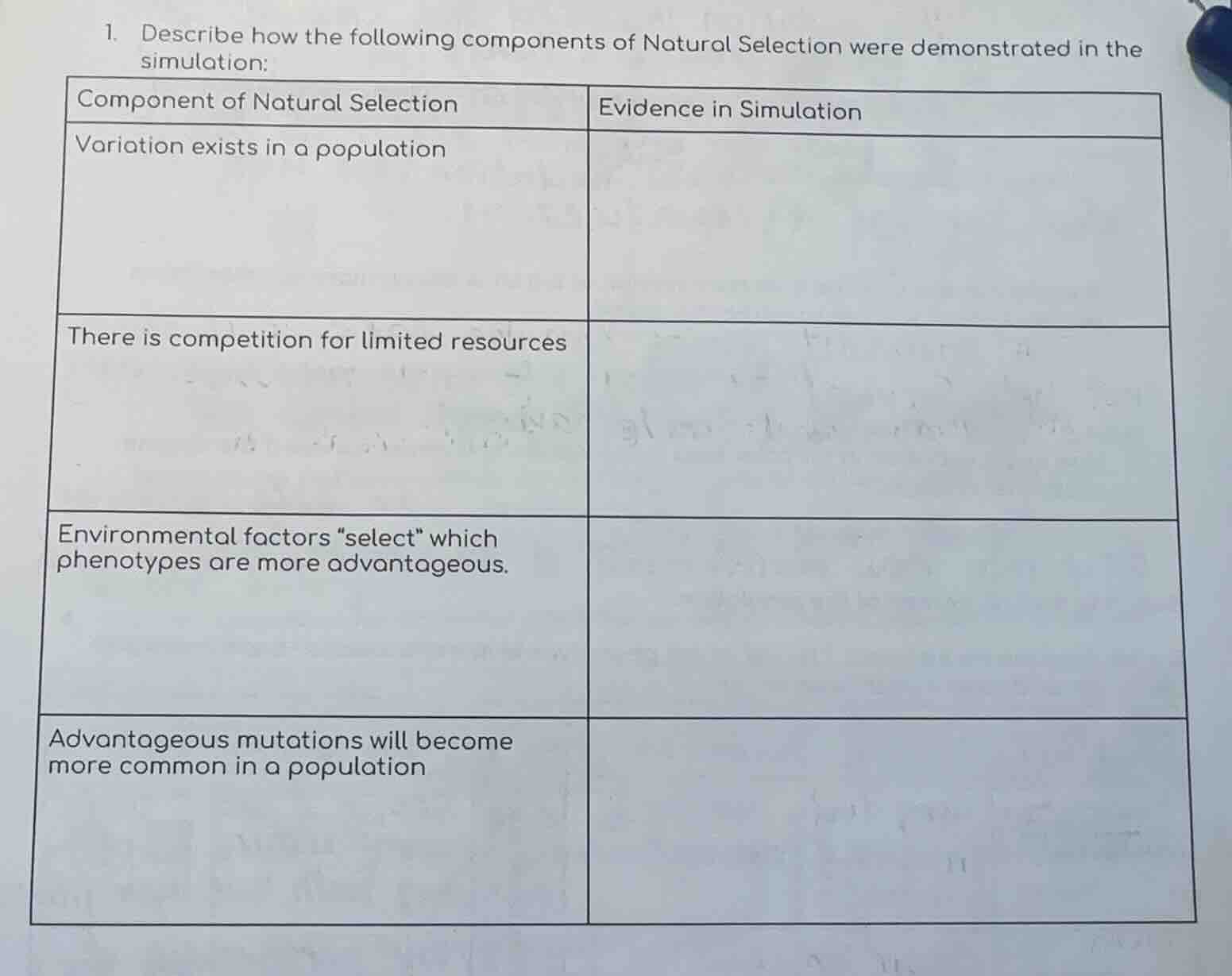
- describe how the following components of natural selection were demonstrated in the simulation:
| component of natural selection | evidence in simulation |
|---|---|
| there is competition for limited resources | |
| environmental factors \select\ which phenotypes are more advantageous. | |
| advantageous mutations will become more common in a population |
To answer this, we analyze each component of natural selection and typical simulation evidence (assuming a common natural selection simulation like predator - prey or resource - based with phenotypic variation, e.g., different colored beans as organisms, different beak - like tools for foraging):
1. Variation exists in a population
In many natural selection simulations (e.g., a bean - color or beak - type simulation), the population has different traits. For example, if simulating bird beaks, there are different tool shapes (like spoons, forceps, etc.) representing beak variations, or different colored "organisms" with distinct phenotypes. These different traits (phenotypes) show that individuals in the population are not identical, so variation is present.
Evidence in Simulation (example - fill based on typical sims):
If using a beak - foraging simulation, there are different tool types (e.g., forceps, spoons, toothpicks) representing different beak structures. Or in a camouflage simulation, "organisms" (e.g., paper dots) have different colors (red, green, blue) to represent phenotypic variation.
2. There is competition for limited resources
In simulations, resources (e.g., food items like beans, seeds) are limited in number or time to collect. Multiple "organisms" (e.g., students with beak tools) try to collect these resources. When the number of resources is less than the number of organisms trying to get them, organisms must compete (e.g., struggle to collect enough to "survive" or "reproduce" in the simulation rules).
Evidence in Simulation (example - fill based on typical sims):
In a beak - foraging simulation, there is a fixed number of food items (e.g., 50 beans) and more "organisms" (e.g., 20 students with tools) than can collect all beans. Organisms that can't collect enough may be "eliminated" (not get to "reproduce" in the next round), showing competition for the limited food resource.
3. Environmental factors “select” which phenotypes are more advantageous
The environment in the simulation (e.g., the type of food, background color) favors certain phenotypes. For example, in a camouflage simulation with a green background, green - colored "organisms" (paper dots) are less likely to be "eaten" (picked up) by a "predator" (student picking dots) than non - green ones. The environmental factor (background color) selects for the camouflaged (green) phenotype as it's more advantageous for survival.
Evidence in Simulation (example - fill based on typical sims):
In a camouflage simulation with a green - colored tray (environment) and paper - dot "organisms" of red, green, and blue colors, the green dots are picked up (eaten) less frequently by the "predator" (student) than red/blue dots. So the green phenotype is selected as more advantageous by the environmental factor (green background).
4. Advantageous mutations will become more common in a population

Snap & solve any problem in the app
Get step-by-step solutions on Sovi AI
Photo-based solutions with guided steps
Explore more problems and detailed explanations
Over multiple generations (rounds) of the simulation, the advantageous phenotype (from selection) increases in frequency. For example, in a beak - foraging simulation, if forceps (beak type) are advantageous (collect more food), in the next generation (students "reproduce" by passing on their tool type or a similar one), the number of forceps - type "beaks" (tools) increases as more organisms with that trait survive and reproduce.
Evidence in Simulation (example - fill based on typical sims):
In a beak - foraging simulation, after several rounds (generations), if forceps (tool) was the most advantageous (collected most food), the number of students using forceps (or "offspring" with forceps - like tools) increases. For example, in generation 1: 5 forceps, 10 spoons, 5 toothpicks. After 3 generations, 15 forceps, 3 spoons, 2 toothpicks (showing the advantageous trait (forceps) becoming more common).
To fill the table properly, you need to base the "Evidence in Simulation" on the specific simulation used (e.g., your class's beak - foraging, camouflage, or other natural selection simulation). The above are general examples to guide you.
If we take a specific example of a camouflage - based natural selection simulation (using paper dots as organisms, different colors, and a student as a predator picking dots):
| Component of Natural Selection | Evidence in Simulation |
|---|---|
| There is competition for limited resources | There are a limited number of "food" resources (or in this case, the "resource" is avoiding being eaten; but if we consider a food - based sim, say limited beans, and more dots than can "survive" (not be eaten). For the camouflage aspect, the "resource" of survival (not being eaten) is limited because the predator can only eat a certain number, and dots compete to avoid being eaten. |
| Environmental factors “select” which phenotypes are more advantageous | The environment is a green - colored tray (background). Green - colored dots are less likely to be picked up (eaten) by the predator (student) than red or blue dots. The environmental factor (green background) selects the green phenotype as more advantageous for survival. |
| Advantageous mutations will become more common in a population | After multiple rounds (generations) of the simulation, the number of green - colored dots (the advantageous phenotype) increases relative to red and blue dots. For example, in generation 1: 10 red, 10 green, 10 blue dots. After 5 generations: 5 red, 20 green, 5 blue dots, showing the advantageous (green) phenotype becoming more common. |
If using a beak - foraging simulation (students with different tools as beaks, beans as food):
| Component of Natural Selection | Evidence in Simulation |
|---|---|
| There is competition for limited resources | There are a limited number of bean "food" items (e.g., 50 beans) and more students (e.g., 20) than can collect all beans. Students must compete to collect enough beans to "survive" (be able to "reproduce" in the next round). |
| Environmental factors “select” which phenotypes are more advantageous | The type of food (e.g., small, round beans) favors certain tool types. Forceps (beak tool) can pick up beans more efficiently than spoons or toothpicks. The environmental factor (bean - type food) selects the forceps - tool phenotype as more advantageous for collecting food. |
| Advantageous mutations will become more common in a population | After multiple rounds (generations), the number of students using forceps (the advantageous tool) increases. For example, in generation 1: 5 forceps, 10 spoons, 5 toothpicks. After 3 generations: 15 forceps, 3 spoons, 2 toothpicks, showing the advantageous (forceps) phenotype becoming more common. |