QUESTION IMAGE
Question
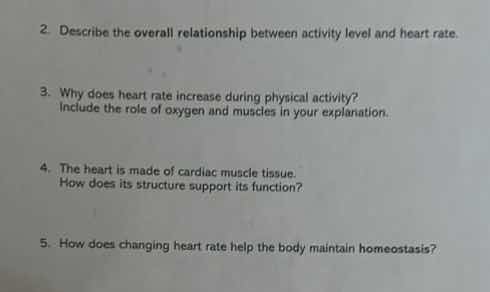
- describe the overall relationship between activity level and heart rate.
- why does heart rate increase during physical activity?
include the role of oxygen and muscles in your explanation.
- the heart is made of cardiac muscle tissue.
how does its structure support its function?
- how does changing heart rate help the body maintain homeostasis?
Question 2
As activity level (like exercise intensity) rises, heart rate generally increases. At rest, heart rate is lower (e.g., resting heart rate ~60 - 100 bpm). With light to moderate activity, heart rate rises to meet increased oxygen and nutrient demands of working muscles. During intense activity, heart rate can further increase (up to max heart rate, calculated as ~220 - age) to supply more oxygen - rich blood to muscles. When activity stops, heart rate decreases back toward resting levels as demand lessens.
Muscles need energy (ATP) to contract during physical activity. Aerobic respiration (using oxygen) is the main way to produce ATP for sustained muscle activity. When muscles work, they consume more oxygen and produce more carbon dioxide (a waste product). The body’s cells (especially muscle cells) need a continuous supply of oxygen to keep producing ATP. To meet this increased demand for oxygen (and to remove carbon dioxide), the heart must pump more blood (which carries oxygen) to the muscles. So, the heart rate increases to increase the rate of blood flow (cardiac output = heart rate × stroke volume). Higher heart rate means more frequent contractions, so more blood (with oxygen) is delivered to muscles per unit time, supporting their increased metabolic activity.
Cardiac muscle tissue has unique structural features:
- Striated and involuntary: Cardiac muscle cells are striated (like skeletal muscle) for strong contractions but involuntary (like smooth muscle), so the heart beats rhythmically without conscious control.
- Intercalated discs: These are special junctions between cardiac muscle cells. They have gap junctions (allowing rapid electrical signal transmission) and desmosomes (providing mechanical strength). Gap junctions enable electrical impulses to spread quickly from cell to cell, ensuring coordinated contraction of the atria and then the ventricles (so the heart contracts as a unit, e.g., atria contract together, then ventricles).
- Branched cells: Cardiac muscle cells are branched, which allows for more connections between cells, enhancing the spread of electrical signals and the synchronization of contractions.
- Rich blood supply: Cardiac muscle has a dense network of blood vessels (capillaries) to supply its own high oxygen and nutrient needs, as the heart is a highly active organ.
- High mitochondria content: Cardiac muscle cells have many mitochondria to produce ATP aerobically, supporting the heart’s continuous, rhythmic contractions (the heart never truly rests, just has short diastole periods). These structural features together allow the heart to contract rhythmically, powerfully, and in a coordinated way to pump blood throughout the body.

Snap & solve any problem in the app
Get step-by-step solutions on Sovi AI
Photo-based solutions with guided steps
Explore more problems and detailed explanations
As activity level increases, heart rate generally increases. At rest, heart rate is relatively low. During physical activity, the body’s demand for oxygen and nutrients (to fuel muscles) rises, so the heart beats faster to pump more oxygen - rich blood to the working muscles. When activity ceases, heart rate decreases as the demand for oxygen and nutrients by the muscles reduces.