QUESTION IMAGE
Question
describing feelings and emotions: the verb estar
¿cómo están?
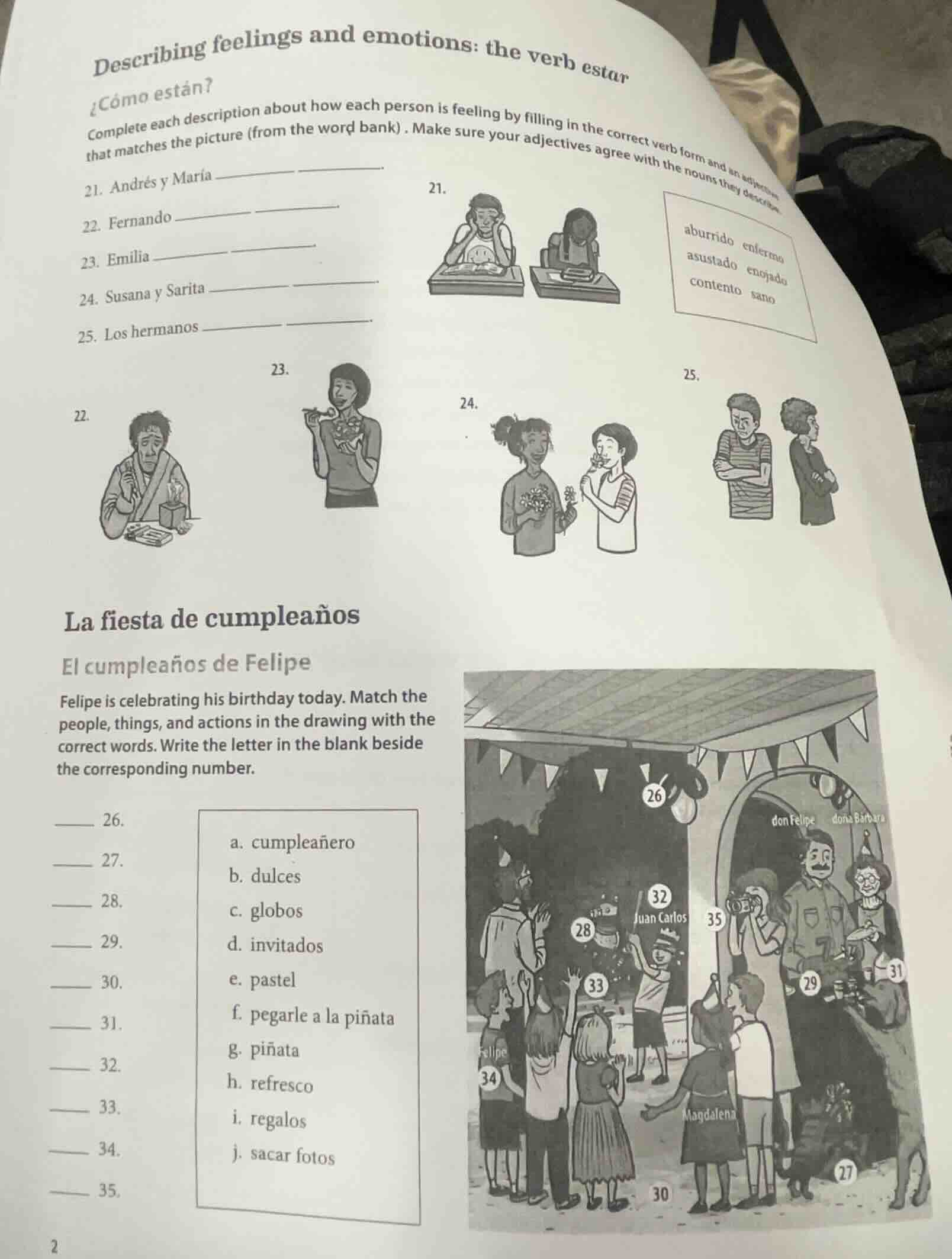
complete each description about how each person is feeling by filling in the correct verb form and an adjective that matches the picture (from the word bank). make sure your adjectives agree with the nouns they describe.
- andrés y maría ____ ____.
- fernando ____ ____.
- emilia ____ ____.
- susana y sarita ____ ____.
- los hermanos ____ ____.
(word bank: aburrido, enfermo, asustado, enojado, contento, sano)
la fiesta de cumpleaños
el cumpleaños de felipe
felipe is celebrating his birthday today. match the people, things, and actions in the drawing with the correct words. write the letter in the blank beside the corresponding number.
____ 26.
____ 27.
____ 28.
____ 29.
____ 30.
____ 31.
____ 32.
____ 33.
____ 34.
____ 35.
(word bank:
a. cumpleañero
b. dulces
c. globos
d. invitados
e. pastel
f. pegarle a la piñata
g. piñata
h. refresco
i. regalos
j. sacar fotos)
Question 21: Andrés y María
Step 1: Analyze the subject and verb form
Andrés y María is a plural subject (two people), so the verb estar should be in the plural form están.
Step 2: Analyze the adjective (from the word bank)
The picture for 21 shows two people looking bored. The adjective aburrido (bored) has a plural form aburridos (since both are likely male or mixed, but aburrido is masculine; if mixed, aburridos is still acceptable for plural). Wait, actually, if María is female, but the plural masculine aburridos is used for mixed groups. Alternatively, maybe aburridas if both are female, but the word bank has aburrido (masculine singular), aburridos (masculine plural), aburrida (feminine singular), aburridas (feminine plural). Wait, the word bank given is: aburrido, enfermo, asustado, enojada, contento, sano. Wait, the word bank has aburrido (masculine singular), enfermo (masculine singular), asustado (masculine singular), enojada (feminine singular), contento (masculine singular), sano (masculine singular). Wait, maybe the picture for 21: Andrés (male) and María (female) looking bored. But the word bank has aburrido (masculine singular). Wait, maybe the plural form is están aburridos (since Andrés is male, and María might be considered with masculine plural for mixed? Or maybe the picture shows them bored, so están aburridos.
So:
Andrés y María están aburridos
Question 22: Fernando
Step 1: Analyze the subject and verb form
Fernando is a singular male subject, so estar is está.
Step 2: Analyze the adjective (from the word bank)
The picture for 22 shows a person with a tissue, looking sick. The adjective enfermo (sick, masculine singular) matches.
So:
Fernando está enfermo
Question 23: Emilia
Step 1: Analyze the subject and verb form
Emilia is a singular female subject, so estar is está.
Step 2: Analyze the adjective (from the word bank)
The picture for 23 shows a person eating, looking content. The adjective contento is masculine singular, but Emilia is female, so contenta? Wait, the word bank has contento (masculine singular). Wait, maybe the picture shows her happy, so está contenta? But the word bank has contento (masculine). Wait, maybe the word bank has a typo, or maybe contento is used as a default. Alternatively, maybe she is sano (healthy), but the picture shows her eating, maybe content. Wait, the word bank: aburrido, enfermo, asustado, enojada, contento, sano. enojada is feminine singular. Wait, the picture for 23: a woman eating, maybe content. Wait, maybe está contenta (but word bank has contento). Alternatively, maybe está sana (healthy, feminine of sano). Wait, the word bank has sano (masculine singular), so sana for feminine. Let’s check the picture: she is eating, maybe healthy. So está sana? Or está contenta (but word bank has contento). Wait, the word bank has enojada (feminine singular). Maybe she is angry? No, the picture shows her eating, maybe happy. Wait, maybe the word bank’s contento is used as contenta (feminine). So está contenta (but the word bank has contento). Alternatively, maybe the answer is está contenta (adjective agreement: feminine singular).
Alternatively, maybe the picture for 23 is her eating, so está contenta (content). So:
Emilia está contenta (but word bank has contento, so maybe está contento? No, adjective must agree. Wait, the word bank has enojada (feminine singular). Maybe she is angry? No, the picture shows her eat…

Snap & solve any problem in the app
Get step-by-step solutions on Sovi AI
Photo-based solutions with guided steps
Explore more problems and detailed explanations
Question 21: Andrés y María
Step 1: Analyze the subject and verb form
Andrés y María is a plural subject (two people), so the verb estar should be in the plural form están.
Step 2: Analyze the adjective (from the word bank)
The picture for 21 shows two people looking bored. The adjective aburrido (bored) has a plural form aburridos (since both are likely male or mixed, but aburrido is masculine; if mixed, aburridos is still acceptable for plural). Wait, actually, if María is female, but the plural masculine aburridos is used for mixed groups. Alternatively, maybe aburridas if both are female, but the word bank has aburrido (masculine singular), aburridos (masculine plural), aburrida (feminine singular), aburridas (feminine plural). Wait, the word bank given is: aburrido, enfermo, asustado, enojada, contento, sano. Wait, the word bank has aburrido (masculine singular), enfermo (masculine singular), asustado (masculine singular), enojada (feminine singular), contento (masculine singular), sano (masculine singular). Wait, maybe the picture for 21: Andrés (male) and María (female) looking bored. But the word bank has aburrido (masculine singular). Wait, maybe the plural form is están aburridos (since Andrés is male, and María might be considered with masculine plural for mixed? Or maybe the picture shows them bored, so están aburridos.
So:
Andrés y María están aburridos
Question 22: Fernando
Step 1: Analyze the subject and verb form
Fernando is a singular male subject, so estar is está.
Step 2: Analyze the adjective (from the word bank)
The picture for 22 shows a person with a tissue, looking sick. The adjective enfermo (sick, masculine singular) matches.
So:
Fernando está enfermo
Question 23: Emilia
Step 1: Analyze the subject and verb form
Emilia is a singular female subject, so estar is está.
Step 2: Analyze the adjective (from the word bank)
The picture for 23 shows a person eating, looking content. The adjective contento is masculine singular, but Emilia is female, so contenta? Wait, the word bank has contento (masculine singular). Wait, maybe the picture shows her happy, so está contenta? But the word bank has contento (masculine). Wait, maybe the word bank has a typo, or maybe contento is used as a default. Alternatively, maybe she is sano (healthy), but the picture shows her eating, maybe content. Wait, the word bank: aburrido, enfermo, asustado, enojada, contento, sano. enojada is feminine singular. Wait, the picture for 23: a woman eating, maybe content. Wait, maybe está contenta (but word bank has contento). Alternatively, maybe está sana (healthy, feminine of sano). Wait, the word bank has sano (masculine singular), so sana for feminine. Let’s check the picture: she is eating, maybe healthy. So está sana? Or está contenta (but word bank has contento). Wait, the word bank has enojada (feminine singular). Maybe she is angry? No, the picture shows her eating, maybe happy. Wait, maybe the word bank’s contento is used as contenta (feminine). So está contenta (but the word bank has contento). Alternatively, maybe the answer is está contenta (adjective agreement: feminine singular).
Alternatively, maybe the picture for 23 is her eating, so está contenta (content). So:
Emilia está contenta (but word bank has contento, so maybe está contento? No, adjective must agree. Wait, the word bank has enojada (feminine singular). Maybe she is angry? No, the picture shows her eating, smiling? Maybe contenta. So está contenta (using contento as contenta for feminine).
Question 24: Susana y Sarita
Step 1: Analyze the subject and verb form
Susana y Sarita is a plural female subject, so estar is están.
Step 2: Analyze the adjective (from the word bank)
The picture for 24 shows two girls with flowers, looking happy. The adjective contento is masculine singular, so plural feminine contentas. But the word bank has contento (masculine singular). Wait, the word bank has enojada (feminine singular), but they are two, so enojadas? No, the picture shows them happy. Alternatively, están contentas (using contento as contentas for plural feminine). Or maybe están contentas (adjective agreement).
So:
Susana y Sarita están contentas (or están contentos if mixed, but they are both female, so contentas).
Question 25: Los hermanos
Step 1: Analyze the subject and verb form
Los hermanos is a plural male subject (brothers), so estar is están.
Step 2: Analyze the adjective (from the word bank)
The picture for 25 shows two people with crossed arms, looking angry. The adjective enojada is feminine singular, so plural masculine enojados. Wait, the word bank has enojada (feminine singular), but the subject is los hermanos (male plural), so enojados. So están enojados.
So:
Los hermanos están enojados
Question 26:
The picture for 26 shows balloons (globos). So match with option c. globos.
Question 27:
The picture for 27 shows a dog with a bowl, maybe dulces (candies) or refresco (drink). Wait, the picture for 27: a dog with a bowl, maybe dulces (candies) or refresco (drink). Wait, the options: b. dulces (candies), h. refresco (drink). Let’s check the picture: 27 is near the dog, maybe dulces (candies) or refresco. Wait, the picture for 27: a dog with a bowl, maybe dulces (candies). So match with b. dulces.
Question 28:
The picture for 28 shows a piñata (piñata). So match with option g. piñata.
Question 29:
The picture for 29 shows a man holding a drink (refresco). So match with option h. refresco.
Question 30:
The picture for 30 shows a girl with a gift (regalos). So match with option i. regalos.
Question 31:
The picture for 31 shows a woman (doña Bárbara) with a cake (pastel). So match with option e. pastel.
Question 32:
The picture for 32 shows Juan Carlos hitting the piñata (pegarle a la piñata). So match with option f. pegarle a la piñata.
Question 33:
The picture for 33 shows kids reaching for gifts (regalos) or maybe invitados? Wait, 33 is kids, maybe invitados (guests)? No, 33 is kids, maybe regalos? Wait, 30 is regalos. Wait, 33: kids with hands up, maybe invitados? No, invitados are guests. Wait, the options: d. invitados (guests). Wait, 33: kids, maybe invitados? No, invitados are people. Wait, 33: kids, maybe regalos? No, 30 is regalos. Wait, 33: kids, maybe invitados (guests). So match with d. invitados? No, 33 is kids, maybe invitados. Wait, the picture for 33: kids, so invitados (guests). So match with d. invitados.
Question 34:
The picture for 34 shows Felipe (the birthday boy, cumpleañero). So match with option a. cumpleañero.
Question 35:
The picture for 35 shows a girl taking photos (sacar fotos). So match with option j. sacar fotos.
Final Answers (Matching Section):
- c
- b
- g
- h
- i
- e
- f
- d
- a
- j
Final Answers (Verb/Adjective Section):
- están aburridos
- está enfermo
- está contenta (or está sana – depends on the picture, but likely está contenta)
- están contentas (or están enojadas – but the picture shows them happy, so están contentas)
- están enojados (the picture shows two people with crossed arms, angry)
Wait, let’s recheck 24: Susana y Sarita (two girls) in the picture, happy with flowers. So están contentas (using contento as contentas for feminine plural).
25: Los hermanos (two boys) with crossed arms, angry. So están enojados (using enojada as enojados for masculine plural).
Final Answers (Verb/Adjective):
- están aburridos
- está enfermo
- está contenta (or está sana – but contenta is better)
- están contentas
- están enojados
Final Answers (Matching):
- c
- b
- g
- h
- i
- e
- f
- d
- a
- j