QUESTION IMAGE
Question
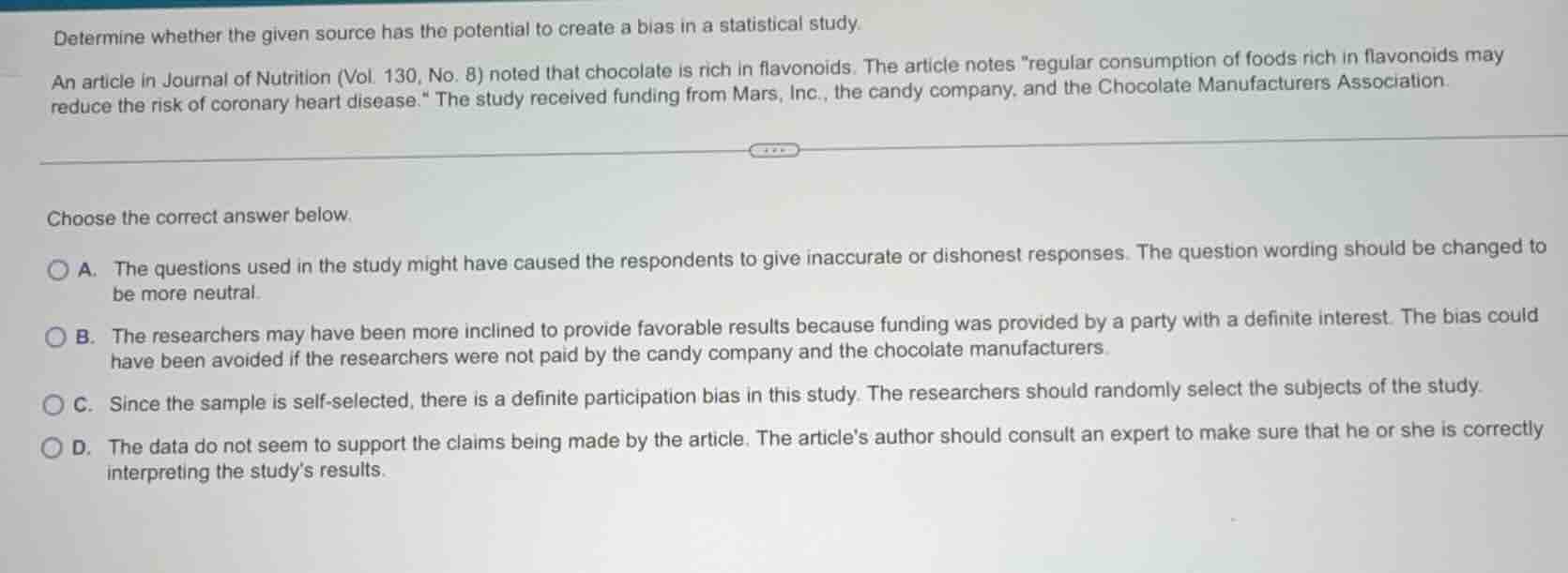
determine whether the given source has the potential to create a bias in a statistical study.
an article in journal of nutrition (vol. 130, no. 8) noted that chocolate is rich in flavonoids. the article notes
egular consumption of foods rich in flavonoids may reduce the risk of coronary heart disease.\ the study received funding from mars, inc., the candy company, and the chocolate manufacturers association.
choose the correct answer below.
a. the questions used in the study might have caused the respondents to give inaccurate or dishonest responses. the question wording should be changed to be more neutral.
b. the researchers may have been more inclined to provide favorable results because funding was provided by a party with a definite interest. the bias could have been avoided if the researchers were not paid by the candy company and the chocolate manufacturers.
c. since the sample is self - selected, there is a definite participation bias in this study. the researchers should randomly select the subjects of the study.
d. the data do not seem to support the claims being made by the article. the articles author should consult an expert to make sure that he or she is correctly interpreting the studys results.
To determine if the source creates bias, we analyze each option:
- Option A: The problem doesn't mention survey questions, so this is irrelevant.
- Option B: The study was funded by Mars, Inc. (a candy company) and the Chocolate Manufacturers Association. These funders have a financial interest in positive results about chocolate. So researchers may be inclined to produce favorable findings, creating bias. This matches the situation.
- Option C: There's no indication of self - selected sampling in the problem description.
- Option D: The problem doesn't suggest the data doesn't support the claims; it's about funding - related bias.

Snap & solve any problem in the app
Get step-by-step solutions on Sovi AI
Photo-based solutions with guided steps
Explore more problems and detailed explanations
B. The researchers may have been more inclined to provide favorable results because funding was provided by a party with a definite interest. The bias could have been avoided if the researchers were not paid by the candy company and the chocolate manufacturers.