QUESTION IMAGE
Question
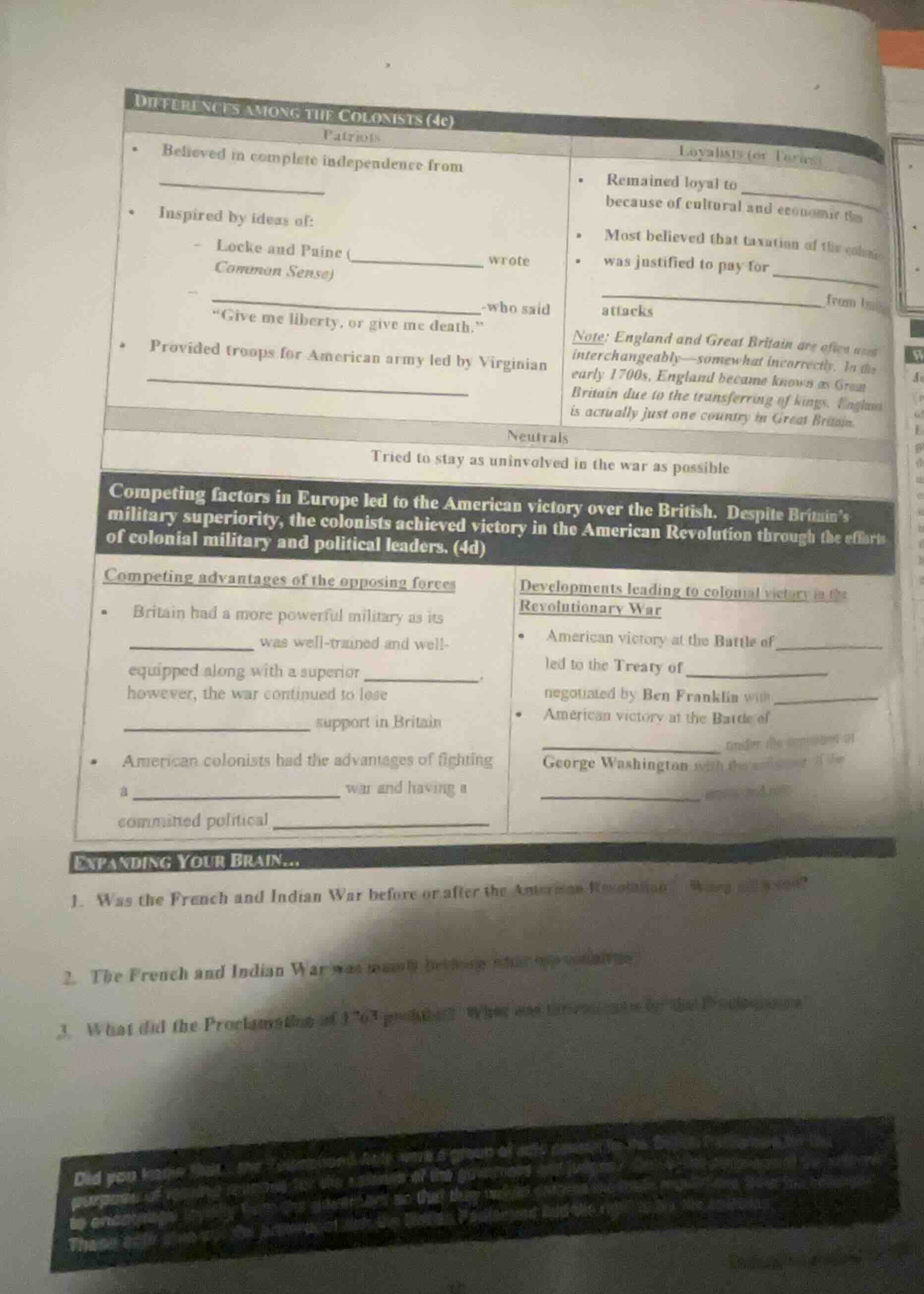
differences among the colonists (4c)
patriots
- believed in complete independence from ______
- inspired by ideas of:
- locke and paine (______ wrote common sense)
- ______ - who said \give me liberty, or give me death.\
- provided troops for american army led by virginian ______
loyalists (or tories)
- remained loyal to ______ because of cultural and economic ties
- most believed that taxation of the colonies was justified to pay for ______ from indian attacks
note: england and great britain are often used interchangeably—somewhat incorrectly. in the early 1700s, england became known as great britain due to the transferring of kings. england is actually just one country in great britain.
neutrals
tried to stay as uninvolved in the war as possible
competing factors in europe led to the american victory over the british. despite britain’s military superiority, the colonists achieved victory in the american revolution through the efforts of colonial military and political leaders. (4d)
competing advantages of the opposing forces
- britain had a more powerful military as its ____ was well - trained and well - equipped along with a superior __, however, the war continued to lose ____ support in britain
- american colonists had the advantages of fighting a ____ war and having a committed political ____
developments leading to colonial victory in the revolutionary war
- american victory at the battle of ____ led to the treaty of __ negotiated by ben franklin with ____
- american victory at the battle of ____ under the command of george washington with the assistance of the ____ army and navy
expanding your brain...
- was the french and indian war before or after the american revolution? why do you think?
- the french and indian war was mainly between what two countries?
- what did the proclamation of 1763 prohibit? what was the primary reason for that proclamation?
1. Answer for the first sub - question (Was the French and Indian War before or after the American Revolution?):
The French and Indian War (1754 - 1763) was a conflict between Britain and France (with Native American allies on both sides) over colonial territory in North America. The American Revolution (1775 - 1783) was a war for independence from British rule by the American colonies. Since 1763 (end of French and Indian War) is before 1775 (start of American Revolution), the French and Indian War was before the American Revolution.
The French and Indian War was part of the larger Seven Years' War. In North America, the main belligerents were the British (along with their American colonial forces and some Native American allies) and the French (along with their Native American allies). The name "French and Indian War" comes from the fact that the French were allied with many Native American tribes against the British and their colonists.
The Proclamation of 1763 prohibited American colonists from settling west of the Appalachian Mountains. The main reason was to avoid further conflicts with Native American tribes who lived in that region. After the French and Indian War, Britain wanted to stabilize relations with Native Americans and also wanted to control the movement of colonists for administrative and economic reasons (such as managing the newly acquired territory).

Snap & solve any problem in the app
Get step-by-step solutions on Sovi AI
Photo-based solutions with guided steps
Explore more problems and detailed explanations
The French and Indian War was before the American Revolution. The French and Indian War took place from 1754 - 1763, while the American Revolution began in 1775.