QUESTION IMAGE
Question
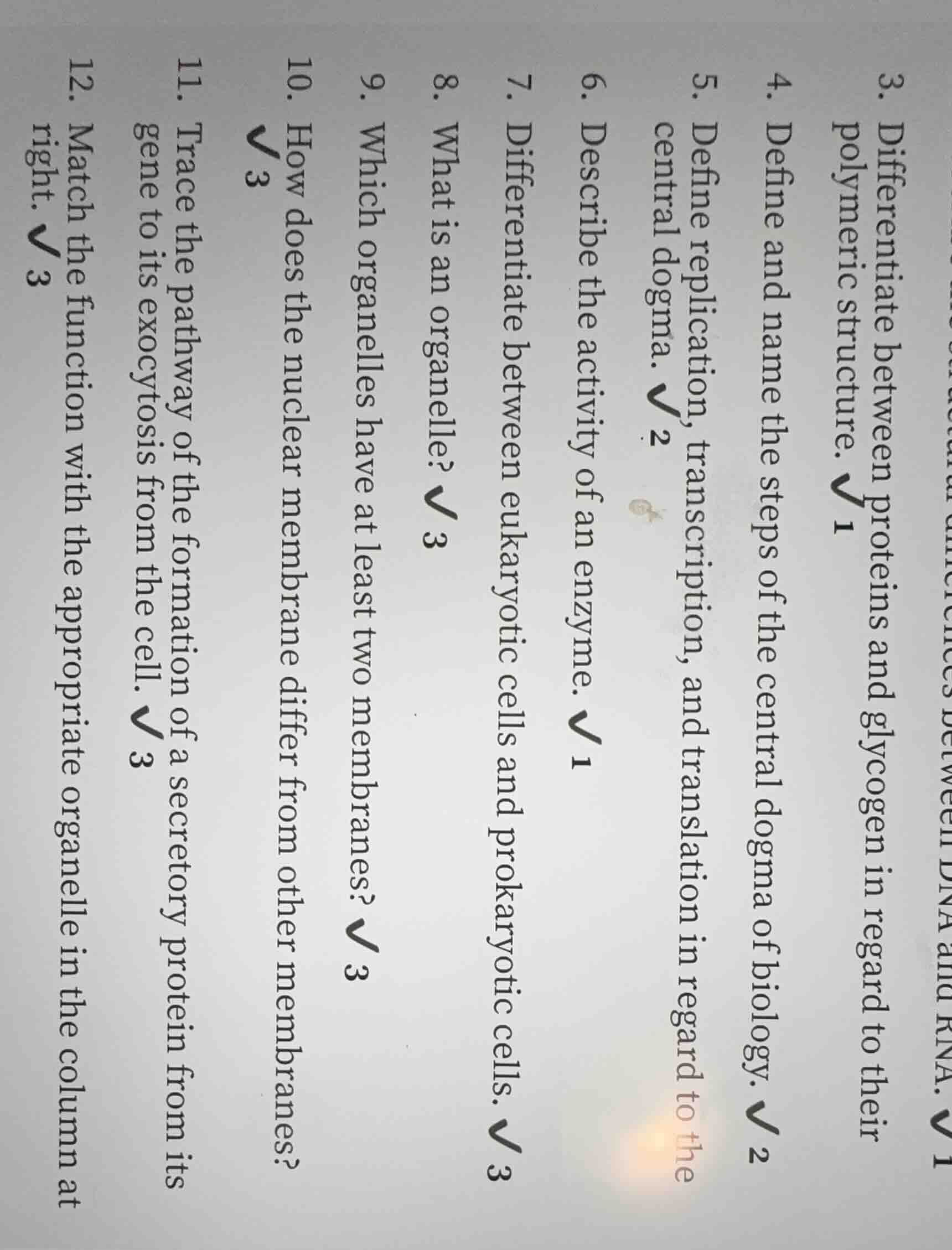
- differentiate between proteins and glycogen in regard to their polymeric structure. √1
- define and name the steps of the central dogma of biology. √2
- define replication, transcription, and translation in regard to the central dogma. √2
- describe the activity of an enzyme. √1
- differentiate between eukaryotic cells and prokaryotic cells. √3
- what is an organelle? √3
- which organelles have at least two membranes? √3
- how does the nuclear membrane differ from other membranes? √3
- trace the pathway of the formation of a secretory protein from its gene to its exocytosis from the cell. √3
- match the function with the appropriate organelle in the column at right. √3
Brief Explanations
All answers are based on core cell and molecular biology principles, defining key terms, differentiating structures/processes, and tracing cellular pathways as required for each question. Each response addresses the specific prompt with precise, discipline-aligned details.

Snap & solve any problem in the app
Get step-by-step solutions on Sovi AI
Photo-based solutions with guided steps
Explore more problems and detailed explanations
- Question 3:
- Answer: Polymeric proteins are linear chains of amino acids linked by peptide bonds, with complex 3D structures (primary, secondary, tertiary, quaternary) that determine their specific functions (e.g., enzymes, antibodies). Glycogen is a branched polymeric carbohydrate made of glucose monomers linked by α-1,4-glycosidic bonds (linear chains) and α-1,6-glycosidic bonds (branch points), functioning solely as a short-term energy storage molecule in animals and fungi.
- Question 4:
- Answer: The central dogma of biology is the fundamental framework describing the flow of genetic information in cells. Its steps are:
- Replication: DNA makes an identical copy of itself.
- Transcription: DNA is converted into messenger RNA (mRNA).
- Translation: mRNA is used as a template to build a polypeptide (protein) at ribosomes.
- Question 5:
- Answer:
- Replication: The process where a double-stranded DNA molecule is copied to produce two identical double-stranded DNA molecules; it occurs in the nucleus (eukaryotes) or cytoplasm (prokaryotes) and uses DNA polymerase.
- Transcription: The synthesis of a single-stranded mRNA molecule from a DNA template; it occurs in the nucleus (eukaryotes) or cytoplasm (prokaryotes) and uses RNA polymerase.
- Translation: The conversion of mRNA sequences into a polypeptide chain (protein); it occurs at ribosomes in the cytoplasm (all cells) and uses transfer RNA (tRNA) to deliver amino acids.
- The central dogma is the overarching principle that genetic information flows from DNA → RNA → protein (with exceptions like reverse transcription in some viruses).
- Question 6:
- Answer: Enzymes are biological catalysts (typically proteins) that speed up chemical reactions in cells by lowering the reaction's activation energy. They bind to specific substrate molecules at their active site, convert the substrate(s) into product(s), and are reused. Enzymes are also sensitive to changes in temperature, pH, and substrate concentration.
- Question 7:
- Answer:
- Eukaryotic cells: Have a membrane-bound nucleus that encloses genetic material, contain membrane-bound organelles (mitochondria, endoplasmic reticulum, Golgi apparatus, etc.), are generally larger, and have linear chromosomes. They make up complex multicellular organisms (animals, plants, fungi) and some single-celled organisms (protists).
- Prokaryotic cells: Lack a membrane-bound nucleus (genetic material is in a nucleoid region), have no membrane-bound organelles, are smaller, and have a single circular chromosome. They include bacteria and archaea, almost all of which are single-celled.
- Question 8:
- Answer: An organelle is a specialized, membrane-bound (in eukaryotes) or distinct subcellular structure that performs a specific, essential function for the cell's survival and operation (e.g., mitochondria for energy production, ribosomes for protein synthesis).
- Question 9:
- Answer: Organelles with at least two membranes are:
- Nucleus: The double nuclear membrane encloses the cell's genetic material.
- Mitochondria: The inner membrane is folded into cristae to carry out cellular respiration, while the outer membrane acts as a barrier.
- Chloroplasts (in plants/algae): Have an outer membrane, inner membrane, and thylakoid membranes (stacked into grana) for photosynthesis.
- Question 10:
- Answer: The nuclear membrane (nuclear envelope) differs from other cell membranes in two key ways:
- It is a double membrane (two lipid bilayers) rather than a single lipid bilayer.
- It contains nuclear pores—specialized channels that regulate the selective transport of molecules (e.g., mRNA, proteins) between the nucleus and cytoplasm, a feature not present in other cell membranes.
- Question 11:
- Answer: The pathway of a secretory protein from gene to exocytosis is:
- Gene transcription: DNA is transcribed into mRNA in the nucleus.
- mRNA export: mRNA moves through nuclear pores to the cytoplasm.
- Translation at rough ER: Ribosomes on the rough endoplasmic reticulum (RER) translate mRNA into a polypeptide, which enters the RER lumen.
- Protein modification in RER: The protein is folded and modified (e.g., glycosylation).
- Transport to Golgi apparatus: The protein is packaged into a vesicle that buds off the RER and fuses with the cis face of the Golgi.
- Further modification in Golgi: The protein is processed and sorted in the Golgi cisternae.
- Vesicle budding for exocytosis: A secretory vesicle containing the mature protein buds off the trans face of the Golgi.
- Exocytosis: The vesicle moves to the cell membrane, fuses with it, and releases the protein outside the cell.
- Question 12:
- Answer: (Note: The matching column is not provided. A standard example of organelle-function matches is:)
- Nucleus: Stores genetic information
- Mitochondria: Produces ATP (cellular energy)
- Ribosome: Synthesizes proteins
- Rough ER: Modifies secretory proteins
- Golgi apparatus: Sorts and modifies proteins
- Lysosome: Breaks down cellular waste
- Chloroplast: Carries out photosynthesis (plants)