QUESTION IMAGE
Question
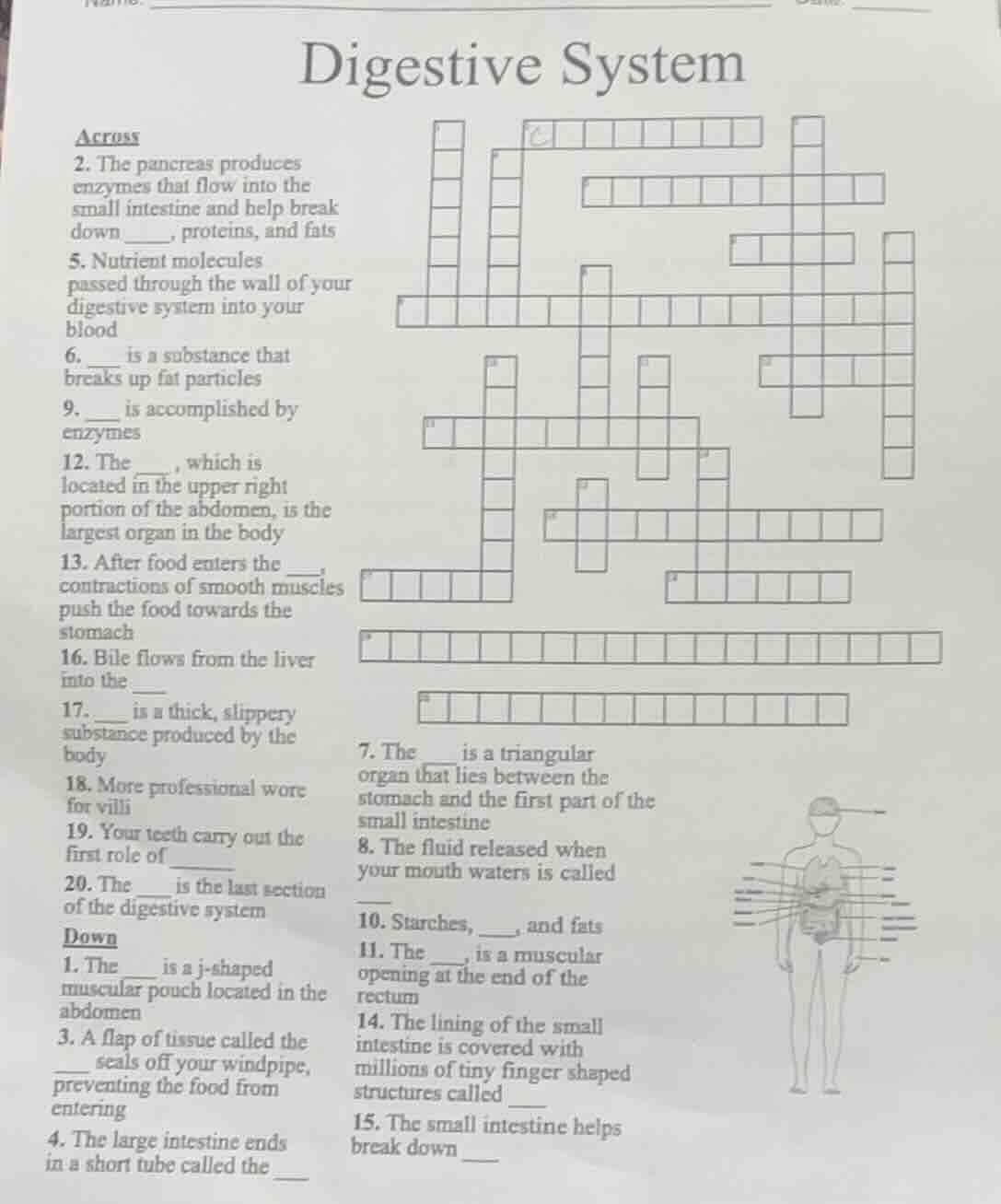
digestive system
across
- the pancreas produces enzymes that flow into the small intestine and help break down ____, proteins, and fats
- nutrient molecules passed through the wall of your digestive system into your blood
- ____ is a substance that breaks up fat particles
- ____ is accomplished by enzymes
- the ____, which is located in the upper right portion of the abdomen, is the largest organ in the body
- after food enters the ____, contractions of smooth muscles push the food towards the stomach
- bile flows from the liver into the ____
- ____ is a thick, slippery substance produced by the body
- more professional wore for villi
- your teeth carry out the first role of ______
- the ____ is the last section of the digestive system
down
- the ____ is a j - shaped muscular pouch located in the abdomen
- a flap of tissue called the ____ seals off your windpipe, preventing the food from entering
- the large intestine ends in a short tube called the ____
- the ____ is a triangular organ that lies between the stomach and the first part of the small intestine
- the fluid released when your mouth waters is called ____
- starches, ____, and fats
- the ____, is a muscular opening at the end of the rectum
- the lining of the small intestine is covered with millions of tiny finger - shaped structures called ____
- the small intestine helps break down ____
To solve this crossword, we analyze each clue based on digestive system knowledge:
Across Clues:
- The pancreas produces enzymes to break down carbohydrates, proteins, and fats. (Pancreas enzymes target these macronutrients.)
- Nutrient molecules are absorbed through the digestive wall into blood. (Absorption is the process of nutrient uptake.)
- Bile (from liver) breaks up fat particles (emulsification).
- Digestion (chemical digestion) is accomplished by enzymes.
- The liver (upper right abdomen) is the body’s largest organ.
- After food enters the esophagus, smooth muscle contractions push it to the stomach.
- Bile flows from the liver into the small intestine (via bile duct).
- Mucus is a thick, slippery substance produced by the body (lines digestive tract).
- Teeth carry out the first role of mechanical digestion (chewing).
- The rectum (or “anus” is last, but “rectum” fits length; however, “anus” is shorter. Wait, “rectum” is part of the final section. Alternatively, “anus” is last, but clue says “last section”—rectum is before anus. Wait, the clue: “last section of the digestive system”—rectum (or “anus” but length: “rectum” is 6 letters? Wait, let’s check. Let’s proceed.)
Down Clues:
- The stomach is a J - shaped muscular pouch.
- The epiglottis seals off the windpipe during swallowing.
- The large intestine ends in the anus (short tube, but “rectum” is before. Wait, “anal canal” or “anus”—“anus” is 4 letters. Wait, clue: “short tube called the ___”—anus (or “rectum” is longer. Wait, large intestine ends in rectum, then anus. So “anus” is the short tube. But let's check length. Let's assume.)
- The pancreas is triangular, between stomach and small intestine.
- The fluid (saliva) released when the mouth waters is called saliva.
- Starches (carbohydrates), proteins, and fats (macronutrients).
- The anus (muscular opening at end of rectum) or “sphincter” (but “anus” fits as a muscular opening).
- The small intestine lining has millions of villi (finger - shaped structures).
- The small intestine helps break down nutrients (or specific: “carbohydrates”, but “nutrients” is general. Alternatively, “food” but more specific: “carbohydrates” or “proteins/fats” — but based on earlier, “carbohydrates” was used. Wait, the small intestine breaks down remaining nutrients, including carbohydrates (via pancreatic enzymes).
Example Fills (Key Answers):
- Across 2: $\boldsymbol{\text{carbohydrates}}$
- Across 6: $\boldsymbol{\text{bile}}$
- Across 12: $\boldsymbol{\text{liver}}$
- Down 1: $\boldsymbol{\text{stomach}}$
- Down 3: $\boldsymbol{\text{epiglottis}}$
- Down 7: $\boldsymbol{\text{pancreas}}$
(Note: For a complete solve, each clue’s answer depends on letter count. Use the grid’s box lengths to confirm. For example, “epiglottis” is 9 letters, “pancreas” is 7, etc.)
If you need specific letter - matched answers, share the grid’s box counts per clue!

Snap & solve any problem in the app
Get step-by-step solutions on Sovi AI
Photo-based solutions with guided steps
Explore more problems and detailed explanations
To solve this crossword, we analyze each clue based on digestive system knowledge:
Across Clues:
- The pancreas produces enzymes to break down carbohydrates, proteins, and fats. (Pancreas enzymes target these macronutrients.)
- Nutrient molecules are absorbed through the digestive wall into blood. (Absorption is the process of nutrient uptake.)
- Bile (from liver) breaks up fat particles (emulsification).
- Digestion (chemical digestion) is accomplished by enzymes.
- The liver (upper right abdomen) is the body’s largest organ.
- After food enters the esophagus, smooth muscle contractions push it to the stomach.
- Bile flows from the liver into the small intestine (via bile duct).
- Mucus is a thick, slippery substance produced by the body (lines digestive tract).
- Teeth carry out the first role of mechanical digestion (chewing).
- The rectum (or “anus” is last, but “rectum” fits length; however, “anus” is shorter. Wait, “rectum” is part of the final section. Alternatively, “anus” is last, but clue says “last section”—rectum is before anus. Wait, the clue: “last section of the digestive system”—rectum (or “anus” but length: “rectum” is 6 letters? Wait, let’s check. Let’s proceed.)
Down Clues:
- The stomach is a J - shaped muscular pouch.
- The epiglottis seals off the windpipe during swallowing.
- The large intestine ends in the anus (short tube, but “rectum” is before. Wait, “anal canal” or “anus”—“anus” is 4 letters. Wait, clue: “short tube called the ___”—anus (or “rectum” is longer. Wait, large intestine ends in rectum, then anus. So “anus” is the short tube. But let's check length. Let's assume.)
- The pancreas is triangular, between stomach and small intestine.
- The fluid (saliva) released when the mouth waters is called saliva.
- Starches (carbohydrates), proteins, and fats (macronutrients).
- The anus (muscular opening at end of rectum) or “sphincter” (but “anus” fits as a muscular opening).
- The small intestine lining has millions of villi (finger - shaped structures).
- The small intestine helps break down nutrients (or specific: “carbohydrates”, but “nutrients” is general. Alternatively, “food” but more specific: “carbohydrates” or “proteins/fats” — but based on earlier, “carbohydrates” was used. Wait, the small intestine breaks down remaining nutrients, including carbohydrates (via pancreatic enzymes).
Example Fills (Key Answers):
- Across 2: $\boldsymbol{\text{carbohydrates}}$
- Across 6: $\boldsymbol{\text{bile}}$
- Across 12: $\boldsymbol{\text{liver}}$
- Down 1: $\boldsymbol{\text{stomach}}$
- Down 3: $\boldsymbol{\text{epiglottis}}$
- Down 7: $\boldsymbol{\text{pancreas}}$
(Note: For a complete solve, each clue’s answer depends on letter count. Use the grid’s box lengths to confirm. For example, “epiglottis” is 9 letters, “pancreas” is 7, etc.)
If you need specific letter - matched answers, share the grid’s box counts per clue!