QUESTION IMAGE
Question
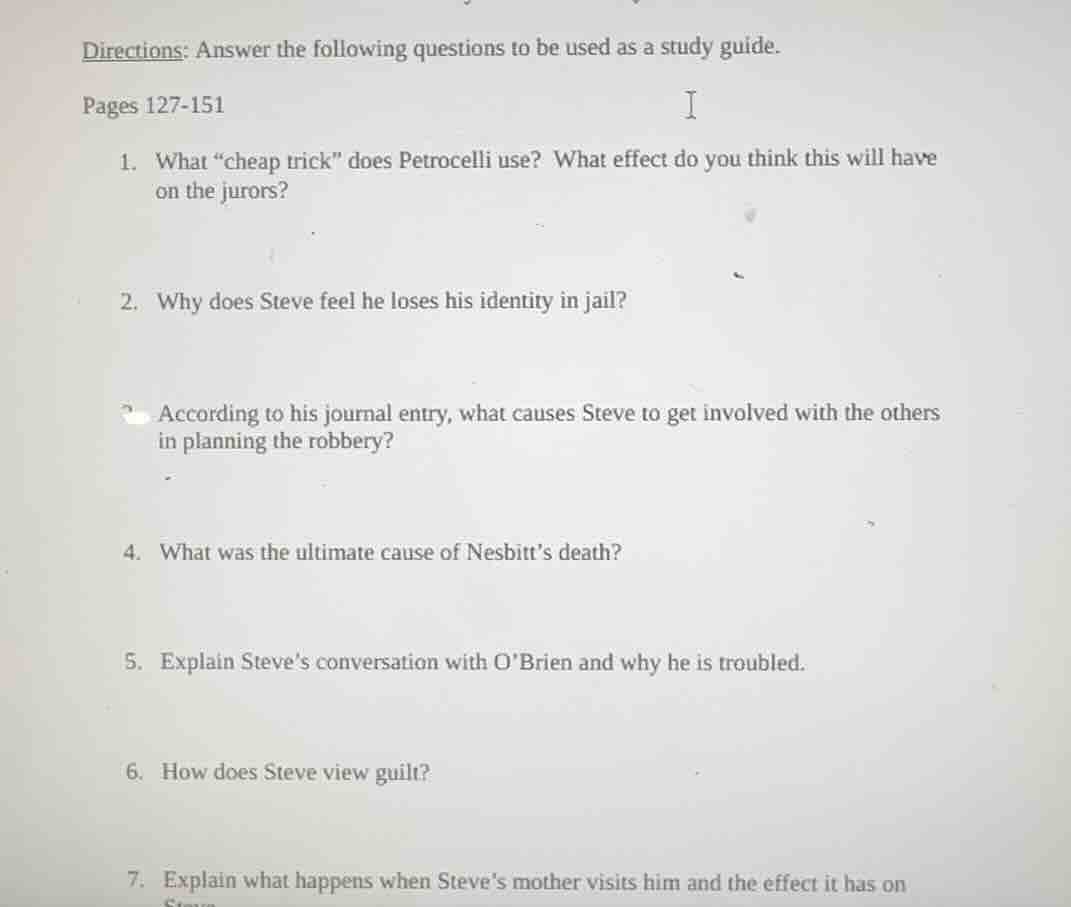
directions: answer the following questions to be used as a study guide.
pages 127 - 151
- what \cheap trick\ does petrocelli use? what effect do you think this will have on the jurors?
- why does steve feel he loses his identity in jail?
- according to his journal entry, what causes steve to get involved with the others in planning the robbery?
- what was the ultimate cause of nesbitt’s death?
- explain steve’s conversation with o’brien and why he is troubled.
- how does steve view guilt?
- explain what happens when steve’s mother visits him and the effect it has on
These questions are related to a literary work (likely Monster by Walter Dean Myers) and fall under the Arts discipline, specifically the subfield of Literature. Here are brief explanations and answers for each question:
1. What “cheap trick” does Petrocelli use? What effect do you think this will have on the jurors?
Petrocelli (the prosecutor) uses the "cheap trick" of referring to Steve and the other defendants as "monsters" to sway the jurors' emotions. By dehumanizing the defendants, she aims to make the jurors view them negatively, influencing their judgment to find them guilty.
In jail, Steve is addressed by his inmate number (not his name) and is part of a system that treats inmates as a collective rather than individuals. The dehumanizing environment, strict routines, and loss of personal autonomy make him feel like he’s just a “number” or a part of a group, not his true self.
From his journal, Steve gets involved with the others in planning the robbery due to peer pressure and a desire to fit in. He wants to be seen as “tough” or part of the group, and he is influenced by those around him (like Bobo and King) who are involved in criminal activities.

Snap & solve any problem in the app
Get step-by-step solutions on Sovi AI
Photo-based solutions with guided steps
Explore more problems and detailed explanations
Petrocelli refers to Steve and the other defendants as “monsters” (this is the “cheap trick”). This is likely to make jurors view the defendants negatively, swaying them to be more inclined to find them guilty by appealing to their emotions and dehumanizing the accused.