QUESTION IMAGE
Question
directions: use the following website so you can label all of the parts of the neuron below: https://www.sciencefacts.net/parts-of-a-neuron.html then answer the following questions based on the article on the previous page.
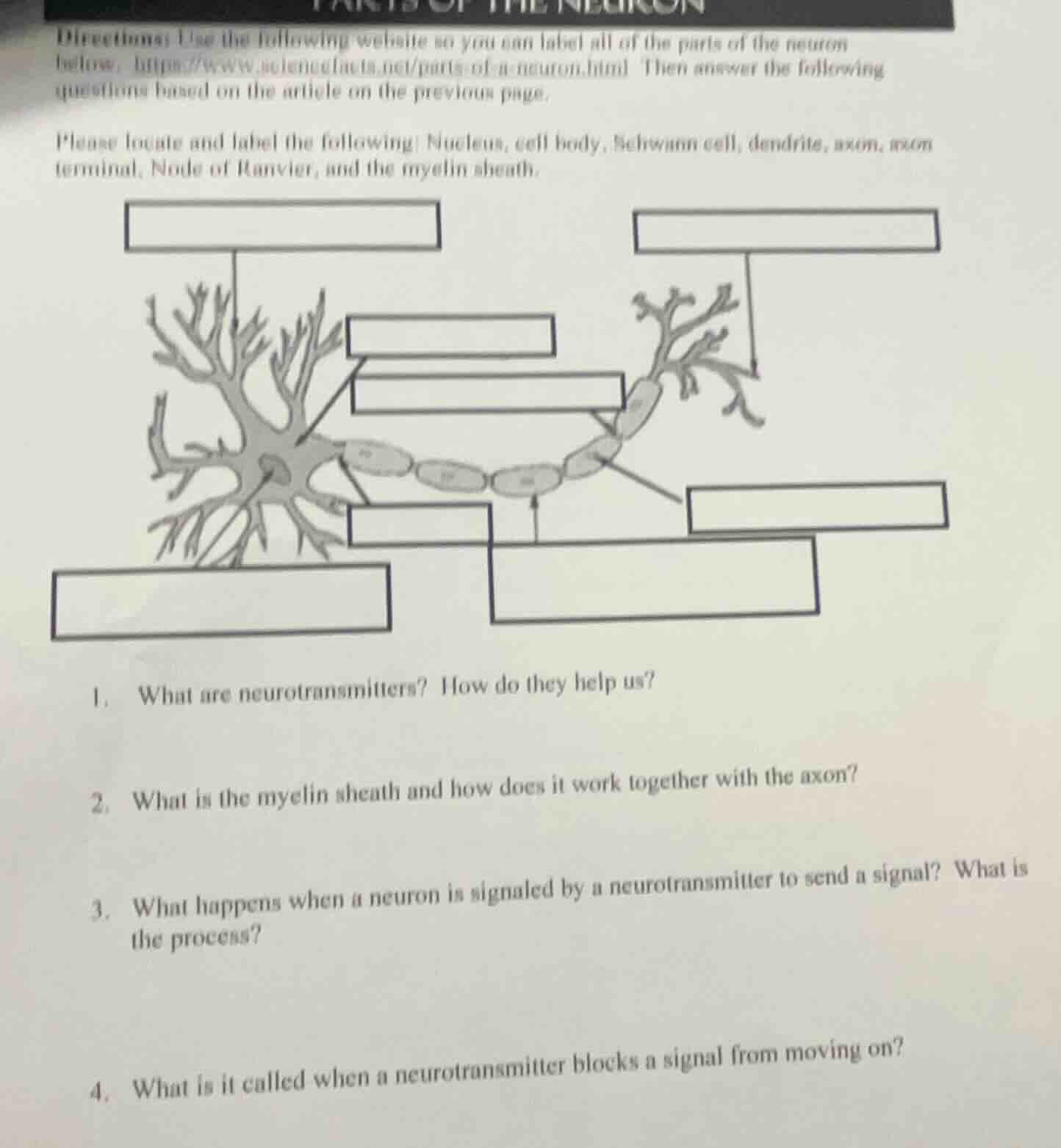
please locate and label the following: nucleus, cell body, schwann cell, dendrite, axon, axon terminal, node of ranvier, and the myelin sheath.
- what are neurotransmitters? how do they help us?
- what is the myelin sheath and how does it work together with the axon?
- what happens when a neuron is signaled by a neurotransmitter to send a signal? what is the process?
- what is it called when a neurotransmitter blocks a signal from moving on?
Neuron Labeling (matching to diagram positions):
- Top-left branching structure: Dendrite - Receives incoming signals.
- Central rounded structure (contains inner dot): Cell body - Holds neuron organelles; inner dot is Nucleus - Stores genetic material.
- Long structure extending right from cell body: Axon - Carries signals away from cell body.
- Bulbous ends at far right: Axon terminal - Releases neurotransmitters.
- Fatty wrappings around axon: Myelin sheath - Insulates axon for faster signaling.
- Cells forming myelin sheath: Schwann cell - Produces myelin in peripheral nervous system.
- Gaps between myelin sections: Node of Ranvier - Allows signal to jump between gaps.
Question 1:
Neurotransmitters are chemical messengers released by axon terminals. They cross synapses (gaps between neurons) to transmit signals to other neurons, muscles, or glands, enabling communication across the nervous system to regulate movement, mood, cognition, and bodily functions.
Question 2:
The myelin sheath is a fatty, insulating layer made by Schwann cells that wraps around axons. It speeds up the transmission of electrical signals (action potentials) along the axon by forcing the signal to jump between the Nodes of Ranvier (gaps in the myelin), rather than traveling along the entire length of the axon.
Question 3:
When a neurotransmitter triggers a neuron, it causes positive ions to enter the dendrites, raising the neuron's electrical charge. If the charge reaches a threshold level, an action potential (electrical signal) is generated at the start of the axon. The signal jumps between Nodes of Ranvier (if myelinated) down the axon to the axon terminals, which then release neurotransmitters to pass the signal to the next cell.
Question 4:
When a neurotransmitter blocks a signal from moving forward, this is called inhibitory neurotransmission, and the neurotransmitter itself is an inhibitory neurotransmitter (e.g., GABA).

Snap & solve any problem in the app
Get step-by-step solutions on Sovi AI
Photo-based solutions with guided steps
Explore more problems and detailed explanations
Neuron Labeling (corresponding to diagram sections):
- Top-left branching: Dendrite
- Central structure (outer): Cell body
- Inner dot in central structure: Nucleus
- Long structure from cell body: Axon
- Far right bulbous ends: Axon terminal
- Fatty axon wrappings: Myelin sheath
- Cells making myelin: Schwann cell
- Gaps between myelin: Node of Ranvier
- Neurotransmitters are chemical messengers that cross synapses to transmit signals between neurons, muscles, or glands. They enable nervous system communication to regulate all bodily and cognitive functions (movement, mood, memory, etc.).
- The myelin sheath is a fatty insulating layer around axons (made by Schwann cells). It works with the axon to speed up electrical signal transmission by forcing action potentials to jump between Nodes of Ranvier, rather than traveling along the full axon length.
- First, the neurotransmitter triggers positive ion flow into the dendrite, raising the neuron's charge. If the charge hits a threshold, an action potential (electrical signal) forms at the axon's start. The signal jumps between Nodes of Ranvier down the axon to the axon terminals, which release new neurotransmitters to pass the signal to the next cell.
- Inhibitory neurotransmission (mediated by inhibitory neurotransmitters)