QUESTION IMAGE
Question
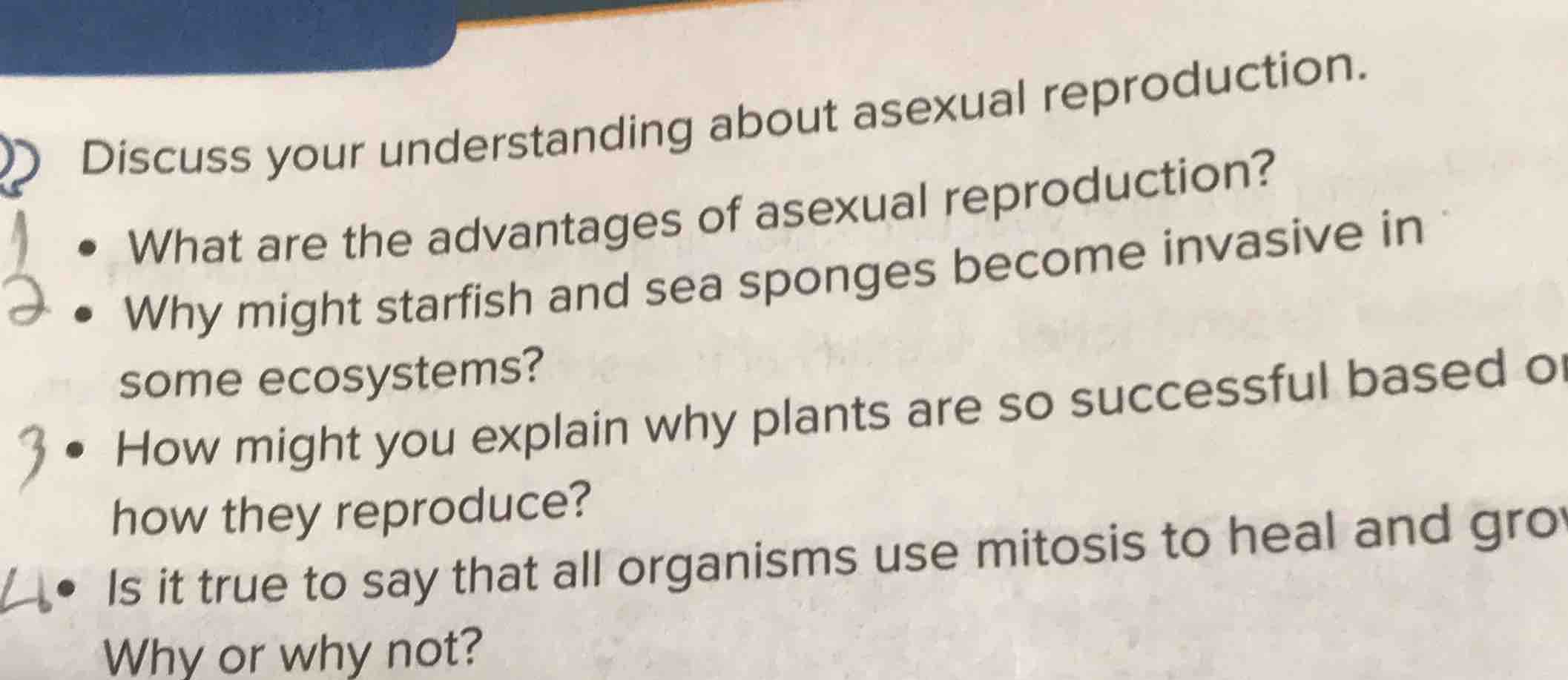
discuss your understanding about asexual reproduction.
- what are the advantages of asexual reproduction?
- why might starfish and sea sponges become invasive in some ecosystems?
- how might you explain why plants are so successful based on how they reproduce?
- is it true to say that all organisms use mitosis to heal and grow? why or why not?
1. Understanding Asexual Reproduction
Asexual reproduction is a mode of reproduction where offspring arise from a single parent, inheriting the parent’s genes (no genetic recombination with another individual). It occurs in various organisms (e.g., bacteria, fungi, plants, some animals) via methods like binary fission, budding, fragmentation, spore formation, or vegetative propagation. Offspring are genetically identical (clones) to the parent, which differs from sexual reproduction (involving gamete fusion and genetic variation).
2. Advantages of Asexual Reproduction
- Rapid Population Growth: Only one parent is needed, so organisms can reproduce quickly (e.g., bacteria dividing by binary fission every 20 minutes).
- Efficient in Stable Environments: Since offspring are genetically identical to successful parents, they’re well - adapted to consistent environments (e.g., a plant with a successful root system in a stable soil type can propagate via runners).
- Energy Conservation: No need to find a mate, produce gametes, or engage in courtship, saving energy for growth/survival.
- Colonization of New Habitats: A single successful individual can start a new population (e.g., a fragment of a sea sponge can establish a new colony in a suitable area).
3. Invasiveness of Starfish and Sea Sponges
Starfish (e.g., crown - of - thorns starfish) and sea sponges can become invasive due to asexual reproduction:
- Fragmentation in Starfish: If a starfish loses an arm (due to predation or damage), the arm can regenerate into a new starfish (if conditions are right). In new ecosystems, this allows rapid population expansion as multiple “clones” can form from a single individual or fragmented parts.
- Regeneration/Colonization in Sea Sponges: Sea sponges can reproduce asexually via budding or fragmentation. A small sponge fragment can attach to a surface and grow into a new sponge. In non - native ecosystems, without natural predators or competitors, these clones can outcompete native species for resources (space, food) and dominate the habitat.
4. Plant Success Based on Reproduction
Plants are successful partly due to their diverse reproductive strategies (including asexual and sexual reproduction):
- Asexual Reproduction Benefits:
- Vegetative Propagation: Plants like strawberries (runners), potatoes (tubers), or succulents (leaf cuttings) can reproduce asexually. This allows them to rapidly spread in favorable environments, as offspring are genetically identical to well - adapted parents (ensuring traits like drought tolerance or efficient nutrient uptake are passed on).
- Colonization: A single plant can establish a large colony (e.g., bamboo spreading via rhizomes). This helps in occupying new areas quickly, outcompeting other plants for light, water, and nutrients.
- Sexual Reproduction Benefits: Sexual reproduction (via flowers/seeds) introduces genetic variation. This variation helps plants adapt to changing environments (e.g., new pests, climate shifts) over time, while asexual reproduction provides short - term stability and rapid growth. The combination of both strategies (asexual for rapid expansion, sexual for long - term adaptability) contributes to plant success.
5. All Organisms Using Mitosis?
No, it is not true that all organisms use mitosis to heal and grow:
- Prokaryotes (Bacteria/Archaea): They use binary fission, not mitosis (mitosis is a eukaryotic process involving a nucleus and spindle fibers; prokaryotes have no nucleus).
- **Some Eukaryotes (e.g., Protis…

Snap & solve any problem in the app
Get step-by-step solutions on Sovi AI
Photo-based solutions with guided steps
Explore more problems and detailed explanations
1. Understanding Asexual Reproduction
Asexual reproduction is a mode of reproduction where offspring arise from a single parent, inheriting the parent’s genes (no genetic recombination with another individual). It occurs in various organisms (e.g., bacteria, fungi, plants, some animals) via methods like binary fission, budding, fragmentation, spore formation, or vegetative propagation. Offspring are genetically identical (clones) to the parent, which differs from sexual reproduction (involving gamete fusion and genetic variation).
2. Advantages of Asexual Reproduction
- Rapid Population Growth: Only one parent is needed, so organisms can reproduce quickly (e.g., bacteria dividing by binary fission every 20 minutes).
- Efficient in Stable Environments: Since offspring are genetically identical to successful parents, they’re well - adapted to consistent environments (e.g., a plant with a successful root system in a stable soil type can propagate via runners).
- Energy Conservation: No need to find a mate, produce gametes, or engage in courtship, saving energy for growth/survival.
- Colonization of New Habitats: A single successful individual can start a new population (e.g., a fragment of a sea sponge can establish a new colony in a suitable area).
3. Invasiveness of Starfish and Sea Sponges
Starfish (e.g., crown - of - thorns starfish) and sea sponges can become invasive due to asexual reproduction:
- Fragmentation in Starfish: If a starfish loses an arm (due to predation or damage), the arm can regenerate into a new starfish (if conditions are right). In new ecosystems, this allows rapid population expansion as multiple “clones” can form from a single individual or fragmented parts.
- Regeneration/Colonization in Sea Sponges: Sea sponges can reproduce asexually via budding or fragmentation. A small sponge fragment can attach to a surface and grow into a new sponge. In non - native ecosystems, without natural predators or competitors, these clones can outcompete native species for resources (space, food) and dominate the habitat.
4. Plant Success Based on Reproduction
Plants are successful partly due to their diverse reproductive strategies (including asexual and sexual reproduction):
- Asexual Reproduction Benefits:
- Vegetative Propagation: Plants like strawberries (runners), potatoes (tubers), or succulents (leaf cuttings) can reproduce asexually. This allows them to rapidly spread in favorable environments, as offspring are genetically identical to well - adapted parents (ensuring traits like drought tolerance or efficient nutrient uptake are passed on).
- Colonization: A single plant can establish a large colony (e.g., bamboo spreading via rhizomes). This helps in occupying new areas quickly, outcompeting other plants for light, water, and nutrients.
- Sexual Reproduction Benefits: Sexual reproduction (via flowers/seeds) introduces genetic variation. This variation helps plants adapt to changing environments (e.g., new pests, climate shifts) over time, while asexual reproduction provides short - term stability and rapid growth. The combination of both strategies (asexual for rapid expansion, sexual for long - term adaptability) contributes to plant success.
5. All Organisms Using Mitosis?
No, it is not true that all organisms use mitosis to heal and grow:
- Prokaryotes (Bacteria/Archaea): They use binary fission, not mitosis (mitosis is a eukaryotic process involving a nucleus and spindle fibers; prokaryotes have no nucleus).
- Some Eukaryotes (e.g., Protists): Some protists use mitosis - like processes (e.g., binary fission in amoeba), but others have unique methods. However, organisms like bacteria (prokaryotes) and some single - celled eukaryotes with simpler cell structures do not use mitosis as defined (mitosis is specific to eukaryotic cells with a nucleus, involving precise chromosome segregation). Also, not all eukaryotic cells undergo mitosis continuously—e.g., mature human nerve cells do not divide (no mitosis) after a certain stage.