QUESTION IMAGE
Question
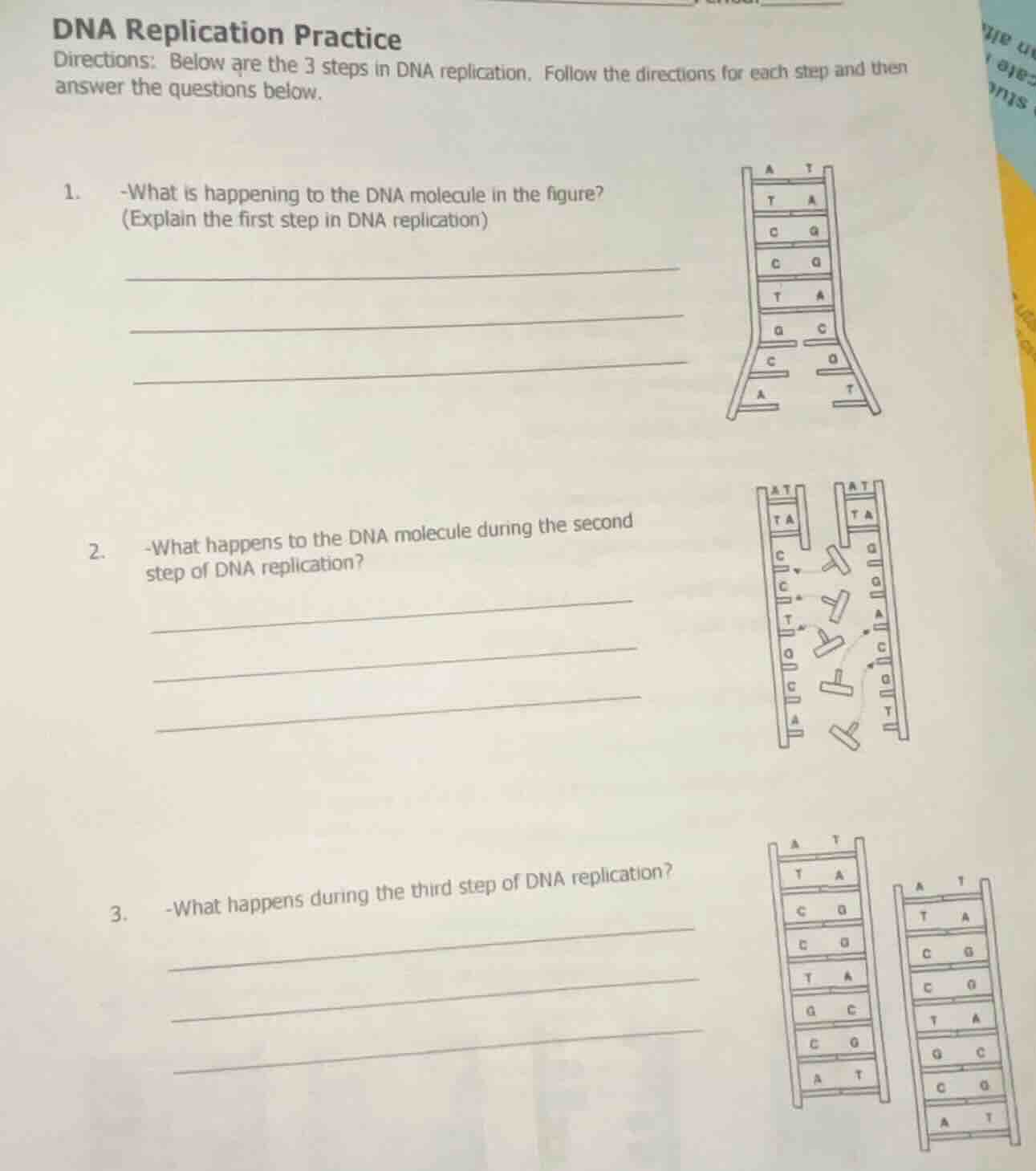
dna replication practice directions: below are the 3 steps in dna replication. follow the directions for each step and then answer the questions below. 1. -what is happening to the dna molecule in the figure? (explain the first step in dna replication) 2. -what happens to the dna molecule during the second step of dna replication? 3. -what happens during the third step of dna replication?
Question 1
The first step of DNA replication is the unwinding and separation of the double - helix structure. The DNA molecule's hydrogen bonds between the complementary base pairs (A - T and C - G) are broken, and the two strands of the DNA double helix are "unzipped" or separated from each other. This forms a replication fork, and each separated strand will serve as a template for the synthesis of a new complementary strand.
During the second step of DNA replication, free - floating nucleotides in the nucleus (adenine, thymine, cytosine, guanine) pair up with the complementary bases on each of the separated DNA strands. Adenine (A) pairs with thymine (T), and cytosine (C) pairs with guanine (G). DNA polymerase enzyme helps in this process of adding the complementary nucleotides to the template strands, forming new complementary strands that are complementary to the original template strands.
The third step of DNA replication involves the formation of two new, complete DNA molecules. The newly added nucleotides are connected together to form a continuous strand. Each new DNA molecule consists of one original (template) strand and one newly synthesized strand, which is known as semi - conservative replication. The two new DNA molecules re - coil into the double - helix structure, and now there are two identical DNA molecules, each with one old and one new strand.

Snap & solve any problem in the app
Get step-by-step solutions on Sovi AI
Photo-based solutions with guided steps
Explore more problems and detailed explanations
In the first step of DNA replication (as shown in the figure), the DNA molecule is undergoing "unzipping". The hydrogen bonds between the complementary nucleotide base pairs (adenine - thymine, cytosine - guanine) are broken, and the double - helix structure of DNA is separated into two single strands. Each of these single strands will act as a template for the creation of a new complementary DNA strand.