QUESTION IMAGE
Question
dna replication practice
period:
directions: below are the 3 steps in dna replication. follow the directions for each step and then answer the questions below.
- -what is happening to the dna molecule in the figure?
(explain the first step in dna replication)
- -what happens to the dna molecule during the second
step of dna replication?
- -what happens during the third step of dna replication?
Question 1
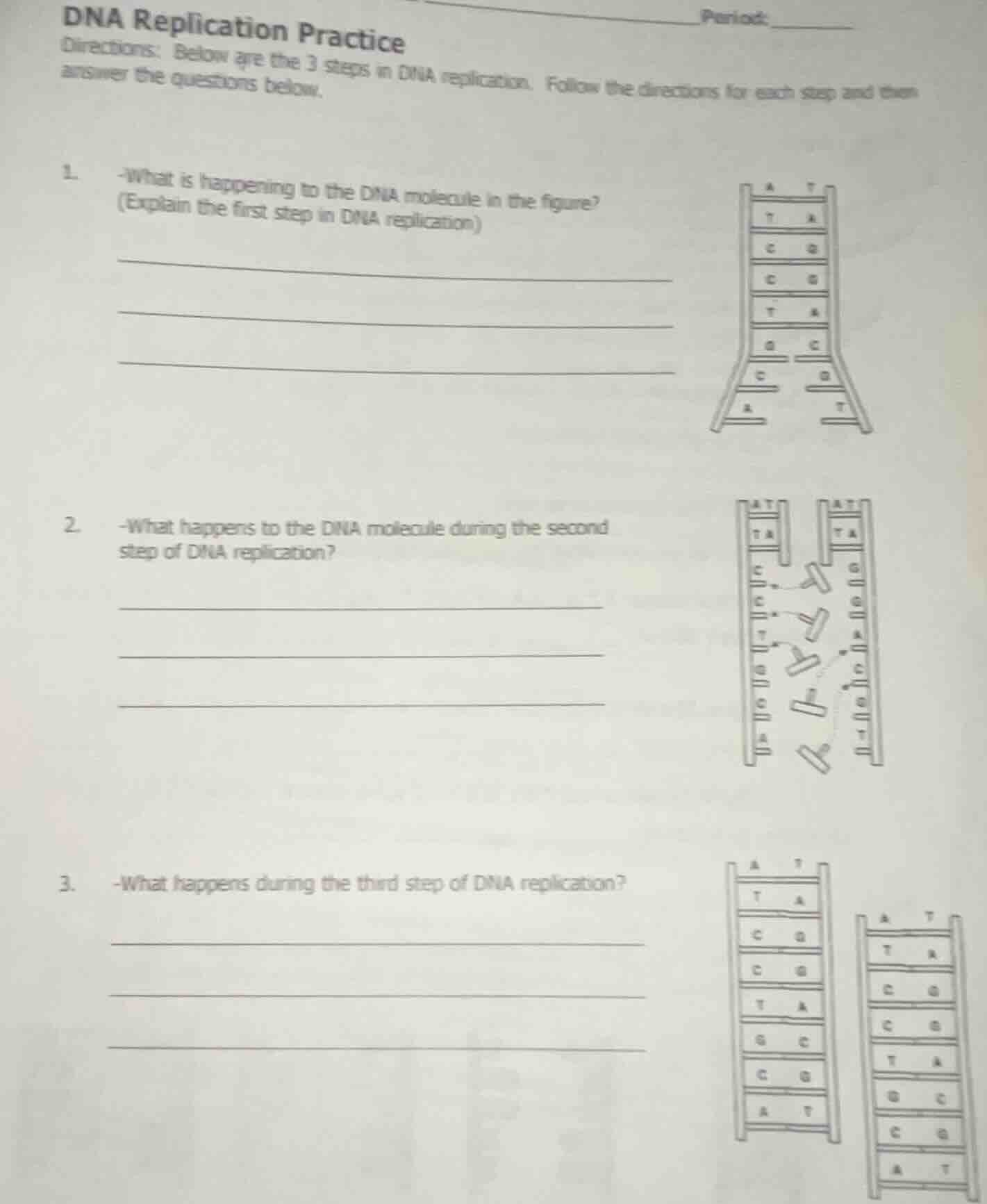
The first step of DNA replication is the unwinding and unzipping of the DNA double helix. The hydrogen bonds between the complementary base pairs (A - T, C - G) break, and the two strands of the DNA molecule separate. This is shown in the figure where the "ladder" structure of DNA is opening up, with the rungs (base pairs) separating and the two sides (sugar - phosphate backbones) starting to come apart.
During the second step of DNA replication, free - floating nucleotides in the nucleus (or the cell's environment where replication occurs) pair up with the exposed bases on each of the separated DNA strands. Adenine (A) pairs with Thymine (T), and Cytosine (C) pairs with Guanine (G). The figure shows nucleotides (represented as the small shapes) approaching the separated DNA strands and attaching to the complementary bases.
In the third step of DNA replication, the sugar - phosphate groups of the newly added nucleotides are connected together to form the backbone of the new DNA strand. Also, the two new DNA molecules (each consisting of one original strand and one newly synthesized strand, which is the semi - conservative nature of DNA replication) are formed. The figure shows two complete DNA "ladders", indicating that two new DNA molecules have been created, each identical to the original DNA molecule (and to each other).

Snap & solve any problem in the app
Get step-by-step solutions on Sovi AI
Photo-based solutions with guided steps
Explore more problems and detailed explanations
The DNA molecule is undergoing unzipping (or unwinding and separation). The hydrogen bonds between the complementary base pairs break, and the two strands of the DNA double helix separate. This is the first step of DNA replication, preparing the DNA for the addition of new nucleotides.