QUESTION IMAGE
Question
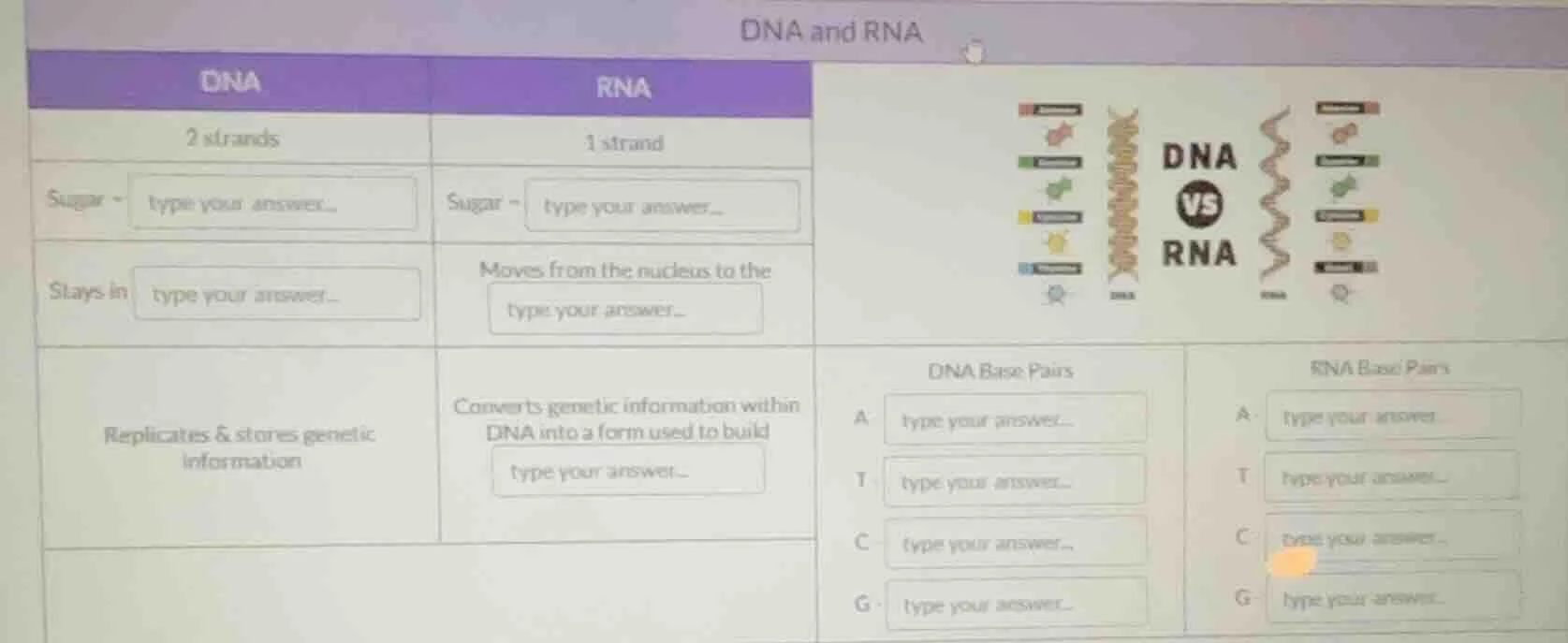
dna and rna
dna\trna
2 strands\t1 strand
sugar - type your answer...\tsugar - type your answer...
stays in type your answer...\tmoves from the nucleus to the type your answer...
replicates & stores genetic information\tconverts genetic information within dna into a form used to build type your answer...
\tdna base pairs\trna base pairs
\ta type your answer...\ta type your answer...
\tt type your answer...\tt type your answer...
\tc type your answer...\tc type your answer...
\tg type your answer...\tg type your answer...
For the DNA and RNA comparison table:
DNA Section:
- Sugar: Deoxyribose (DNA contains deoxyribose sugar, which has one less oxygen atom compared to RNA's sugar).
- Stays in: Nucleus (DNA is located in the nucleus of eukaryotic cells and does not leave, as it is the genetic blueprint that needs to be protected).
- Function: Replicates (during cell division, DNA makes a copy of itself) and stores genetic information (it holds the instructions for the development, functioning, and reproduction of organisms).
RNA Section:
- Sugar: Ribose (RNA has ribose sugar, which has an additional oxygen atom compared to deoxyribose in DNA).
- Moves from the nucleus to the: Cytoplasm (After being transcribed from DNA in the nucleus, RNA moves to the cytoplasm where it can be translated into proteins or perform other functions like in the case of ribosomal RNA, transfer RNA, etc.).
- Function: Converts genetic information within DNA into a form used to build proteins (RNA, specifically messenger RNA (mRNA), carries the genetic code from DNA to the ribosomes in the cytoplasm where proteins are synthesized; also, transfer RNA (tRNA) and ribosomal RNA (rRNA) are involved in the translation process to build proteins).
DNA Base Pairs:
- A (Adenine) pairs with: T (Thymine) (In DNA, adenine forms two hydrogen bonds with thymine as part of the base - pairing rules that hold the two strands of the double helix together).
- T (Thymine) pairs with: A (Adenine)
- C (Cytosine) pairs with: G (Guanine) (Cytosine forms three hydrogen bonds with guanine in the DNA double helix)
- G (Guanine) pairs with: C (Cytosine)
RNA Base Pairs:
- A (Adenine) pairs with: U (Uracil) (In RNA, instead of thymine, uracil is present, and adenine forms two hydrogen bonds with uracil)
- T (Thymine) is not present in RNA base - pairing in the same way as in DNA. If we consider the template DNA strand, during transcription, the RNA base pairs with DNA. But in RNA - RNA interactions (like in some RNA molecules with secondary structure) or in the context of translation, for the RNA base - pairing related to the genetic code: when mRNA is translated, the tRNA anticodons pair with mRNA codons. However, for the basic RNA base - pairing (similar to DNA but with U instead of T):
- A pairs with U, U pairs with A, C pairs with G, G pairs with C
- So, for the RNA base pairs:
- A (Adenine) pairs with: U (Uracil)
- T (Thymine): In RNA, there is no thymine in the same base - pairing context as in DNA. If we are looking at the RNA that is complementary to DNA, when DNA has T, RNA will have A. But in terms of RNA - RNA base pairing (like in a folded RNA molecule), U pairs with A.
- C (Cytosine) pairs with: G (Guanine)
- G (Guanine) pairs with: C (Cytosine)
Final Answers (filling in the blanks):
DNA:
- Sugar: Deoxyribose
- Stays in: Nucleus
- Function: Replicates & stores genetic information (already filled, but for clarity, the key is the replication and storage of genetic data)
RNA:
- Sugar: Ribose
- Moves from the nucleus to the: Cytoplasm
- Function: Converts genetic information within DNA into a form used to build proteins (specifically, it is involved in the process of transcription and translation to make proteins)
DNA Base Pairs:
- A pairs with T
- T pairs with A
- C pairs with G
- G pairs with C
RNA Base Pairs:
- A pairs with U
- T (in the context of DNA - RNA pairing, RNA has A opposite DNA's T; in RNA - RNA, U pairs with A)
- C pairs with G
- G pairs with C…

Snap & solve any problem in the app
Get step-by-step solutions on Sovi AI
Photo-based solutions with guided steps
Explore more problems and detailed explanations
For the DNA and RNA comparison table:
DNA Section:
- Sugar: Deoxyribose (DNA contains deoxyribose sugar, which has one less oxygen atom compared to RNA's sugar).
- Stays in: Nucleus (DNA is located in the nucleus of eukaryotic cells and does not leave, as it is the genetic blueprint that needs to be protected).
- Function: Replicates (during cell division, DNA makes a copy of itself) and stores genetic information (it holds the instructions for the development, functioning, and reproduction of organisms).
RNA Section:
- Sugar: Ribose (RNA has ribose sugar, which has an additional oxygen atom compared to deoxyribose in DNA).
- Moves from the nucleus to the: Cytoplasm (After being transcribed from DNA in the nucleus, RNA moves to the cytoplasm where it can be translated into proteins or perform other functions like in the case of ribosomal RNA, transfer RNA, etc.).
- Function: Converts genetic information within DNA into a form used to build proteins (RNA, specifically messenger RNA (mRNA), carries the genetic code from DNA to the ribosomes in the cytoplasm where proteins are synthesized; also, transfer RNA (tRNA) and ribosomal RNA (rRNA) are involved in the translation process to build proteins).
DNA Base Pairs:
- A (Adenine) pairs with: T (Thymine) (In DNA, adenine forms two hydrogen bonds with thymine as part of the base - pairing rules that hold the two strands of the double helix together).
- T (Thymine) pairs with: A (Adenine)
- C (Cytosine) pairs with: G (Guanine) (Cytosine forms three hydrogen bonds with guanine in the DNA double helix)
- G (Guanine) pairs with: C (Cytosine)
RNA Base Pairs:
- A (Adenine) pairs with: U (Uracil) (In RNA, instead of thymine, uracil is present, and adenine forms two hydrogen bonds with uracil)
- T (Thymine) is not present in RNA base - pairing in the same way as in DNA. If we consider the template DNA strand, during transcription, the RNA base pairs with DNA. But in RNA - RNA interactions (like in some RNA molecules with secondary structure) or in the context of translation, for the RNA base - pairing related to the genetic code: when mRNA is translated, the tRNA anticodons pair with mRNA codons. However, for the basic RNA base - pairing (similar to DNA but with U instead of T):
- A pairs with U, U pairs with A, C pairs with G, G pairs with C
- So, for the RNA base pairs:
- A (Adenine) pairs with: U (Uracil)
- T (Thymine): In RNA, there is no thymine in the same base - pairing context as in DNA. If we are looking at the RNA that is complementary to DNA, when DNA has T, RNA will have A. But in terms of RNA - RNA base pairing (like in a folded RNA molecule), U pairs with A.
- C (Cytosine) pairs with: G (Guanine)
- G (Guanine) pairs with: C (Cytosine)
Final Answers (filling in the blanks):
DNA:
- Sugar: Deoxyribose
- Stays in: Nucleus
- Function: Replicates & stores genetic information (already filled, but for clarity, the key is the replication and storage of genetic data)
RNA:
- Sugar: Ribose
- Moves from the nucleus to the: Cytoplasm
- Function: Converts genetic information within DNA into a form used to build proteins (specifically, it is involved in the process of transcription and translation to make proteins)
DNA Base Pairs:
- A pairs with T
- T pairs with A
- C pairs with G
- G pairs with C
RNA Base Pairs:
- A pairs with U
- T (in the context of DNA - RNA pairing, RNA has A opposite DNA's T; in RNA - RNA, U pairs with A)
- C pairs with G
- G pairs with C
If we are to fill each blank:
- DNA Sugar: Deoxyribose
- RNA Sugar: Ribose
- DNA "Stays in": Nucleus
- RNA "Moves from the nucleus to the": Cytoplasm
- RNA Function (the blank): Proteins (or "a protein" or more precisely "polypeptides" but "proteins" is a common answer here)
- DNA Base Pairs:
- A: T
- T: A
- C: G
- G: C
- RNA Base Pairs:
- A: U
- T: (If the question is about RNA base - pairing with DNA, then A; but if it's RNA - RNA, then U. However, in the context of RNA base pairs (like in the RNA molecule itself), T is not present. If the question is about the RNA complement to DNA's T, then A. But usually, in RNA base - pairing (for example, in the codon - anticodon pairing in translation), when the DNA has T, the mRNA has A, and the tRNA anticodon has U. But for the RNA base pairs table as given, if we assume it's about the RNA's own base - pairing (like in a folded RNA structure) or the pairing during translation:
- A: U
- T: (Since RNA doesn't have T as a base, maybe the question is mis - phrased, but if we consider the RNA complement to DNA's T, then A)
- C: G
- G: C
Assuming the "RNA Base Pairs" table is about the RNA's base - pairing (like in the RNA molecule or during translation, where the RNA (mRNA) has codons and tRNA has anticodons):
- RNA Base Pairs:
- A: U
- T: (If the question is about the RNA that is made from DNA, then the RNA will have A where DNA has T. So in the RNA base pairs table, if the first column is the RNA base and the second is what it pairs with, then for the row with "T" in the first column (which is not a typical RNA base, but maybe a mistake and it's supposed to be "U"), but if we follow the DNA - RNA transcription, then for the RNA base that pairs with DNA's T, it's A. But this is a bit confusing. However, the standard RNA base - pairing (A - U, U - A, C - G, G - C) so:
- A: U
- (If the "T" in the RNA Base Pairs table is a mistake and should be "U", then U: A)
- C: G
- G: C
To summarize the answers for each blank:
- DNA Sugar: Deoxyribose
- RNA Sugar: Ribose
- DNA "Stays in": Nucleus
- RNA "Moves from the nucleus to the": Cytoplasm
- RNA Function (the blank): Proteins (or "a protein" or "polypeptides")
- DNA Base Pairs - A: T
- DNA Base Pairs - T: A
- DNA Base Pairs - C: G
- DNA Base Pairs - G: C
- RNA Base Pairs - A: U
- RNA Base Pairs - T: (If it's about RNA complement to DNA's T, then A; if it's RNA - RNA, then U. But since RNA doesn't have T as a base, maybe the question intended "U" instead of "T" in the RNA Base Pairs table. If we assume "U" instead of "T", then U: A)
- RNA Base Pairs - C: G
- RNA Base Pairs - G: C