QUESTION IMAGE
Question
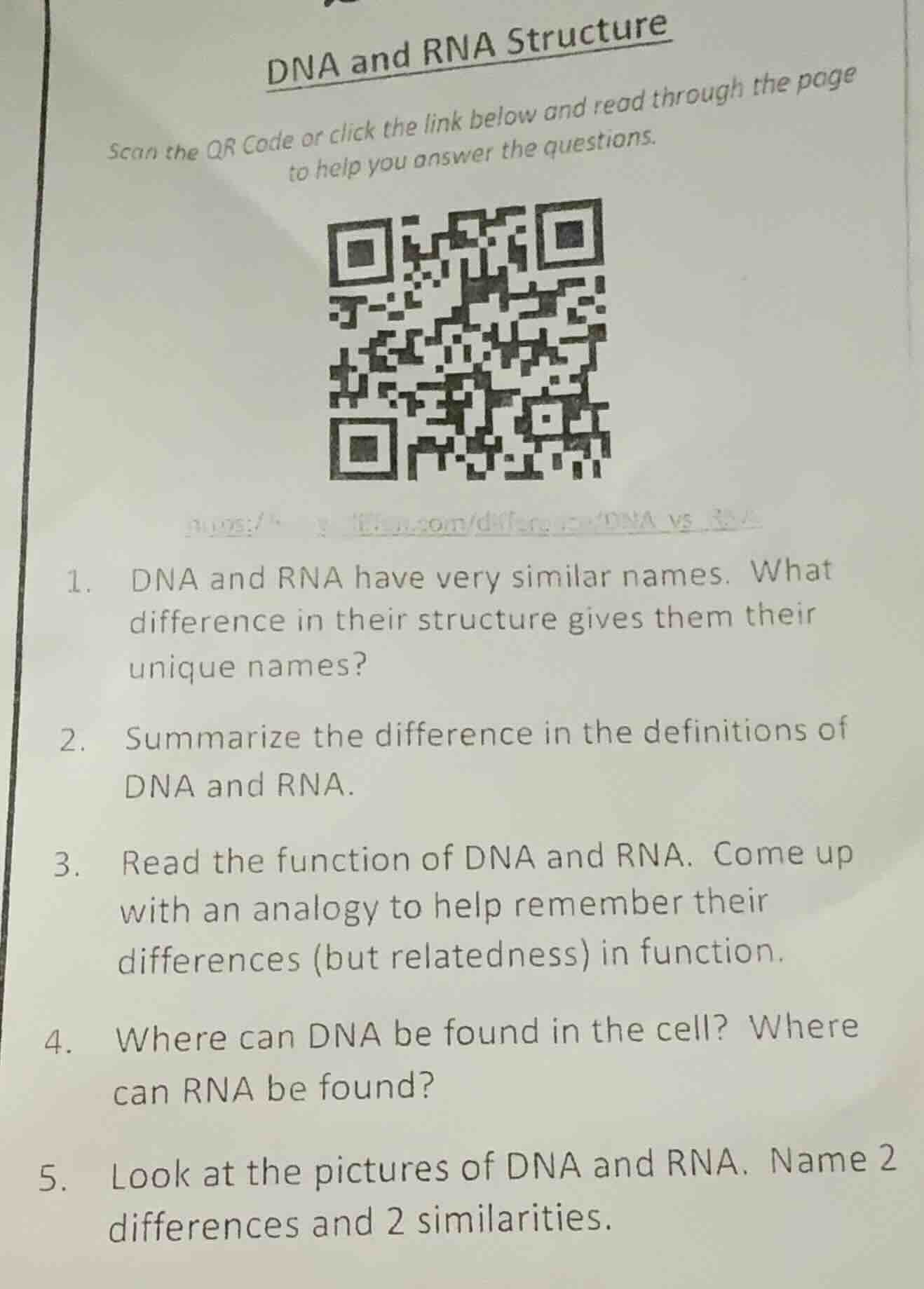
dna and rna structure
scan the qr code or click the link below and read through the page
to help you answer the questions.
- dna and rna have very similar names. what
difference in their structure gives them their
unique names?
- summarize the difference in the definitions of
dna and rna.
- read the function of dna and rna. come up
with an analogy to help remember their
differences (but relatedness) in function.
- where can dna be found in the cell? where
can rna be found?
- look at the pictures of dna and rna. name 2
differences and 2 similarities.
Since the problem is about DNA and RNA structure, which falls under Biology (a subfield of Natural Science), and the questions require explanations rather than calculations, we'll use the Answer - Explanation Format for each sub - question:
Sub - question 1
The names of DNA (Deoxyribonucleic Acid) and RNA (Ribonucleic Acid) differ because of the sugar in their structure. DNA has deoxyribose sugar (lacks an oxygen atom on the 2' carbon of the pentose sugar), while RNA has ribose sugar (has an oxygen atom on the 2' carbon of the pentose sugar).
DNA is a double - stranded molecule that stores the genetic information of an organism. It serves as the long - term repository of genetic instructions. RNA is usually single - stranded and has multiple functions. Messenger RNA (mRNA) carries genetic information from DNA to the ribosome, transfer RNA (tRNA) helps in amino acid delivery during translation, and ribosomal RNA (rRNA) is a component of ribosomes. In general, DNA is the "blueprint" for an organism's development and function, while RNA is involved in the process of using that blueprint to make proteins (and has other regulatory roles too).
We can use an analogy related to a library and a messenger. DNA is like a library's master book (or a vault of books) that contains all the information (genetic instructions) about how to build and maintain an organism. It is kept safe and is the original source of information. RNA is like a librarian (or a messenger) who takes a copy (transcription) of a specific book (gene) from the library (DNA) and brings it to the place (ribosome) where the information is used to build something (a protein, like building a product from the instructions in the book). Another analogy: DNA is like a computer's hard drive that stores all the data (genetic code), and RNA is like the USB drive (or the data transfer cable) that takes a specific set of data (gene) from the hard drive to the place (ribosome, like a computer program) where the data is used to perform a task (make a protein).

Snap & solve any problem in the app
Get step-by-step solutions on Sovi AI
Photo-based solutions with guided steps
Explore more problems and detailed explanations
The difference in the sugar component of their nucleotides gives them unique names. DNA has deoxyribose (in its nucleotide's sugar - phosphate backbone), and RNA has ribose.