QUESTION IMAGE
Question
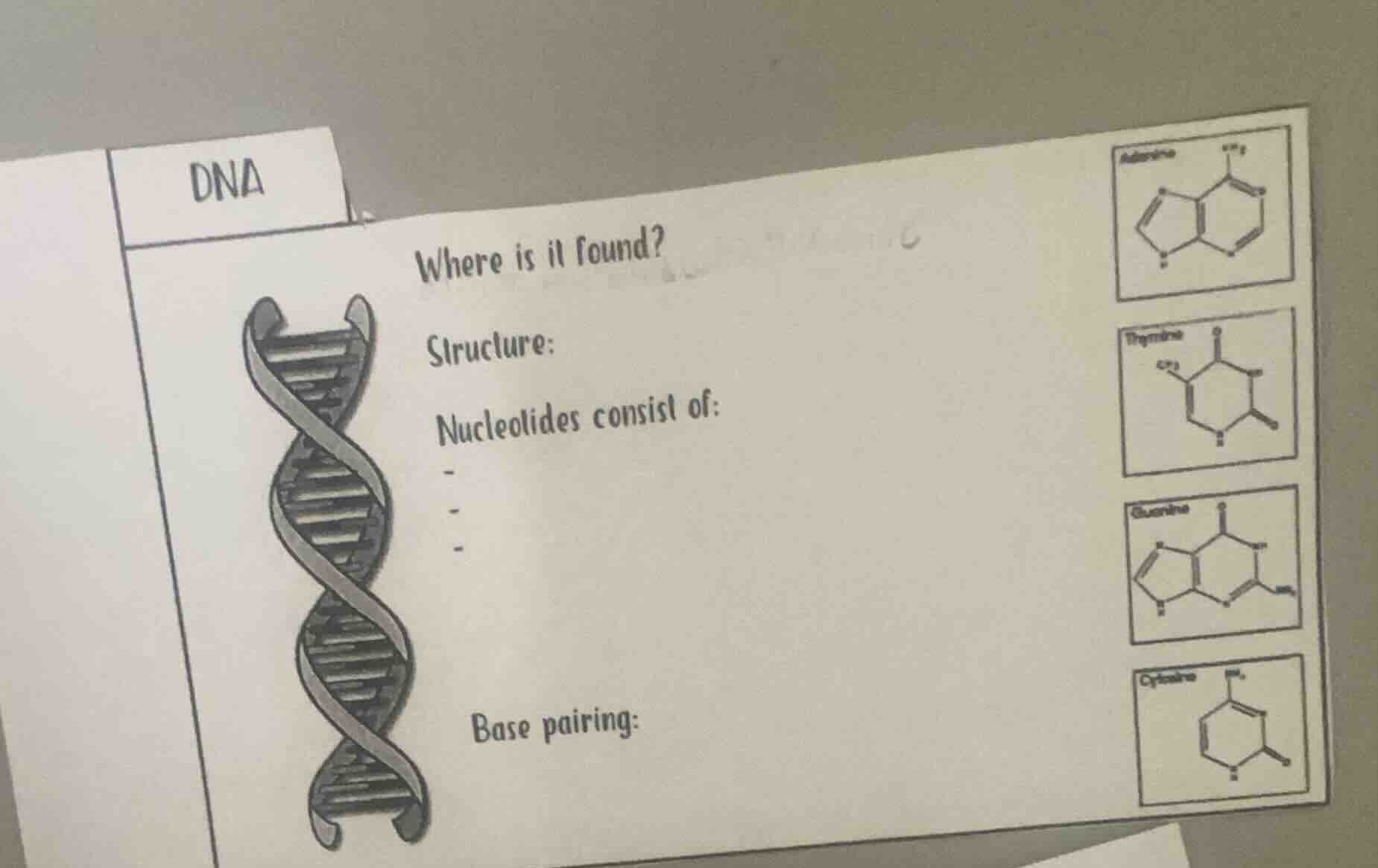
dna
where is it found?
structure:
nucleotides consist of:
-
-
-
base pairing:
Brief Explanations
- Where is it found?: DNA is located in the nucleus of eukaryotic cells (as nuclear DNA), in mitochondria (as mitochondrial DNA), and in the cytoplasm of prokaryotic cells (since they lack a nucleus).
- Structure: DNA is a double-stranded helix, with two polynucleotide strands running antiparallel to each other, held together by hydrogen bonds between complementary nitrogenous bases.
- Nucleotides consist of: Nucleotides, the building blocks of DNA, have three core components: a deoxyribose (5-carbon sugar) molecule, a phosphate group, and a nitrogen-containing base (adenine, thymine, guanine, or cytosine).
- Base pairing: DNA follows complementary base pairing rules: adenine (A) forms hydrogen bonds only with thymine (T), and guanine (G) forms hydrogen bonds only with cytosine (C).

Snap & solve any problem in the app
Get step-by-step solutions on Sovi AI
Photo-based solutions with guided steps
Explore more problems and detailed explanations
- Where is it found?
- In the nucleus of eukaryotic cells; in the cytoplasm of prokaryotic cells; also in mitochondria (mitochondrial DNA)
- Structure:
- Double-stranded antiparallel helix made of polynucleotide chains
- Nucleotides consist of:
- Deoxyribose (5-carbon sugar)
- Phosphate group
- Nitrogenous base (A, T, G, C)
- Base pairing:
- Adenine (A) pairs with Thymine (T); Guanine (G) pairs with Cytosine (C)