QUESTION IMAGE
Question
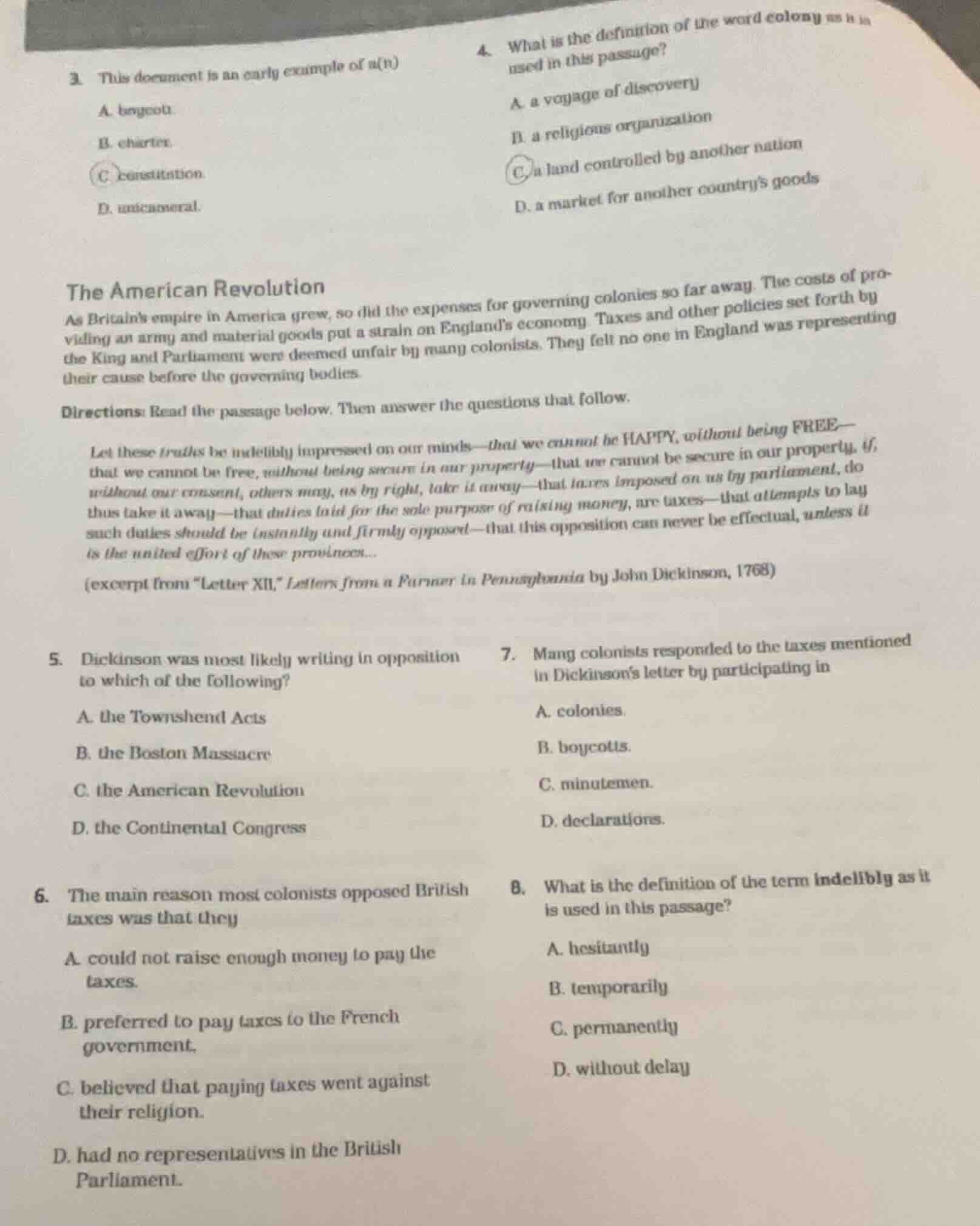
- this document is an early example of a(n)a. boycottb. charterc. constitutiond. unicameral4. what is the definition of the word colony as it is used in this passage?a. a voyage of discoveryb. a religious organizationc. a land controlled by another nationd. a market for another countrys goodsthe american revolutionas britains empire in america grew, so did the expenses for governing colonies so far away. the costs of providing an army and material goods put a strain on englands economy. taxes and other policies set forth by the king and parliament were deemed unfair by many colonists. they felt no one in england was representing their cause before the governing bodies.directions: read the passage below. then answer the questions that follow.let these truths be indelibly impressed on our minds—that we cannot be happy, without being free—that we cannot be free, without being secure in our property—that we cannot be secure in our property, if, without our consent, others may, as by right, take it away—that taxes imposed on us by parliament, do thus take it away—that duties laid for the sole purpose of raising money, are taxes—that attempts to lay such duties should be instantly and firmly opposed—that this opposition can never be effectual, unless it is the united effort of these provinces...(excerpt from \letter xii,\ letters from a farmer in pennsylvania by john dickinson, 1768)5. dickinson was most likely writing in opposition to which of the following?a. the townshend actsb. the boston massacrec. the american revolutiond. the continental congress6. the main reason most colonists opposed british taxes was that theya. could not raise enough money to pay the taxes.b. preferred to pay taxes to the french government.c. believed that paying taxes went against their religion.d. had no representatives in the british parliament.7. many colonists responded to the taxes mentioned in dickinsons letter by participating ina. colonies.b. boycotts.c. minutemen.d. declarations.8. what is the definition of the term indelibly as it is used in this passage?a. hesitantlyb. temporarilyc. permanentlyd. without delay
Brief Explanations
- Early colonial governing documents that outline rules and governance structures are constitutions, matching the context of self-governance leading to the Revolution.
- In the passage, "colonies" refer to American lands controlled by Britain, a distant nation.
- John Dickinson's 1768 letter protested taxes imposed by Parliament without colonial consent, which aligns with the Townshend Acts (1767-1768) that taxed imported goods.
- The core grievance stated is "no one in England was representing their cause" and taxes imposed without colonial consent, meaning colonists had no representatives in British Parliament.
- Colonists' primary non-violent response to unfair British taxes was boycotting British goods to pressure Parliament.
- "Indelibly" means leaving a permanent mark; in the passage, it describes truths meant to be permanently impressed on minds.

Snap & solve any problem in the app
Get step-by-step solutions on Sovi AI
Photo-based solutions with guided steps
Explore more problems and detailed explanations
- C. constitution.
- C. a land controlled by another nation
- A. the Townshend Acts
- D. had no representatives in the British Parliament.
- B. boycotts.
- C. permanently