QUESTION IMAGE
Question
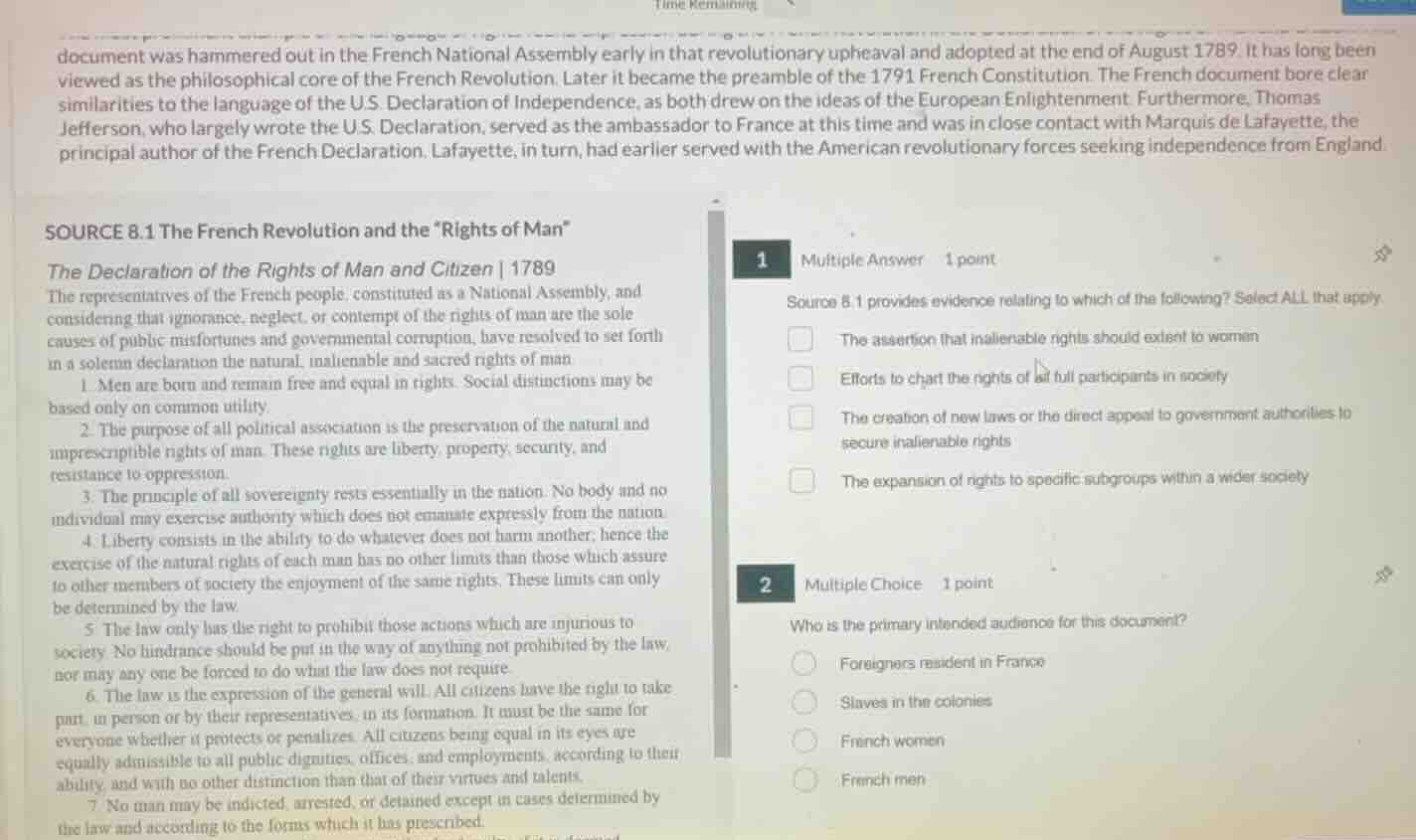
document was hammered out in the french national assembly early in that revolutionary upheaval and adopted at the end of august 1789. it has long been viewed as the philosophical core of the french revolution. later it became the preamble of the 1791 french constitution. the french document bore clear similarities to the language of the u.s. declaration of independence, as both drew on the ideas of the european enlightenment. furthermore, thomas jefferson, who largely wrote the u.s. declaration, served as the ambassador to france at this time and was in close contact with marquis de lafayette, the principal author of the french declaration. lafayette, in turn, had earlier served with the american revolutionary forces seeking independence from england
source 8.1 the french revolution and the “rights of man”
the declaration of the rights of man and citizen | 1789
the representatives of the french people, constituted as a national assembly, and considering that ignorance, neglect, or contempt of the rights of man are the sole causes of public misfortunes and governmental corruption, have resolved to set forth in a solemn declaration the natural, inalienable and sacred rights of man
1 men are born and remain free and equal in rights. social distinctions may be based only on common utility.
2 the purpose of all political association is the preservation of the natural and imprescriptible rights of man. these rights are liberty, property, security, and resistance to oppression.
3 the principle of all sovereignty rests essentially in the nation. no body and no individual may exercise authority which does not emanate expressly from the nation.
4 liberty consists in the ability to do whatever does not harm another; hence the exercise of the natural rights of each man has no other limits than those which assure to other members of society the enjoyment of the same rights. these limits can only be determined by the law.
5 the law only has the right to prohibit those actions which are injurious to society no hindrance should be put in the way of anything not prohibited by the law, nor may any one be forced to do what the law does not require
6 the law is the expression of the general will. all citizens have the right to take part, in person or by their representatives, in its formation. it must be the same for everyone whether it protects or penalizes. all citizens being equal in its eyes are equally admissible to all public dignities, offices, and employments, according to their ability, and with no other distinction than that of their virtues and talents.
7 no man may be indicted, arrested, or detained except in cases determined by the law and according to the forms which it has prescribed.
1 multiple answer 1 point
source 8.1 provides evidence relating to which of the following? select all that apply
□ the assertion that inalienable rights should exist to women
□ efforts to chart the rights of all full participants in society
□ the creation of new laws or the direct appeal to government authorities to secure inalienable rights
□ the expansion of rights to specific subgroups within a wider society
2 multiple choice 1 point
who is the primary intended audience for this document?
○ foreigners resident in france
○ slaves in the colonies
○ french women
○ french men
Question 1 (Multiple Answer)
- For "The assertion that inalienable rights should exist to women": The Declaration of the Rights of Man and Citizen (1789) initially focused on men's rights and did not explicitly extend inalienable rights to women, so this is incorrect.
- For "Efforts to chart the rights of all full participants in society": The document outlines rights for men (who were considered full participants at the time), so it does chart rights for full participants, this is correct.
- For "The creation of new laws or the direct appeal to government authorities to secure inalienable rights": The text mentions the law's role in protecting rights and the National Assembly's role in setting forth rights, implying efforts to secure rights through law/government, this is correct.
- For "The expansion of rights to specific subgroups within a wider society": The declaration was more about establishing rights for men (the dominant group then) rather than expanding to subgroups, so this is incorrect.
- "Foreigners resident in France": The document is about French people's rights, not foreigners.
- "Slaves in the colonies": The declaration was about French citizens (men) in France, not slaves in colonies.
- "French women": The 1789 declaration did not extend full rights to women.
- "French men": The Declaration of the Rights of Man and Citizen was primarily for French men (who were considered citizens with rights at the time).

Snap & solve any problem in the app
Get step-by-step solutions on Sovi AI
Photo-based solutions with guided steps
Explore more problems and detailed explanations
B. Efforts to chart the rights of all full participants in society, C. The creation of new laws or the direct appeal to government authorities to secure inalienable rights