QUESTION IMAGE
Question
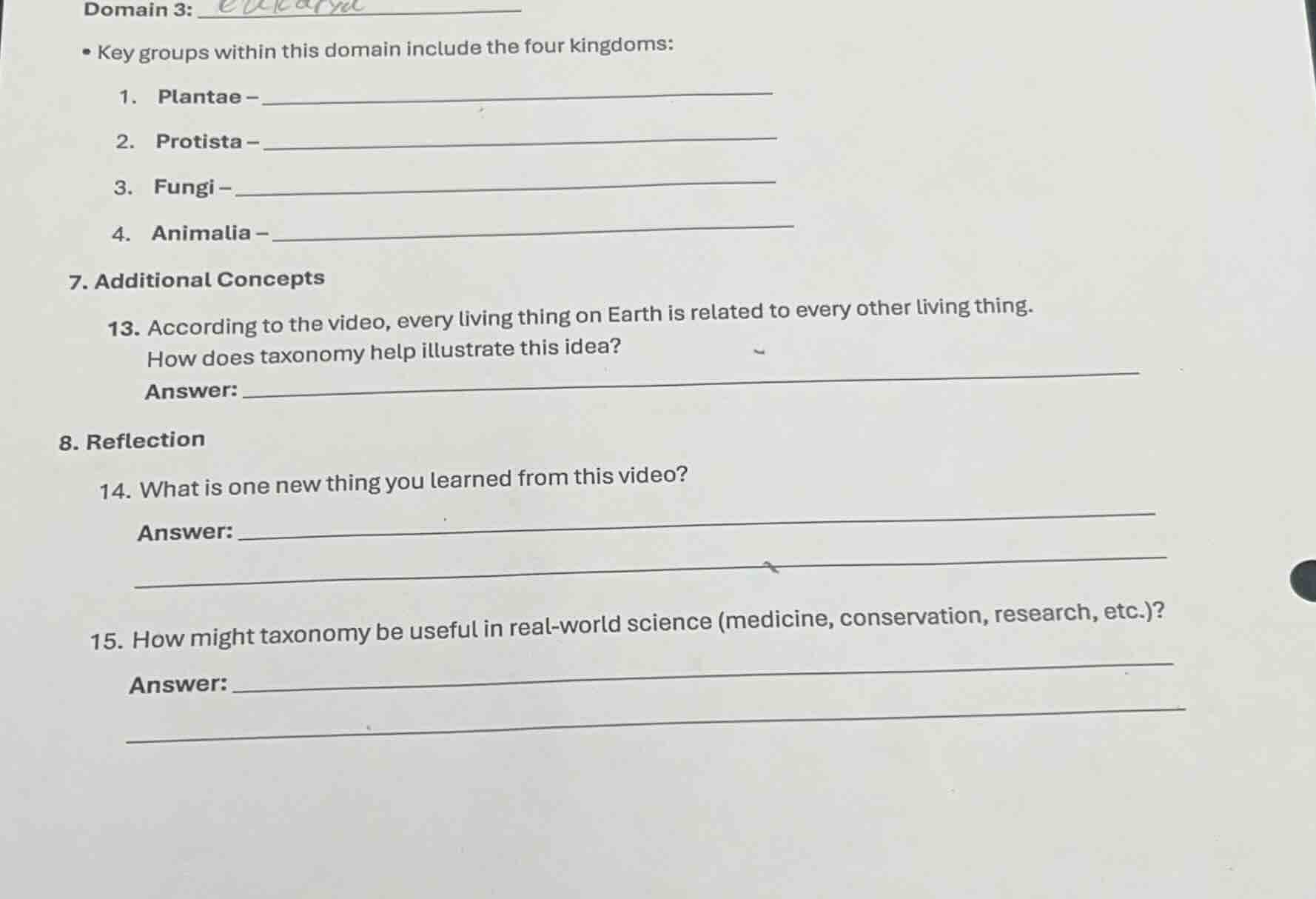
domain 3:• key groups within this domain include the four kingdoms:1. plantae -2. protista -3. fungi -4. animalia -7. additional concepts13. according to the video, every living thing on earth is related to every other living thing.how does taxonomy help illustrate this idea?answer:8. reflection14. what is one new thing you learned from this video?answer:15. how might taxonomy be useful in real-world science (medicine, conservation, research, etc.)?answer:
Step1: Define each eukaryotic kingdom
- Plantae - Multicellular, photosynthetic autotrophs with cell walls of cellulose
- Protista - Mostly unicellular (some multicellular) eukaryotes, diverse nutrition modes
- Fungi - Heterotrophic, chitin cell walls, absorb nutrients
- Animalia - Multicellular heterotrophs, no cell walls, motile (most)
Step2: Explain taxonomy's evolutionary link
Taxonomy groups organisms by shared traits, creating a hierarchical classification (domain, kingdom, phylum, etc.) that reflects shared ancestry. Organisms in the same lower taxon (e.g., species, genus) share more recent common ancestors, while even distantly related organisms share a distant common ancestor at higher taxonomic levels, showing universal relatedness.
Step3: Example new learning (sample)
One new thing learned could be that all eukaryotic organisms fall into just four distinct kingdoms, each with defining unifying traits.
Step4: Real-world taxonomy uses
- Medicine: Identifies closely related pathogens to predict disease behavior and develop treatments.
- Conservation: Helps identify genetically distinct species/subspecies to prioritize conservation efforts.
- Research: Organizes organisms to study evolutionary relationships and biological traits across groups.

Snap & solve any problem in the app
Get step-by-step solutions on Sovi AI
Photo-based solutions with guided steps
Explore more problems and detailed explanations
- Plantae - Multicellular, photosynthetic autotrophs with cellulose cell walls
- Protista - Diverse mostly unicellular eukaryotes with varied nutrition
- Fungi - Heterotrophs with chitin cell walls that absorb nutrients
- Animalia - Multicellular heterotrophs without cell walls (mostly motile)
- Taxonomy creates a hierarchical classification based on shared traits and ancestry; organisms share common ancestors at different taxonomic levels, demonstrating universal relatedness.
- (Sample answer) I learned that all complex, nucleated life on Earth is grouped into only four distinct kingdoms.
- (Sample answer) In medicine, taxonomy helps link related pathogens to develop targeted treatments; in conservation, it identifies unique species to protect; in research, it organizes organisms to study evolutionary connections.