QUESTION IMAGE
Question
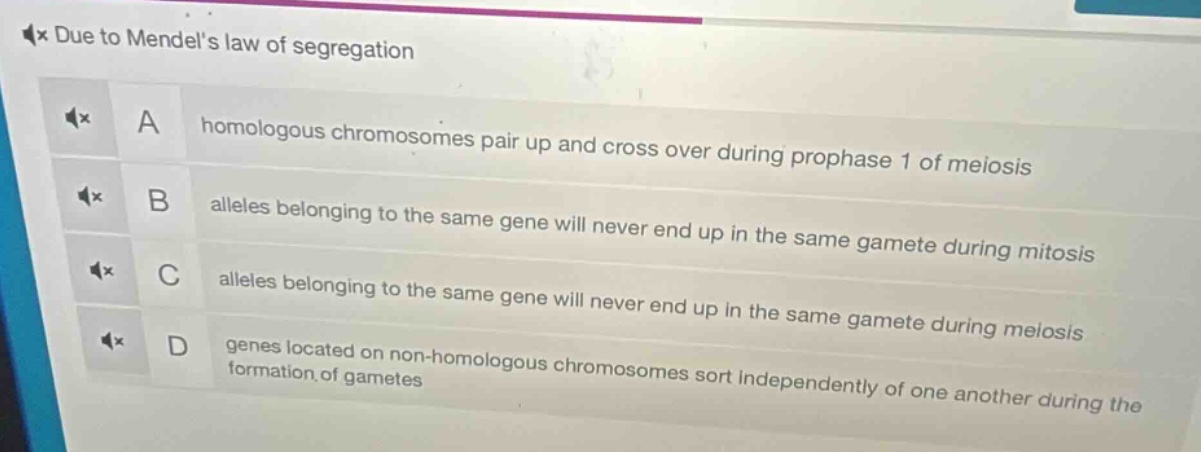
due to mendels law of segregation
a homologous chromosomes pair up and cross over during prophase 1 of meiosis
b alleles belonging to the same gene will never end up in the same gamete during mitosis
c alleles belonging to the same gene will never end up in the same gamete during meiosis
d genes located on non-homologous chromosomes sort independently of one another during the formation of gametes
Mendel's Law of Segregation states that for a diploid organism, the two alleles of a gene separate during gamete formation, so each gamete only gets one allele.
- Option A describes crossing over, related to genetic recombination, not segregation.
- Option B is incorrect because mitosis produces identical somatic cells, not gametes, so this does not relate to the law.
- Option C aligns with the law: the two alleles of a single gene separate during meiosis, so they will not be in the same gamete.
- Option D describes Mendel's Law of Independent Assortment, not Segregation.

Snap & solve any problem in the app
Get step-by-step solutions on Sovi AI
Photo-based solutions with guided steps
Explore more problems and detailed explanations
C. alleles belonging to the same gene will never end up in the same gamete during meiosis