QUESTION IMAGE
Question
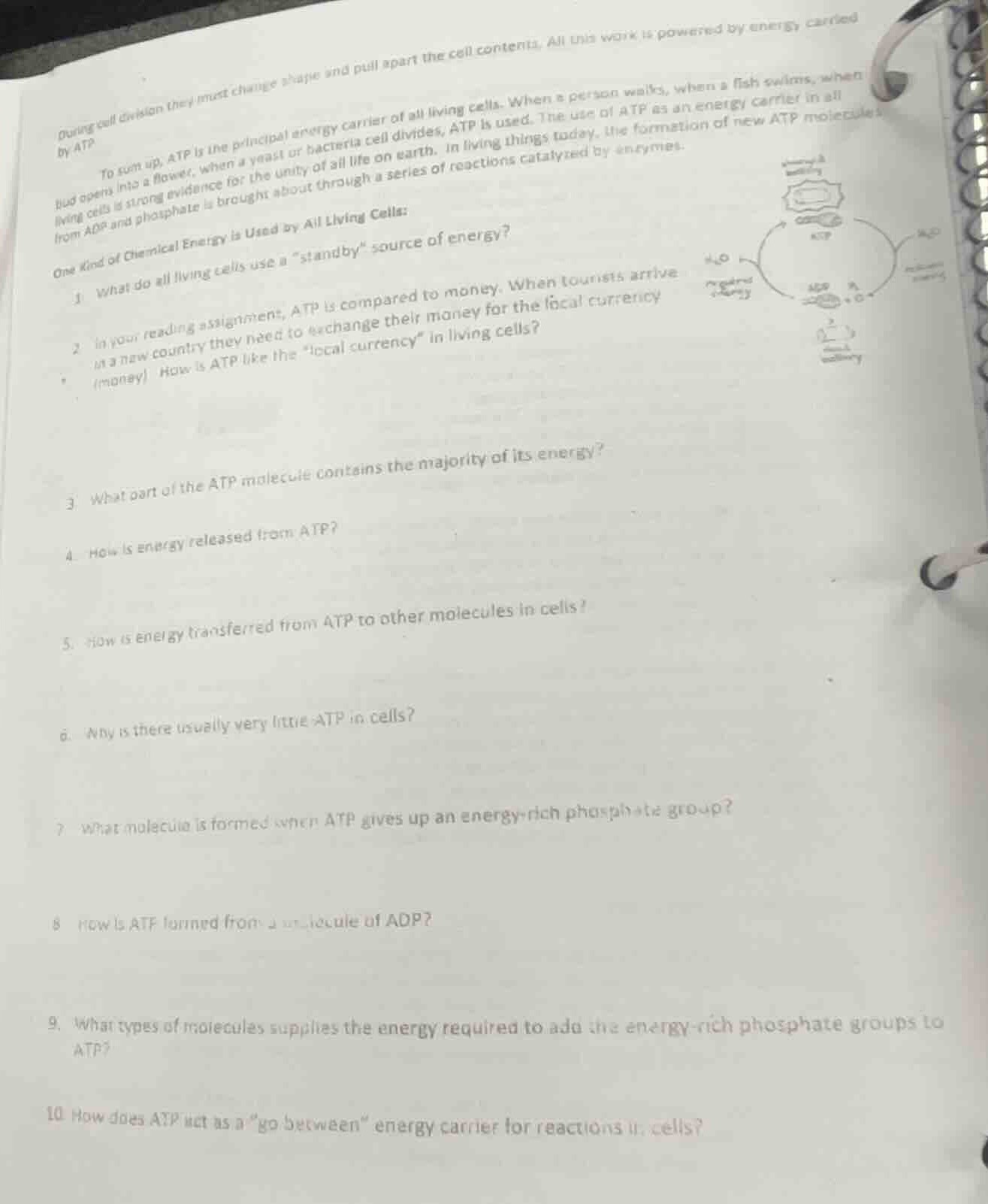
during cell division they must change shape and pull apart the cell contents. all this work is powered by energy carried by atp
to sum up, atp is the principal energy carrier of all living cells. when a person walks, when a fish swims, when bud opens into a flower, when a yeast or bacteria cell divides, atp is used. the use of atp as an energy carrier in all living cells is strong evidence for the unity of all life on earth. in living things today, the formation of new atp molecules from adp and phosphate is brought about through a series of reactions catalyzed by enzymes.
one kind of chemical energy is used by all living cells:
1 what do all living cells use a \standby\ source of energy?
2 in your reading assignment, atp is compared to money. when tourists arrive in a new country they need to exchange their money for the local currency (money). how is atp like the \local currency\ in living cells?
3 what part of the atp molecule contains the majority of its energy?
4 how is energy released from atp?
5 how is energy transferred from atp to other molecules in cells?
6 why is there usually very little atp in cells?
7 what molecule is formed when atp gives up an energy - rich phosphate group?
8 how is atp formed from a molecule of adp?
9 what types of molecules supplies the energy required to add the energy - rich phosphate groups to atp?
10 how does atp act as a \go - between\ energy carrier for reactions in cells?
Question 1
All living cells use ATP (adenosine triphosphate) as the "standby" source of energy. ATP is the principal energy carrier in all living cells, used for various cellular processes like cell division, movement, and biochemical reactions.
ATP is like the "local currency" because just as money is used as a medium of exchange for goods and services, ATP is used to transfer energy for cellular processes. When energy is needed, cells "spend" ATP (by breaking it down) to get the energy, similar to how tourists exchange money to use the local currency for transactions.
The majority of ATP's energy is contained in the bonds between the phosphate groups, specifically the high - energy phosphate bonds (especially the bond between the second and third phosphate groups). When these bonds are broken, a large amount of energy is released.

Snap & solve any problem in the app
Get step-by-step solutions on Sovi AI
Photo-based solutions with guided steps
Explore more problems and detailed explanations
All living cells use ATP (adenosine triphosphate) as a "standby" source of energy.