QUESTION IMAGE
Question
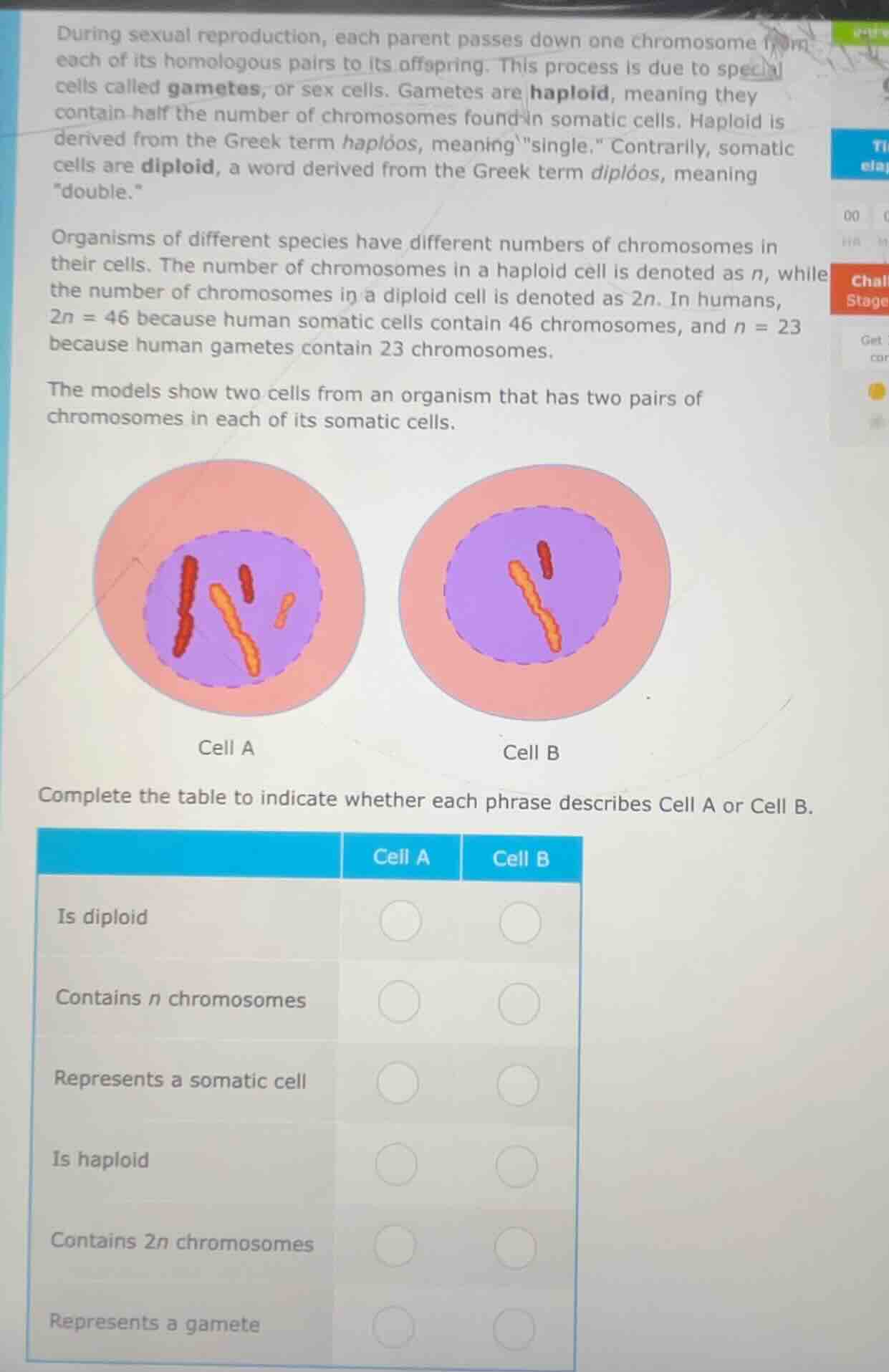
during sexual reproduction, each parent passes down one chromosome from each of its homologous pairs to its offspring. this process is due to special cells called gametes, or sex cells. gametes are haploid, meaning they contain half the number of chromosomes found in somatic cells. haploid is derived from the greek term haplóos, meaning \single.\ contrarily, somatic cells are diploid, a word derived from the greek term diplóos, meaning \double.\ organisms of different species have different numbers of chromosomes in their cells. the number of chromosomes in a haploid cell is denoted as n, while the number of chromosomes in a diploid cell is denoted as 2n. in humans, 2n = 46 because human somatic cells contain 46 chromosomes, and n = 23 because human gametes contain 23 chromosomes. the models show two cells from an organism that has two pairs of chromosomes in each of its somatic cells. images of cell a and cell b complete the table to indicate whether each phrase describes cell a or cell b. | | cell a | cell b | |---|---|---| | is diploid | | | | contains n chromosomes | | | | represents a somatic cell | | | | is haploid | | | | contains 2n chromosomes | | | | represents a gamete | | |
Step1: Identify chromosome counts
The organism's somatic cells have 2 homologous pairs, so $2n=4$, $n=2$. Cell A has 4 chromosomes; Cell B has 2.
Step2: Match diploid traits
Diploid = $2n$ = somatic cell. Cell A has 4 chromosomes, so it fits diploid/somatic/$2n$.
Step3: Match haploid traits
Haploid = $n$ = gamete. Cell B has 2 chromosomes, so it fits haploid/gamete/$n$.

Snap & solve any problem in the app
Get step-by-step solutions on Sovi AI
Photo-based solutions with guided steps
Explore more problems and detailed explanations
| Phrase | Cell A | Cell B |
|---|---|---|
| Contains $n$ chromosomes | ❌ | ✅ |
| Represents a somatic cell | ✅ | ❌ |
| Is haploid | ❌ | ✅ |
| Contains $2n$ chromosomes | ✅ | ❌ |
| Represents a gamete | ❌ | ✅ |