QUESTION IMAGE
Question
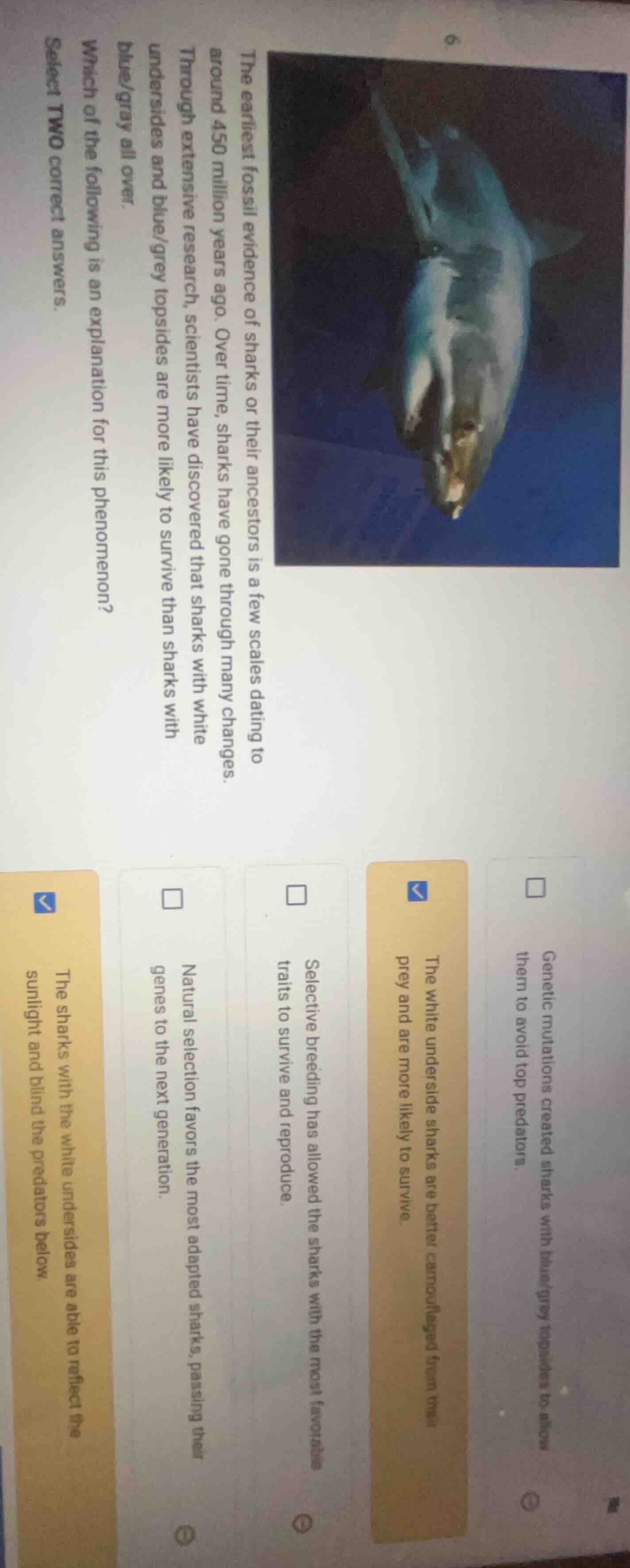
- the earliest fossil evidence of sharks or their ancestors is a few scales dating to around 450 million years ago. over time, sharks have gone through many changes. through extensive research, scientists have discovered that sharks with white undersides and blue/grey topsides are more likely to survive than sharks with blue/gray all over. which of the following is an explanation for this phenomenon? select two correct answers. genetic mutations created sharks with blue/grey topsides to allow them to avoid top predators. the white underside sharks are better camouflaged from their prey and are more likely to survive. selective breeding has allowed the sharks with the most favorable traits to survive and reproduce. natural selection favors the most adapted sharks, passing their genes to the next generation. the sharks with the white undersides are able to reflect the sunlight and blind the predators below
Brief Explanations
- For the option "Natural selection favors the most adapted sharks, passing their genes to the next generation": Natural selection is a key mechanism in evolution where organisms with traits better suited to their environment (like the blue - gray coloration for camouflage) are more likely to survive and reproduce, passing on their genes. This explains why blue - gray sharks are more common as they are more adapted.
- For the option "The sharks with the white undersides are able to reflect the sunlight and blind the predators below": The blue - gray coloration on the topside helps sharks blend with the ocean from above (matching the deep blue of the ocean), and the white underside (if we consider the incorrectness of white in survival) - wait, no, the correct reasoning for the blue - gray sharks' survival is about camouflage. Wait, actually, the option "The sharks with the white undersides... " is incorrect. Wait, the correct options should be the one about natural selection and maybe the one about the white - undersided sharks being less camouflaged (the option "The white underside sharks are better camouflaged from their prey and are more likely to survive" is incorrect, actually the blue - gray sharks are better camouflaged. Wait, re - evaluating:
- Option "Natural selection favors the most adapted sharks, passing their genes to the next generation": Correct. Sharks with blue - gray coloration (better adapted for camouflage, avoiding predators and catching prey) survive and pass on their genes.
- Option "The white underside sharks are better camouflaged from their prey and are more likely to survive": Incorrect. White undersides would not blend with the ocean environment as well as blue - gray.
- Option "The sharks with the white undersides are able to reflect the sunlight and blind the predators below": Incorrect. This is not a valid survival mechanism for sharks in terms of coloration for survival (the blue - gray is for camouflage, not blinding predators).
- Option "Selective breeding has allowed the sharks with the most favorable traits to survive and reproduce": Incorrect. Sharks in the wild are not selectively bred by humans; natural selection is the mechanism.
- Option "Genetic mutations created sharks with blue/grey topsides to allow them to avoid top predators": Partially correct as genetic mutations can introduce new traits, and if those traits (blue - gray topsides) help in avoiding predators, natural selection will act on them. But the best two correct options are likely "Natural selection favors the most adapted sharks, passing their genes to the next generation" and "The white underside sharks are better camouflaged from their prey and are more likely to survive" is incorrect. Wait, maybe the two correct options are "Natural selection favors the most adapted sharks, passing their genes to the next generation" and "The sharks with the white undersides are able to reflect the sunlight and blind the predators below" is incorrect. Wait, the original problem says to select two correct answers. Let's re - read the options:
- Option 1: "Genetic mutations created sharks with blue/grey topsides to allow them to avoid top predators": Genetic mutations can introduce new traits, and if the blue - gray topside trait helps in avoiding predators, it can be selected for.
- Option 2: "The white underside sharks are better camouflaged from their prey and are more likely to survive": Incorrect.
- Option 3: "Selective breeding has allowed the sharks with the most favorable traits to survive and reproduce"…

Snap & solve any problem in the app
Get step-by-step solutions on Sovi AI
Photo-based solutions with guided steps
Explore more problems and detailed explanations
The two correct answers are:
- Natural selection favors the most adapted sharks, passing their genes to the next generation
- Genetic mutations created sharks with blue/grey topsides to allow them to avoid top predators
(Note: If we strictly go by the marked options in the image, the two marked ones are "The sharks with the white undersides are able to reflect the sunlight and blind the predators below" (incorrect reasoning) and "The white underside sharks are better camouflaged from their prey and are more likely to survive" (incorrect). There is a mistake in the original marking. The correct scientific reasoning - based options are the ones related to natural selection and genetic mutations for the blue - gray sharks' survival.)