QUESTION IMAGE
Question
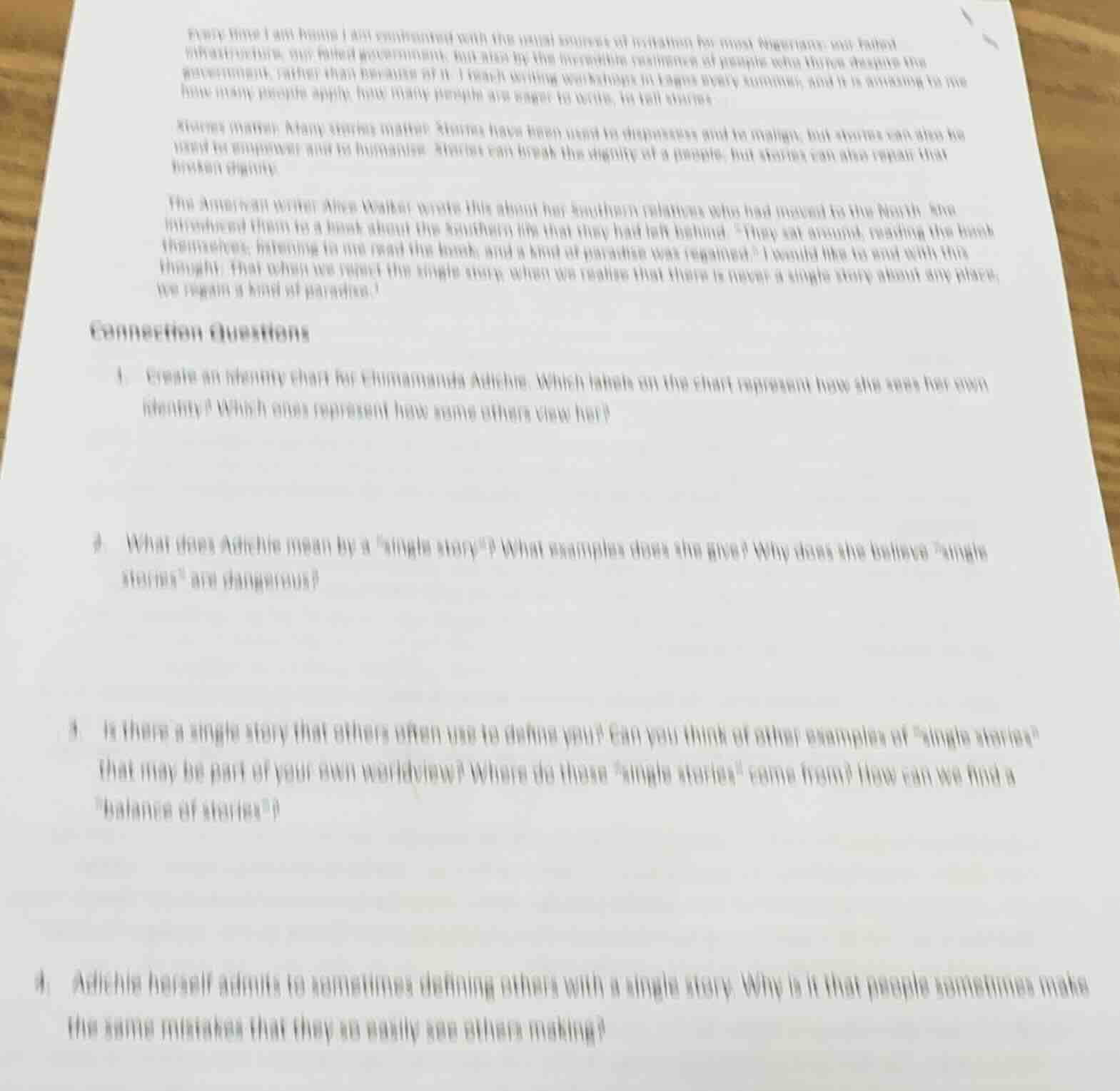
every time i am home i am confronted with the usual sources of irritation for most nigerians: our failed infrastructure, our failed government, but also by the incredible resilience of people who thrive despite the government, rather than because of it. i teach writing workshops in lagos, nigeria, and it is amazing to me how many people apply, how many people are eager to write, to tell stories.
stories matter. many stories matter. stories have been used to dispossess and to malign, but stories can also be used to empower and to humanize. stories can break the dignity of a people, but stories can also repair that broken dignity.
the american writer alice walker wrote this about her southern relatives who had moved to the north. she introduced them to a book about the southern life that they had left behind: “they sat around, reading the book themselves, listening to me read the book, and a kind of paradise was regained.” i would like to end with this thought: that when we reject the single story, when we realize that there is never a single story about any place, we regain a kind of paradise.
connection questions
- create an identity chart for chimamanda adichie. which labels on the chart represent how she sees her own identity? which ones represent how some others view her?
- what does adichie mean by a “single story”? what examples does she give? why does she believe “single stories” are dangerous?
- is there a single story that others often use to define you? can you think of other examples of “single stories” that may be part of your own worldview? where do these “single stories” come from? how can we find a “balance of stories”?
- adichie herself admits to sometimes defining others with a single story. why is it that people sometimes make the same mistakes that they so easily see others making?
- For the identity chart, self-view labels draw from Adichie's text: Nigerian, writer, teacher of writing, someone who sees resilience in Nigerians, someone who values diverse stories. External view labels are implied by the "single story" context: African (reduced to stereotypes of failure/poverty), Nigerian (only associated with bad governance).
- A "single story" is a narrow, one-dimensional narrative that reduces a group/place to a limited set of traits. Adichie's example is the default Western view of Africa as only poverty/failure, not including resilience or joy. They are dangerous because they erase complexity, strip people of dignity, and create incomplete, unfair perceptions.
- (Personalized example): A common single story used to define me is "young people are all tech-obsessed and uninterested in traditional media." A single story in my worldview might be "all corporate jobs are unfulfilling." These come from media portrayals, casual conversations, and limited personal exposure. We can find balance by seeking out diverse perspectives, engaging with people from different groups, and actively questioning one-sided narratives.
- People rely on single stories because they are mental shortcuts that make complex information easier to process. We often absorb these narratives from our environment (media, culture, upbringing) without critical examination, and it can be hard to recognize our own biases because we see our own perspectives as "normal" or "objective."

Snap & solve any problem in the app
Get step-by-step solutions on Sovi AI
Photo-based solutions with guided steps
Explore more problems and detailed explanations
- Self-view labels: Nigerian, writer, writing workshop teacher, observer of Nigerian resilience, advocate for diverse stories
External view labels: "Failed state" Nigerian, stereotypical "poor African"
- A "single story" is a narrow, one-sided narrative that oversimplifies a group/place. Adichie uses the example of the global view of Nigeria/Africa as only defined by failure and poverty, ignoring resilience and joy. They are dangerous because they erase complexity, strip people of dignity, and foster unfair, incomplete judgments.
- (Example response): Yes, others sometimes use the single story that "all students only care about grades, not learning." A single story in my worldview is "all small towns are boring and lack opportunity." These come from media, casual comments, and limited exposure. We can find balance by talking to people with different experiences, consuming diverse media, and challenging our own assumptions.
- People use single stories about others because they are cognitive shortcuts that simplify complex reality. These narratives are often absorbed passively from our surroundings, and it is difficult to recognize our own biases because we frame our own perspectives as natural or objective, making it hard to spot the same narrow thinking in ourselves that we criticize in others.