QUESTION IMAGE
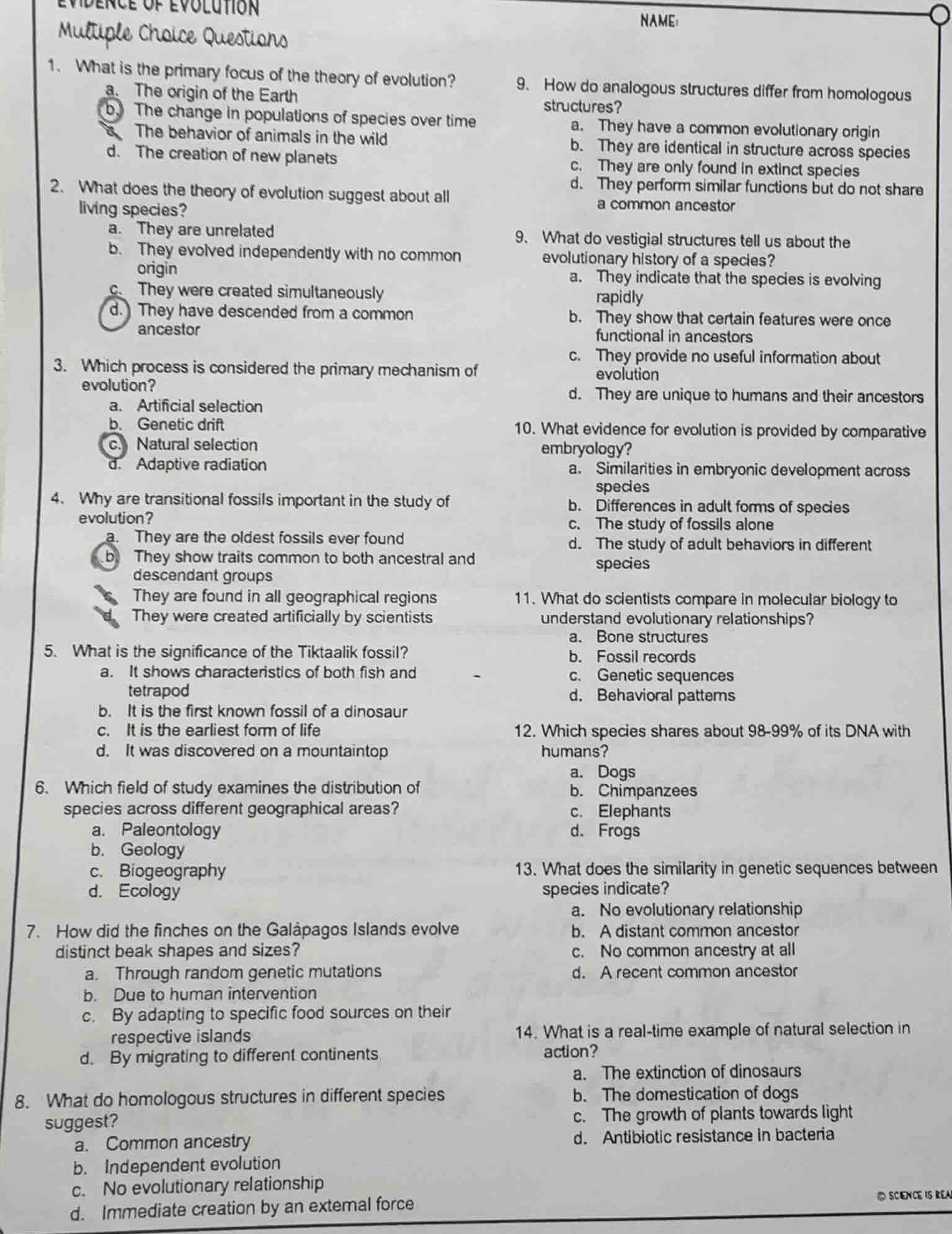
Question
evidence of evolution
multiple choice questions
- what is the primary focus of the theory of evolution?
a. the origin of the earth
b. the change in populations of species over time
c. the behavior of animals in the wild
d. the creation of new planets
- what does the theory of evolution suggest about all living species?
a. they are unrelated
b. they evolved independently with no common origin
c. they were created simultaneously
d. they have descended from a common ancestor
- which process is considered the primary mechanism of evolution?
a. artificial selection
b. genetic drift
c. natural selection
d. adaptive radiation
- why are transitional fossils important in the study of evolution?
a. they are the oldest fossils ever found
b. they show traits common to both ancestral and descendant groups
c. they are found in all geographical regions
d. they were created artificially by scientists
- what is the significance of the tiktaalik fossil?
a. it shows characteristics of both fish and tetrapod
b. it is the first known fossil of a dinosaur
c. it is the earliest form of life
d. it was discovered on a mountaintop
- which field of study examines the distribution of species across different geographical areas?
a. paleontology
b. geology
c. biogeography
d. ecology
- how did the finches on the galápagos islands evolve distinct beak shapes and sizes?
a. through random genetic mutations
b. due to human intervention
c. by adapting to specific food sources on their respective islands
d. by migrating to different continents
- what do homologous structures in different species suggest?
a. common ancestry
b. independent evolution
c. no evolutionary relationship
d. immediate creation by an external force
- how do analogous structures differ from homologous structures?
a. they have a common evolutionary origin
b. they are identical in structure across species
c. they are only found in extinct species
d. they perform similar functions but do not share a common ancestor
- what do vestigial structures tell us about the evolutionary history of a species?
a. they indicate that the species is evolving rapidly
b. they show that certain features were once functional in ancestors
c. they provide no useful information about evolution
d. they are unique to humans and their ancestors
- what evidence for evolution is provided by comparative embryology?
a. similarities in embryonic development across species
b. differences in adult forms of species
c. the study of fossils alone
d. the study of adult behaviors in different species
- what do scientists compare in molecular biology to understand evolutionary relationships?
a. bone structures
b. fossil records
c. genetic sequences
d. behavioral patterns
- which species shares about 98 - 99% of its dna with humans?
a. dogs
b. chimpanzees
c. elephants
d. frogs
- what does the similarity in genetic sequences between species indicate?
a. no evolutionary relationship
b. a distant common ancestor
c. no common ancestry at all
d. a recent common ancestor
- what is a real - time example of natural selection in action?
a. the extinction of dinosaurs
b. the domestication of dogs
c. the growth of plants towards light
d. antibiotic resistance in bacteria
Question 1
The theory of evolution focuses on how species' populations change over time. Option a is about Earth's origin (not evolution's focus), c is about animal behavior (not evolution's main focus), d is about new planets (irrelevant). So b is correct.
Evolution theory states all living species share a common ancestor. Options a (unrelated), b (evolved independently), and c (created simultaneously) go against evolutionary theory. So d is correct.
Natural selection is the primary mechanism of evolution, as proposed by Darwin. Artificial selection is human - driven, genetic drift is a random change, and adaptive radiation is a result of evolution, not the primary mechanism. So c is correct.

Snap & solve any problem in the app
Get step-by-step solutions on Sovi AI
Photo-based solutions with guided steps
Explore more problems and detailed explanations
b. The change in populations of species over time