QUESTION IMAGE
Question
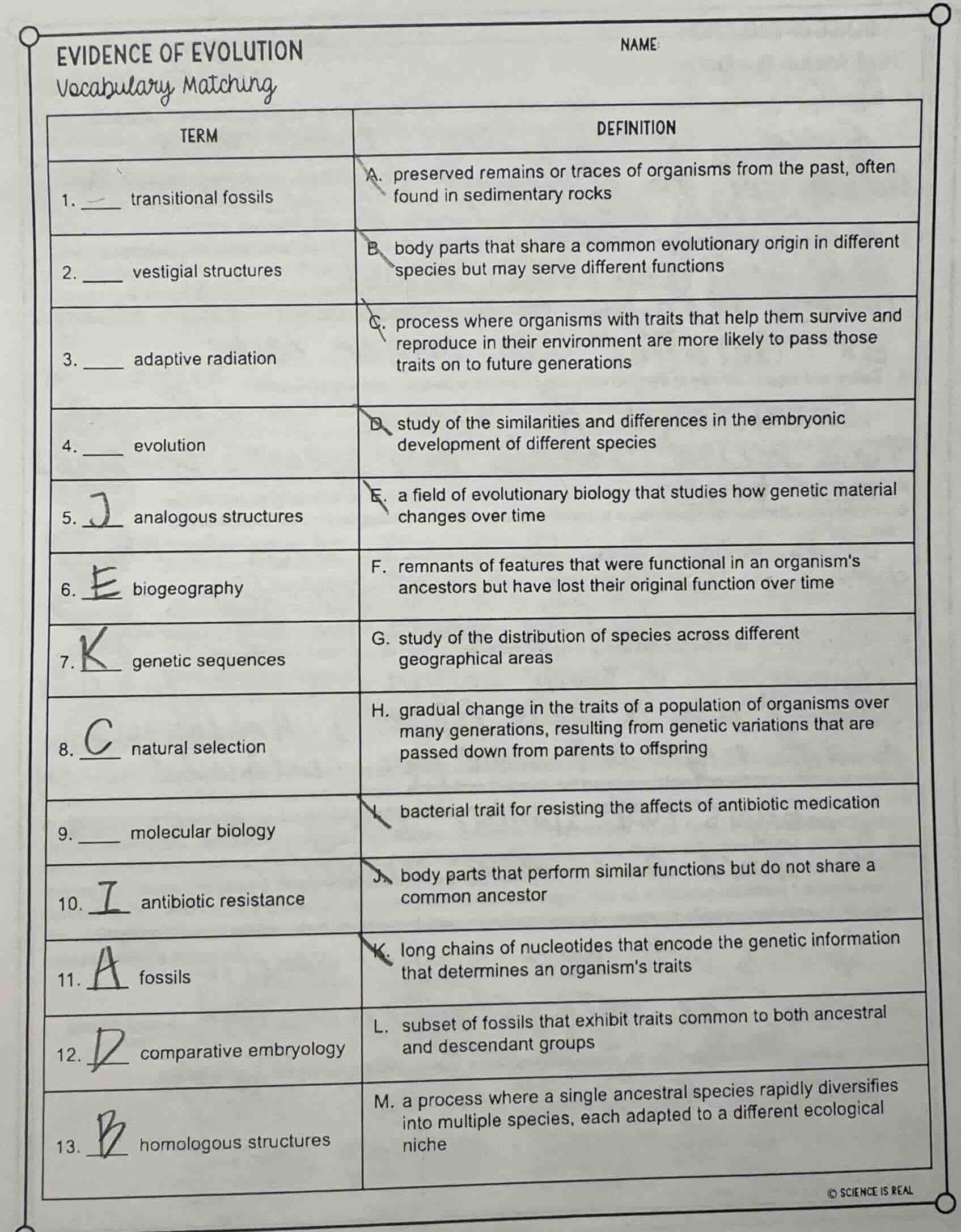
evidence of evolution
vocabulary matching
term | definition
- ____ transitional fossils | a. preserved remains or traces of organisms from the past, often found in sedimentary rocks
- ____ vestigial structures | b. body parts that share a common evolutionary origin in different species but may serve different functions
- ____ adaptive radiation | c. process where organisms with traits that help them survive and reproduce in their environment are more likely to pass those traits on to future generations
- ____ evolution | d. study of the similarities and differences in the embryonic development of different species
- ____ analogous structures | e. a field of evolutionary biology that studies how genetic material changes over time
- ____ biogeography | f. remnants of features that were functional in an organisms ancestors but have lost their original function over time
- ____ genetic sequences | g. study of the distribution of species across different geographical areas
- ____ natural selection | h. gradual change in the traits of a population of organisms over many generations, resulting from genetic variations that are passed down from parents to offspring
- ____ molecular biology | i. bacterial trait for resisting the affects of antibiotic medication
- ____ antibiotic resistance | j. body parts that perform similar functions but do not share a common ancestor
- ____ fossils | k. long chains of nucleotides that encode the genetic information that determines an organisms traits
- ____ comparative embryology | l. subset of fossils that exhibit traits common to both ancestral and descendant groups
- ____ homologous structures | m. a process where a single ancestral species rapidly diversifies into multiple species, each adapted to a different ecological niche
To solve this vocabulary matching for evidence of evolution, we analyze each term and its definition:
Term 1: transitional fossils
Transitional fossils are a subset of fossils showing traits of both ancestral and descendant groups. So match with L.
Term 2: vestigial structures
Vestigial structures are remnants of features functional in ancestors but lost function. Match with F.
Term 3: adaptive radiation
Adaptive radiation is when a single species diversifies into multiple species for different niches. Match with M.
Term 4: evolution
Evolution is the gradual change of a population’s traits over generations. Match with H.
Term 5: analogous structures
Analogous structures have similar functions but no common ancestor. Match with J (already marked correctly).
Term 6: biogeography
Biogeography studies species distribution across geographic areas. Match with G (original “E” was incorrect).
Term 7: genetic sequences
Genetic sequences are long nucleotide chains encoding genetic info. Match with K (already marked correctly).
Term 8: natural selection
Natural selection is organisms with beneficial traits passing them to future generations. Match with C (already marked correctly).
Term 9: molecular biology
Molecular biology in evolution studies genetic material changes over time. Match with E (original “E” was misapplied to biogeography).
Term 10: antibiotic resistance
Antibiotic resistance is a bacterial trait resisting antibiotics. Match with I (already marked correctly).
Term 11: fossils
Fossils are preserved remains/traces of past organisms. Match with A (already marked correctly).
Term 12: comparative embryology
Comparative embryology studies embryonic development similarities/differences. Match with D (already marked correctly).
Term 13: homologous structures
Homologous structures share a common evolutionary origin but different functions. Match with B (already marked correctly).
Corrected Matches:
- transitional fossils - L
- vestigial structures - F
- adaptive radiation - M
- evolution - H
- analogous structures - J (correct)
- biogeography - G
- genetic sequences - K (correct)
- natural selection - C (correct)
- molecular biology - E
- antibiotic resistance - I (correct)
- fossils - A (correct)
- comparative embryology - D (correct)
- homologous structures - B (correct)
(Note: The original markings for 6 and 9 were incorrect; the above provides the correct matches.)

Snap & solve any problem in the app
Get step-by-step solutions on Sovi AI
Photo-based solutions with guided steps
Explore more problems and detailed explanations
To solve this vocabulary matching for evidence of evolution, we analyze each term and its definition:
Term 1: transitional fossils
Transitional fossils are a subset of fossils showing traits of both ancestral and descendant groups. So match with L.
Term 2: vestigial structures
Vestigial structures are remnants of features functional in ancestors but lost function. Match with F.
Term 3: adaptive radiation
Adaptive radiation is when a single species diversifies into multiple species for different niches. Match with M.
Term 4: evolution
Evolution is the gradual change of a population’s traits over generations. Match with H.
Term 5: analogous structures
Analogous structures have similar functions but no common ancestor. Match with J (already marked correctly).
Term 6: biogeography
Biogeography studies species distribution across geographic areas. Match with G (original “E” was incorrect).
Term 7: genetic sequences
Genetic sequences are long nucleotide chains encoding genetic info. Match with K (already marked correctly).
Term 8: natural selection
Natural selection is organisms with beneficial traits passing them to future generations. Match with C (already marked correctly).
Term 9: molecular biology
Molecular biology in evolution studies genetic material changes over time. Match with E (original “E” was misapplied to biogeography).
Term 10: antibiotic resistance
Antibiotic resistance is a bacterial trait resisting antibiotics. Match with I (already marked correctly).
Term 11: fossils
Fossils are preserved remains/traces of past organisms. Match with A (already marked correctly).
Term 12: comparative embryology
Comparative embryology studies embryonic development similarities/differences. Match with D (already marked correctly).
Term 13: homologous structures
Homologous structures share a common evolutionary origin but different functions. Match with B (already marked correctly).
Corrected Matches:
- transitional fossils - L
- vestigial structures - F
- adaptive radiation - M
- evolution - H
- analogous structures - J (correct)
- biogeography - G
- genetic sequences - K (correct)
- natural selection - C (correct)
- molecular biology - E
- antibiotic resistance - I (correct)
- fossils - A (correct)
- comparative embryology - D (correct)
- homologous structures - B (correct)
(Note: The original markings for 6 and 9 were incorrect; the above provides the correct matches.)