QUESTION IMAGE
Question
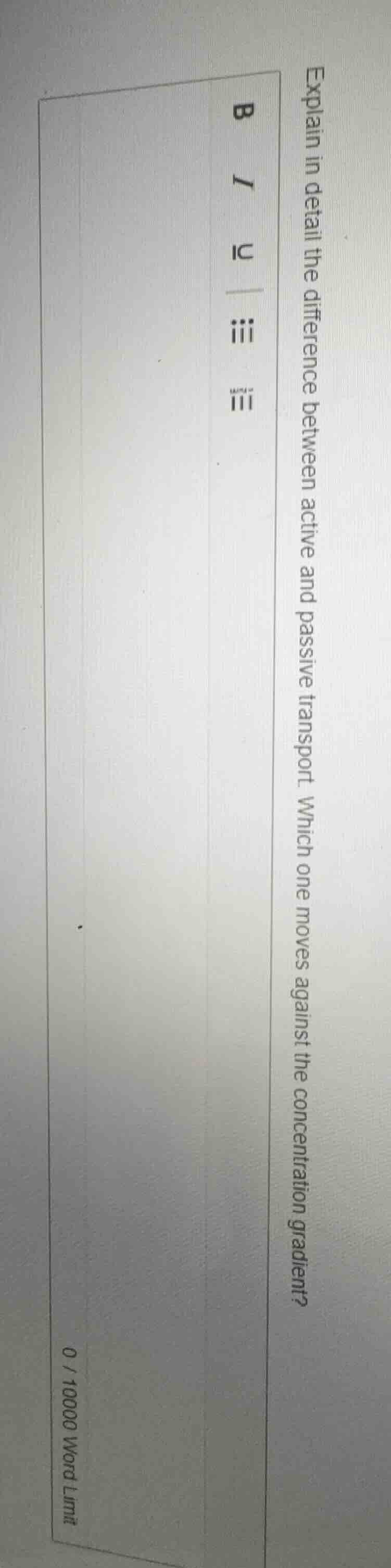
explain in detail the difference between active and passive transport. which one moves against the concentration gradient?
Active and passive transport are mechanisms for moving substances across cell membranes, differing in energy use, concentration gradient direction, and mechanisms:
- Passive Transport: Moves substances down their concentration gradient (from high to low concentration), requiring no cellular energy (ATP). It includes simple diffusion (small, nonpolar molecules like oxygen moving directly through the membrane), facilitated diffusion (charged/large molecules like glucose using channel or carrier proteins), and osmosis (movement of water across a semipermeable membrane).
- Active Transport: Moves substances against their concentration gradient (from low to high concentration), which requires cellular energy (usually ATP) and often uses specialized carrier proteins (e.g., sodium-potassium pump). It can also involve bulk transport (endocytosis/exocytosis) for large particles.
Active transport is the process that moves substances against the concentration gradient.

Snap & solve any problem in the app
Get step-by-step solutions on Sovi AI
Photo-based solutions with guided steps
Explore more problems and detailed explanations
Passive transport moves substances down their concentration gradient (high to low concentration) without requiring cellular energy (ATP). It includes simple diffusion, facilitated diffusion (using channel/carrier proteins), and osmosis (water movement). Active transport moves substances against their concentration gradient (low to high concentration) and requires cellular energy (typically ATP) and specialized carrier proteins (e.g., sodium-potassium pump) or bulk transport mechanisms.
Active transport is the process that moves substances against the concentration gradient.