QUESTION IMAGE
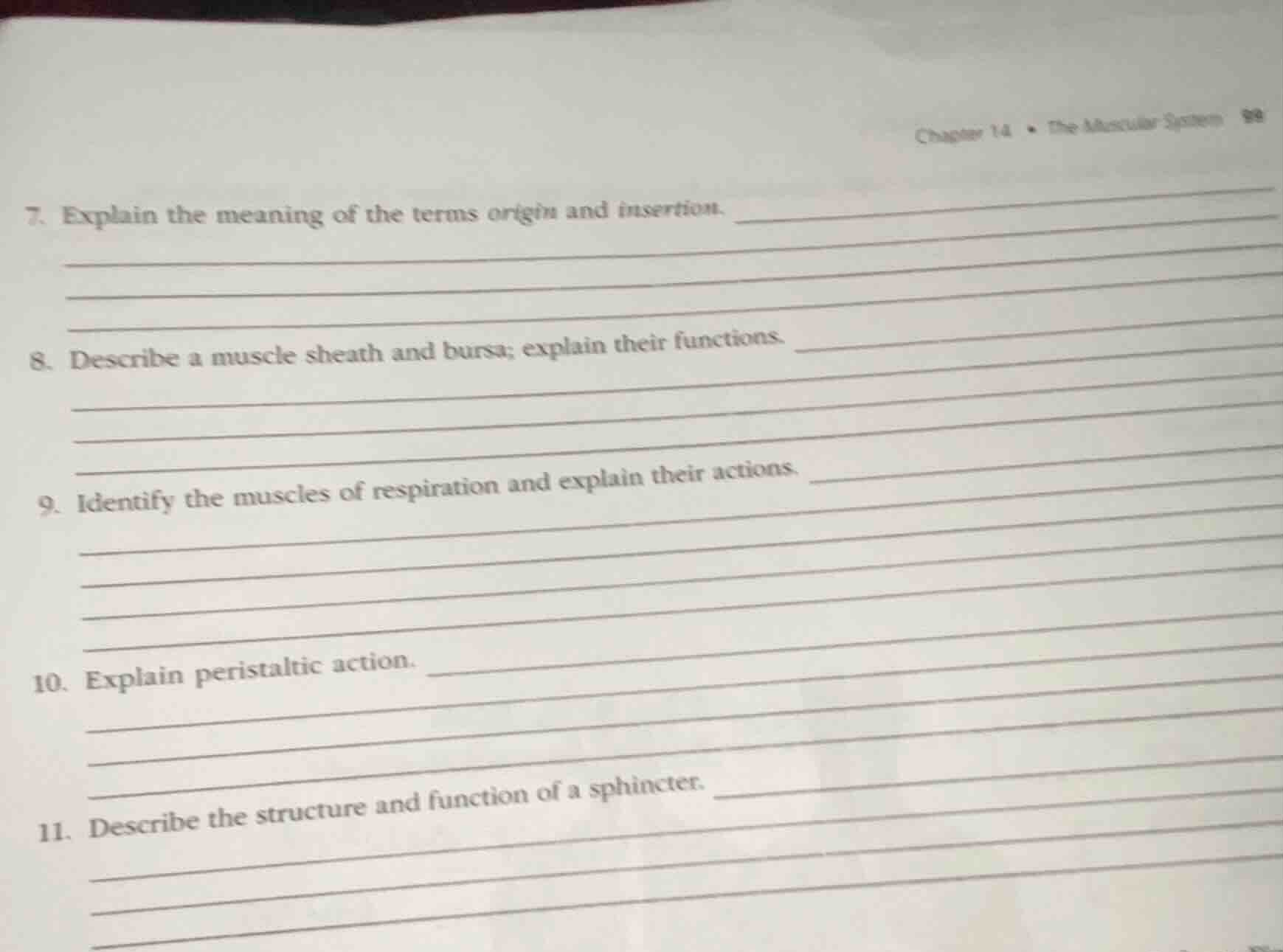
Question
- explain the meaning of the terms origin and insertion.
- describe a muscle sheath and bursa; explain their functions.
- identify the muscles of respiration and explain their actions.
- explain peristaltic action.
- describe the structure and function of a sphincter.
Response
Question 7
Brief Explanations
In muscle anatomy, the origin of a muscle is the relatively fixed or less movable attachment point (usually on a bone), while the insertion is the more movable attachment point (also typically on a bone). When a muscle contracts, the insertion moves toward the origin, producing movement (e.g., the origin of the biceps brachii is on the scapula, and the insertion is on the radius; contraction moves the forearm toward the shoulder).
Brief Explanations
- Muscle Sheath (Fascia): Connective tissue layers (epimysium, perimysium, endomysium) surrounding muscles. The epimysium wraps the entire muscle, perimysium surrounds fascicles (muscle fiber bundles), and endomysium surrounds individual muscle fibers. Functions: Organize muscle structure, provide support, transmit force, and separate muscles.
- Bursa: A small, fluid - filled sac (lined with synovial membrane) located between structures (e.g., bones, muscles, tendons) that rub against each other. Function: Reduce friction (e.g., the subacromial bursa reduces friction between the acromion and the rotator cuff tendons).
Brief Explanations
- Diaphragm: A dome - shaped muscle separating the thoracic and abdominal cavities. During inhalation, it contracts (flattens), increasing thoracic volume (decreasing pressure) to draw air in. During exhalation, it relaxes (returns to dome shape), decreasing thoracic volume (increasing pressure) to expel air.
- Intercostal Muscles (External and Internal):
- External Intercostals: Run obliquely between ribs. Contract during inhalation, lifting ribs and expanding the thoracic cavity (increasing volume for air intake).
- Internal Intercostals: Run obliquely in the opposite direction of external intercostals. Contract during forced exhalation, depressing ribs and decreasing thoracic volume to force air out.
- Accessory Muscles (e.g., Sternocleidomastoid, Scalenes): Assist in forced inhalation (e.g., during heavy breathing/exercise) by elevating the sternum/upper ribs to further increase thoracic volume.

Snap & solve any problem in the app
Get step-by-step solutions on Sovi AI
Photo-based solutions with guided steps
Explore more problems and detailed explanations
- Origin: The relatively fixed (or less movable) attachment point of a muscle (typically on a bone), serving as a stable base for muscle contraction.
- Insertion: The more movable attachment point of a muscle (typically on a bone), which moves toward the origin during muscle contraction to produce movement.