QUESTION IMAGE
Question
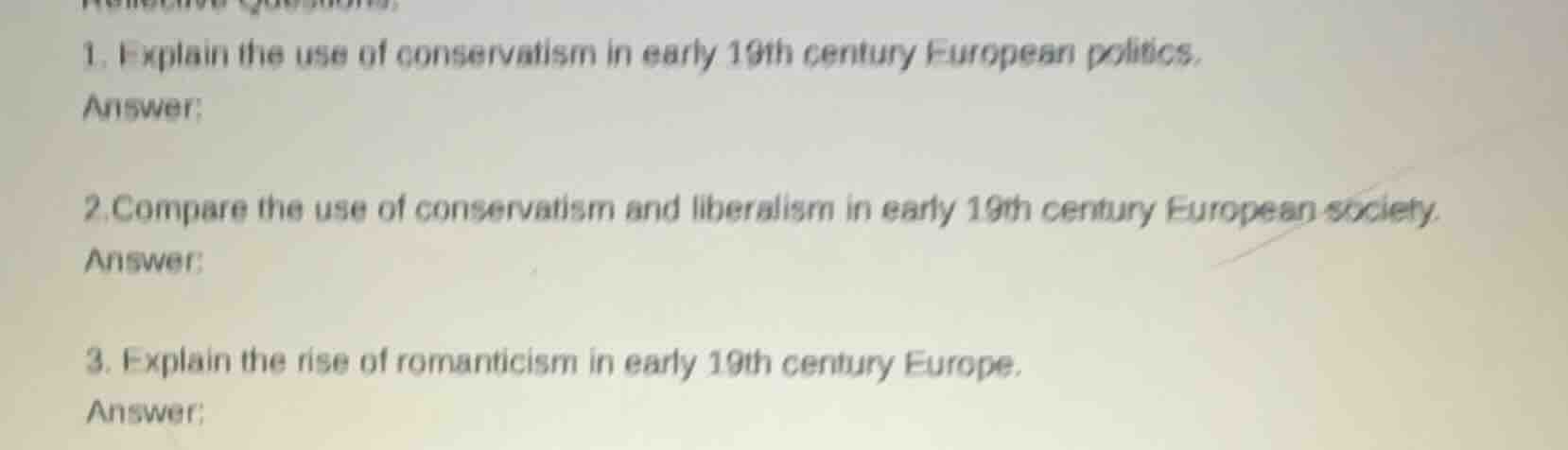
- explain the use of conservatism in early 19th century european politics.
answer:
2.compare the use of conservatism and liberalism in early 19th century european society.
answer:
- explain the rise of romanticism in early 19th century europe.
answer:
Brief Explanations
- For the first question: Early 19th-century European conservative politics emerged as a reaction to the French Revolution, aiming to restore pre-revolutionary traditional institutions like monarchies, aristocratic power, and established churches. Conservatives such as Metternich used it to suppress liberal and nationalist uprisings, maintain social hierarchy, and preserve stability through the Congress of Vienna system.
- For the second question: Conservatism defended traditional social structures, royal authority, and religious orthodoxy, appealing to aristocrats and the church to resist revolutionary change. Liberalism advocated for individual rights, constitutional government, free markets, and representative democracy, supported by the rising middle class, pushing for limits on monarchical power and social reform.
- For the third question: Romanticism rose as a rejection of Enlightenment rationalism and the industrial revolution's dehumanizing effects. It emphasized emotion, individualism, nature, and historical nostalgia, fueled by post-French Revolution disillusionment, a desire for authentic experience, and artistic and intellectual pushback against rigid scientific and social norms.

Snap & solve any problem in the app
Get step-by-step solutions on Sovi AI
Photo-based solutions with guided steps
Explore more problems and detailed explanations
- In early 19th-century European politics, conservatism served as a counter to the upheaval of the French Revolution. Conservative leaders (e.g., Klemens von Metternich) sought to restore pre-revolutionary traditional institutions: absolute monarchies, aristocratic privilege, and the dominant role of the Catholic Church. They used the Congress of Vienna system to enforce this, suppressing liberal and nationalist movements to maintain social order, hierarchical power structures, and the status quo across European states.
2.
- Conservatism: Focused on upholding traditional social, political, and religious hierarchies (monarchy, aristocracy, established churches). It was backed by the old ruling elite, aimed to suppress revolutionary and liberal change, and prioritized stability and tradition over individual rights.
- Liberalism: Championed individual freedoms (speech, property), constitutional government, representative democracy, and free markets. Supported by the emerging middle class, it pushed to limit monarchical power, expand political participation, and embrace social and economic reform that challenged traditional hierarchies.
- Romanticism rose in early 19th-century Europe as a rejection of Enlightenment rationalism and the dehumanizing impacts of the Industrial Revolution. Post-French Revolution disillusionment with rationalist ideals of progress led artists, writers, and thinkers to prioritize emotion, individualism, nature, and historical nostalgia. It also emerged as a response to the standardization and alienation of industrial society, seeking authentic, subjective experience and celebrating national heritage, folklore, and the sublime power of nature as alternatives to cold scientific logic.