QUESTION IMAGE
Question
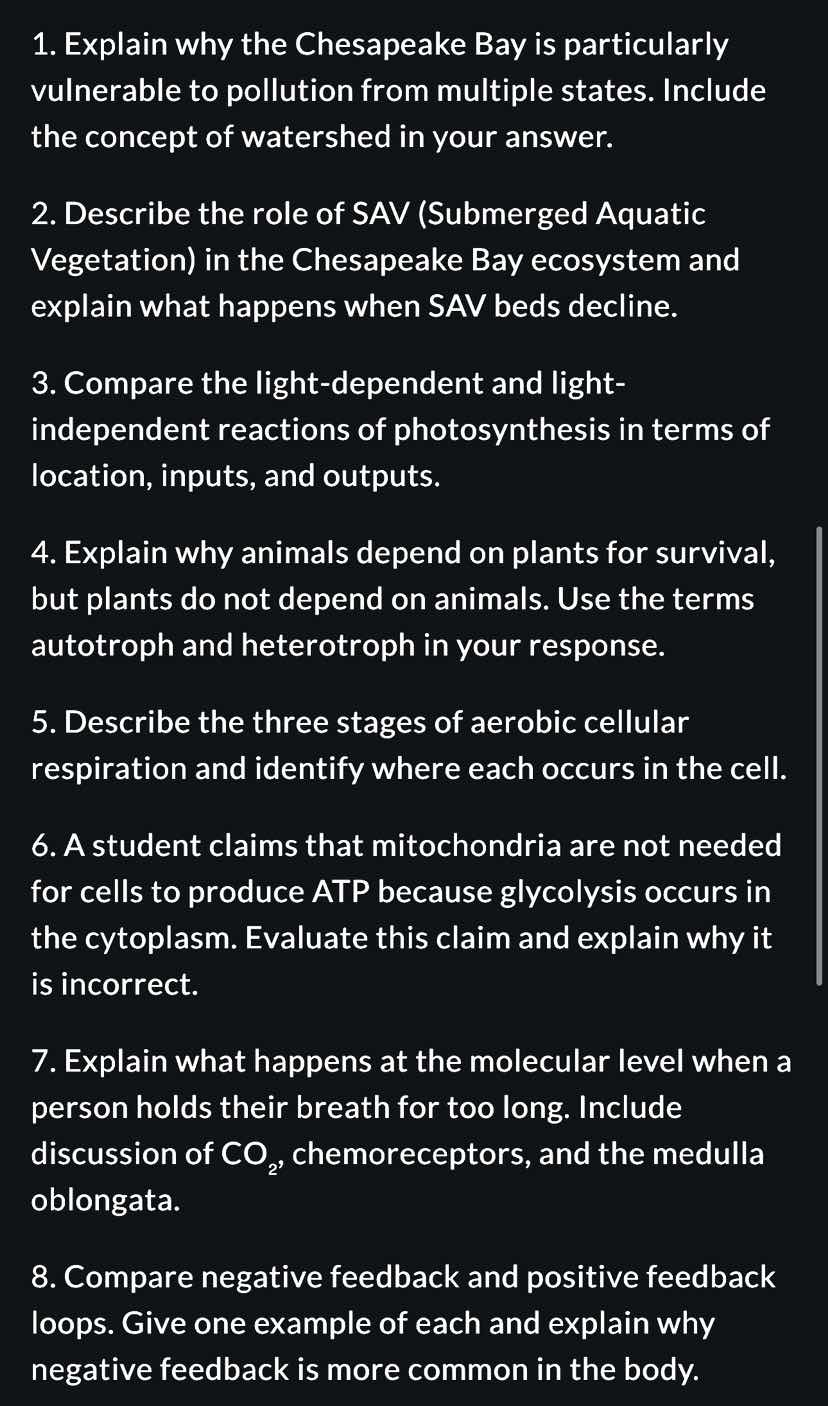
- explain why the chesapeake bay is particularly vulnerable to pollution from multiple states. include the concept of watershed in your answer.
- describe the role of sav (submerged aquatic vegetation) in the chesapeake bay ecosystem and explain what happens when sav beds decline.
- compare the light - dependent and light - independent reactions of photosynthesis in terms of location, inputs, and outputs.
- explain why animals depend on plants for survival, but plants do not depend on animals. use the terms autotroph and heterotroph in your response.
- describe the three stages of aerobic cellular respiration and identify where each occurs in the cell.
- a student claims that mitochondria are not needed for cells to produce atp because glycolysis occurs in the cytoplasm. evaluate this claim and explain why it is incorrect.
- explain what happens at the molecular level when a person holds their breath for too long. include discussion of $\ce{co_{2}}$, chemoreceptors, and the medulla oblongata.
- compare negative feedback and positive feedback loops. give one example of each and explain why negative feedback is more common in the body.
Question 1
The Chesapeake Bay watershed spans multiple states (e.g., VA, MD, PA, WV, DE, NY, DC). A watershed is an area where all water drains to a common body. Pollution (e.g., runoff with nutrients, sediment) from these states’ urban, agricultural, or industrial areas flows via rivers/streams into the Bay. The Bay’s semi - enclosed nature (shallow, slow - flowing) limits water exchange, so pollution accumulates, making it vulnerable to multi - state pollution.
Role of SAV in Chesapeake Bay Ecosystem: SAV (e.g., eelgrass, widgeongrass) provides habitat for fish, shellfish, and invertebrates. It stabilizes sediments (reducing turbidity), absorbs nutrients (reducing eutrophication), and produces oxygen. It also serves as a food source (directly or via detritus).
When SAV Beds Decline: Sediment resuspension increases turbidity, blocking light and further reducing SAV. Nutrient levels rise (less uptake), causing algal blooms. Algae deplete oxygen (hypoxia), harming aquatic life. Habitat loss occurs, reducing biodiversity and fish/shellfish populations.
| Reaction Type | Location | Inputs | Outputs |
|---|---|---|---|
| Light - Independent (Calvin Cycle) | Stroma (chloroplasts) | $CO_2$, ATP, $NADPH$ | Glucose (or other sugars), ADP, $P_i$, $NADP^+$ |
Light - dependent reactions use light to split $H_2O$, make ATP (via photophosphorylation) and $NADPH$ (electron transport), releasing $O_2$. Light - independent reactions (Calvin Cycle) use ATP and $NADPH$ to fix $CO_2$ into glucose, regenerating ADP, $P_i$, and $NADP^+$.

Snap & solve any problem in the app
Get step-by-step solutions on Sovi AI
Photo-based solutions with guided steps
Explore more problems and detailed explanations
The Chesapeake Bay is vulnerable to multi - state pollution because its watershed covers multiple states (VA, MD, PA, WV, DE, NY, DC). A watershed is a land area where all water drains to a common body (the Bay here). Pollution (nutrient - rich runoff, sediment, etc.) from urban, agricultural, or industrial areas in these states flows via rivers/streams into the Bay. The Bay’s semi - enclosed, shallow, and slow - flowing nature restricts water exchange, causing pollution to accumulate.