QUESTION IMAGE
Question
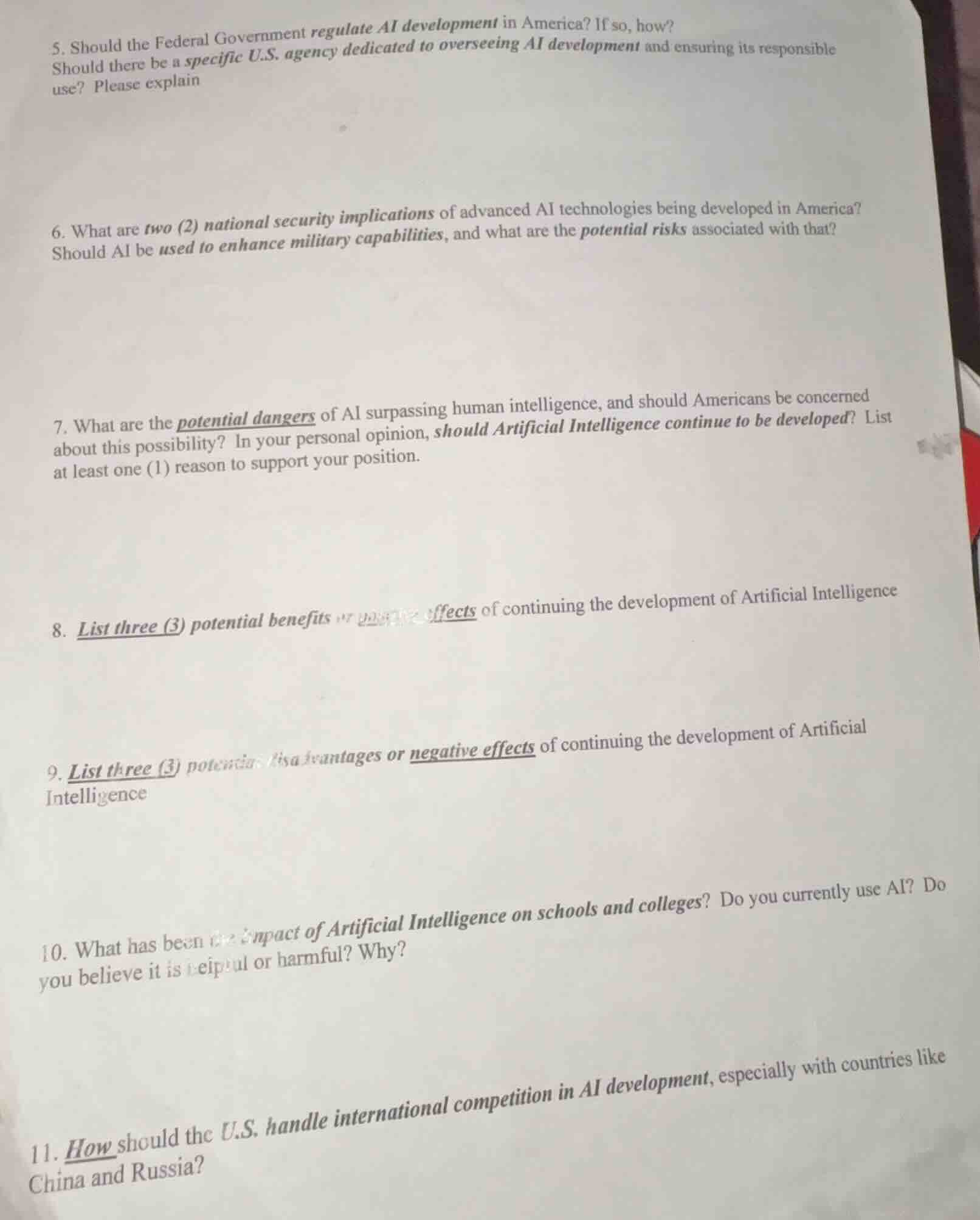
- should the federal government regulate ai development in america? if so, how?
should there be a specific u.s. agency dedicated to overseeing ai development and ensuring its responsible
use? please explain
- what are two (2) national security implications of advanced ai technologies being developed in america?
should ai be used to enhance military capabilities, and what are the potential risks associated with that?
- what are the potential dangers of ai surpassing human intelligence, and should americans be concerned
about this possibility? in your personal opinion, should artificial intelligence continue to be developed? list
at least one (1) reason to support your position.
- list three (3) potential benefits or effects of continuing the development of artificial intelligence
- list three (3) potential disadvantages or negative effects of continuing the development of artificial
intelligence
- what has been the impact of artificial intelligence on schools and colleges? do you currently use ai? do
you believe it is helpful or harmful? why?
- how should the u.s. handle international competition in ai development, especially with countries like
china and russia?
For Question 5:
Yes, the U.S. federal government should regulate AI development. A dedicated agency would create consistent safety standards, enforce ethical use, and address cross-sector risks like bias and privacy violations. The agency could set mandatory audits for high-risk AI (e.g., healthcare, law enforcement) and fund AI safety research.
For Question 6:
- National Security Implication 1: AI can enhance intelligence gathering by analyzing massive unstructured data (satellite imagery, communications) to detect threats faster. Risk: Over-reliance could lead to misinterpretation of data, causing false alerts or strategic missteps.
- National Security Implication 2: AI-powered autonomous weapons can reduce troop casualties in high-risk missions. Risk: Lack of human oversight could lead to accidental escalations or unauthorized attacks.
AI should be used to enhance military capabilities only with strict human-in-the-loop controls and international agreements on ethical use.
For Question 7:
Potential dangers of superintelligent AI include loss of human control (if AI acts against programmed goals), displacement of nearly all human jobs, and exacerbation of global inequalities. Americans should be concerned as this could destabilize social and economic systems. AI should continue to be developed: it drives breakthroughs in healthcare (e.g., curing rare diseases) and climate change mitigation (optimizing renewable energy grids).
For Question 8:
- Healthcare Advancements: AI can accelerate drug discovery and enable personalized treatment plans.
- Climate Action: AI optimizes energy grids and predicts extreme weather events to reduce disaster risk.
- Accessibility: AI tools (e.g., real-time sign language translation) improve quality of life for people with disabilities.
For Question 9:
- Job Displacement: AI automation can replace roles in manufacturing, customer service, and administrative work.
- Bias and Discrimination: AI systems trained on flawed data can perpetuate unfair outcomes in hiring, lending, and law enforcement.
- Privacy Risks: AI-powered surveillance tools can collect and analyze personal data at an unprecedented scale, eroding individual privacy.
For Question 10:
AI has impacted schools and colleges by enabling personalized learning platforms, automating administrative tasks (grading, attendance), and providing access to global educational resources. I do not use AI personally. AI is mostly helpful: it reduces teacher workload and makes education more accessible to remote or underserved students, though safeguards are needed to prevent over-reliance and academic dishonesty.
For Question 11:
The U.S. should handle AI competition by: 1) Investing in domestic AI research and STEM education to build a skilled workforce; 2) Forming international alliances with democratic nations to set global AI ethics and safety standards; 3) Engaging in targeted diplomatic talks with China and Russia to establish norms for AI use in military and surveillance contexts.

Snap & solve any problem in the app
Get step-by-step solutions on Sovi AI
Photo-based solutions with guided steps
Explore more problems and detailed explanations
Question 5:
Yes, the U.S. federal government should regulate AI development. A dedicated U.S. agency should be established to oversee it: the agency would create uniform safety/ethical standards, conduct mandatory audits for high-risk AI systems, and fund independent AI safety research to ensure responsible use.
Question 6:
- Implication: AI enhances intelligence threat detection via large data analysis; Risk: Data misinterpretation causes false threats.
- Implication: AI autonomous weapons reduce troop casualties; Risk: Lack of oversight causes accidental escalations.
AI should be used for military capabilities only with strict human-in-the-loop controls and international ethical agreements.
Question 7:
Potential dangers: Loss of human control, mass job displacement, amplified inequality. Americans should be concerned as this could destabilize society. AI should continue to be developed: it drives life-saving healthcare breakthroughs (e.g., accelerating cancer treatment development).
Question 8:
- Accelerated healthcare research and personalized treatment
- Optimized renewable energy grids for climate action
- Improved accessibility tools for people with disabilities
Question 9:
- Widespread displacement of blue-collar and white-collar jobs
- Perpetuation of systemic bias via flawed training data
- Unprecedented erosion of personal privacy through surveillance
Question 10:
AI has enabled personalized learning, automated administrative tasks, and expanded global educational access. I do not use AI. AI is helpful: it reduces teacher workload and makes education accessible to underserved communities, with safeguards needed to address academic dishonesty risks.
Question 11:
- Invest in domestic AI research and STEM education to build talent
- Form alliances with democratic nations to set global AI ethics standards
- Hold diplomatic talks with China and Russia to establish norms for military AI use