QUESTION IMAGE
Question
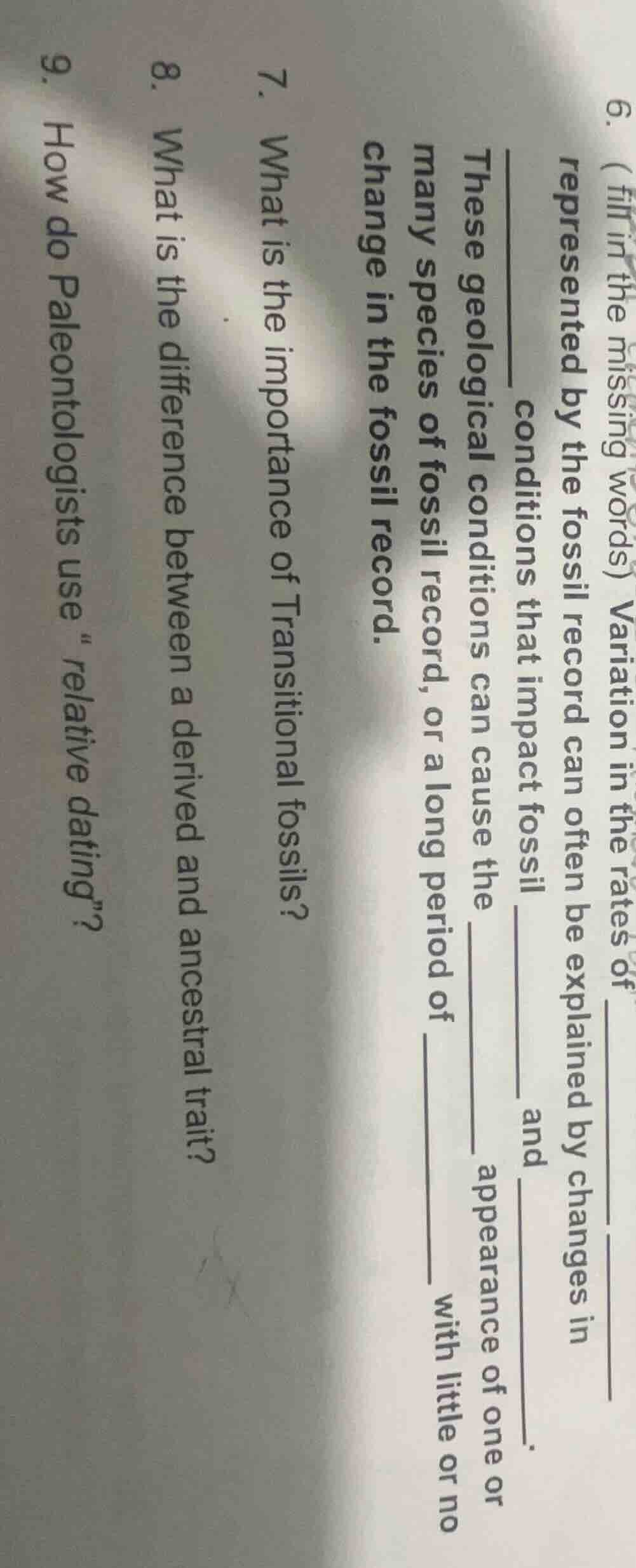
- (fill in the missing words) variation in the rates of __ represented by the fossil record can often be explained by changes in conditions that impact fossil and . these geological conditions can cause the appearance of one or many species of fossil record, or a long period of __ with little or no change in the fossil record.
- what is the importance of transitional fossils?
- what is the difference between a derived and ancestral trait?
- how do paleontologists use \ relative dating\?
Brief Explanations
- This question relates to fossil formation and the fossil record, focusing on factors that affect how fossils preserve and appear over time.
- Transitional fossils document evolutionary links between groups.
- Defines the two key trait types in evolutionary study.
- Explains the core application of this dating method in paleontology.

Snap & solve any problem in the app
Get step-by-step solutions on Sovi AI
Photo-based solutions with guided steps
Explore more problems and detailed explanations
- Variation in the rates of evolutionary change represented by the fossil record can often be explained by changes in environmental conditions that impact fossil preservation and formation. These geological conditions can cause the sudden appearance of one or many species of fossil record, or a long period of stasis with little or no change in the fossil record.
- Transitional fossils are critical because they provide direct physical evidence of evolutionary transitions, showing intermediate traits between ancestral and descendant species, which helps confirm evolutionary relationships and the gradual nature of evolution.
- An ancestral trait is a characteristic inherited from a common ancestor and shared by multiple related species, while a derived trait is a new, modified characteristic that evolved in a specific lineage and is not present in the common ancestor.
- Paleontologists use relative dating to determine the chronological order of fossil-containing rock layers (and thus the fossils within them) by applying principles like superposition (older layers are lower) and cross-cutting relationships, without assigning absolute numerical ages.