QUESTION IMAGE
Question
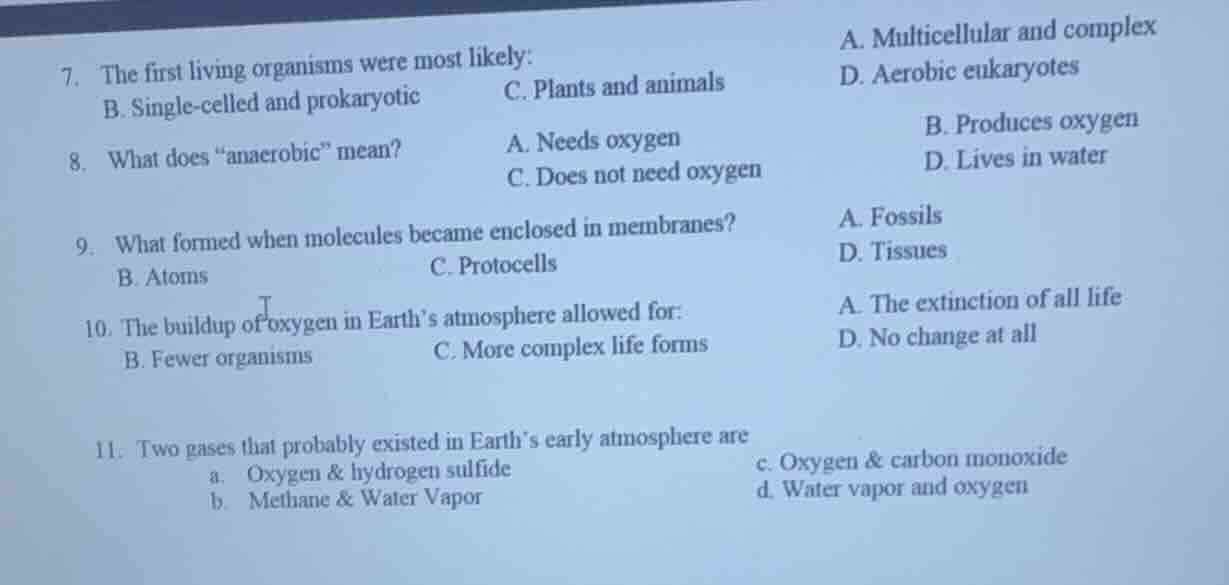
- the first living organisms were most likely:
b. single-celled and prokaryotic c. plants and animals a. multicellular and complex d. aerobic eukaryotes
- what does \anaerobic\ mean? a. needs oxygen b. produces oxygen c. does not need oxygen d. lives in water
- what formed when molecules became enclosed in membranes?
b. atoms c. protocells a. fossils d. tissues
- the buildup of oxygen in earths atmosphere allowed for:
b. fewer organisms c. more complex life forms a. the extinction of all life d. no change at all
- two gases that probably existed in earths early atmosphere are
a. oxygen & hydrogen sulfide c. oxygen & carbon monoxide
b. methane & water vapor d. water vapor and oxygen
Brief Explanations
- The earliest life forms were simple, single-celled organisms without a nucleus (prokaryotes), as complex life evolved much later.
- The prefix "an-" means without, so anaerobic refers to not needing oxygen.
- Protocells are structures where molecules are enclosed in membranes, a key step in the origin of life.
- The rise of atmospheric oxygen allowed for aerobic respiration, which supports more energy-intensive, complex life forms.
- Earth's early atmosphere lacked free oxygen; methane and water vapor are among the gases that are widely accepted to have been present.

Snap & solve any problem in the app
Get step-by-step solutions on Sovi AI
Photo-based solutions with guided steps
Explore more problems and detailed explanations
- B. Single-celled and prokaryotic
- C. Does not need oxygen
- C. Protocells
- C. More complex life forms
- b. Methane & Water Vapor