QUESTION IMAGE
Question
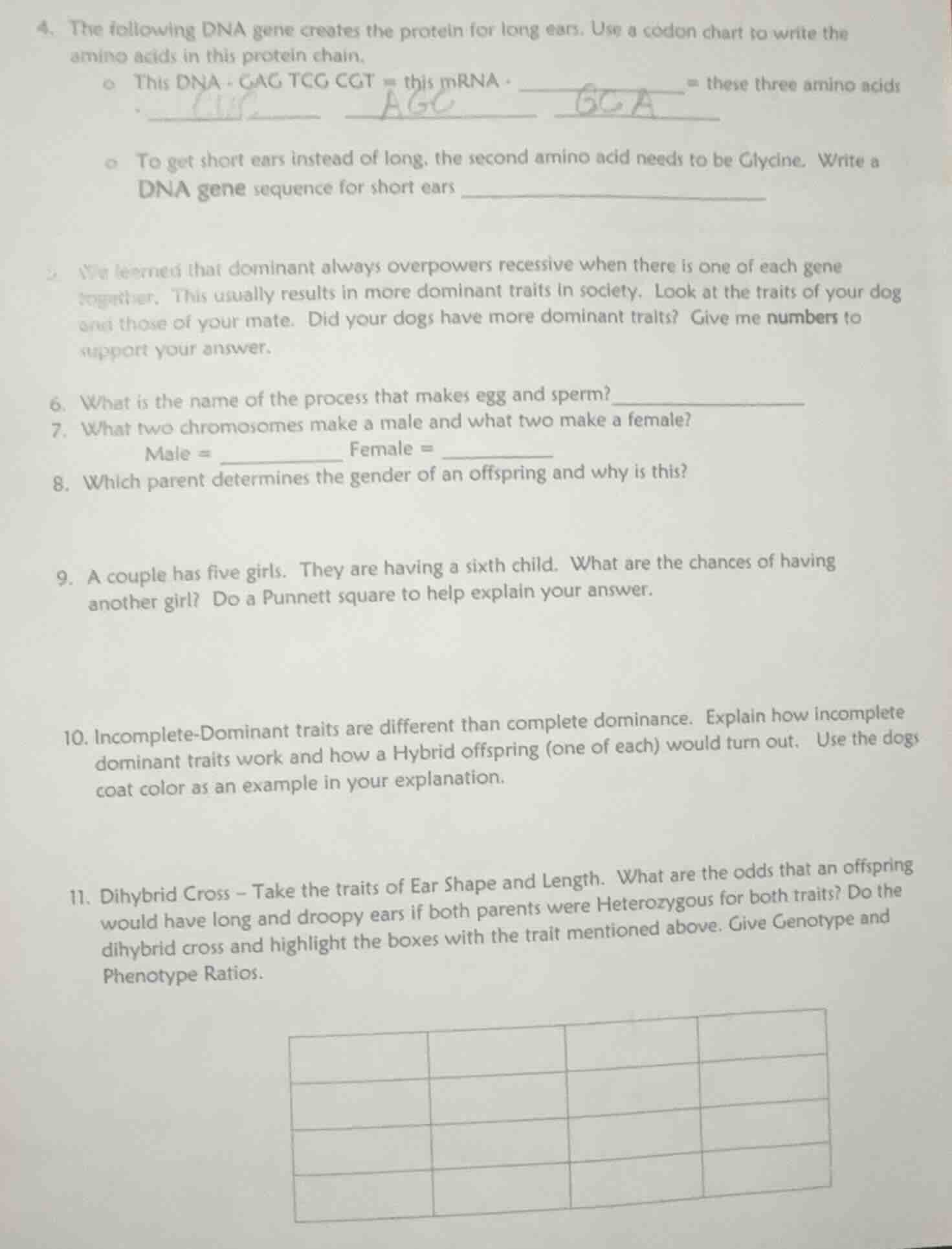
- the following dna gene creates the protein for long ears. use a codon chart to write the amino acids in this protein chain.○ this dna - gag tcg cgt = this mrna ____ = these three amino acids○ to get short ears instead of long, the second amino acid needs to be glycine. write a dna gene sequence for short ears ___________5. we learned that dominant always overpowers recessive when there is one of each gene together. this usually results in more dominant traits in society. look at the traits of your dog and those of your mate. did your dogs have more dominant traits? give me numbers to support your answer.6. what is the name of the process that makes egg and sperm?_______7. what two chromosomes make a male and what two make a female?male = _____ female = _______8. which parent determines the gender of an offspring and why is this?9. a couple has five girls. they are having a sixth child. what are the chances of having another girl? do a punnett square to help explain your answer.10. incomplete-dominant traits are different than complete dominance. explain how incomplete dominant traits work and how a hybrid offspring (one of each) would turn out. use the dogs coat color as an example in your explanation.11. dihybrid cross - take the traits of ear shape and length. what are the odds that an offspring would have long and droopy ears if both parents were heterozygous for both traits? do the dihybrid cross and highlight the boxes with the trait mentioned above. give genotype and phenotype ratios.
Step1: Transcribe DNA to mRNA
DNA: GAG TCG CGT → mRNA: $\text{CUC}$ $\text{AGC}$ $\text{GCA}$ (A→U, T→A, C→G, G→C)
Step2: Find mRNA to amino acids
Use codon chart:
- CUC = Leucine
- AGC = Serine
- GCA = Alanine
Step3: Modify DNA for Glycine
Glycine codons: GGU, GGC, GGA, GGG. Complementary DNA for these: CCA, CCG, CCT, CCC. Replace original TCG with CCG (one valid option). New DNA: GAG CCG CGT
Step6: Identify gamete-making process
Gametes (egg/sperm) form via meiosis.
Step7: Identify sex chromosomes
Male: XY; Female: XX
Step8: Determine gender-determining parent
Father has XY, passes X or Y; mother has XX, only passes X. Father's gamete determines gender.
Step9: Calculate girl probability
Each pregnancy is independent. Punnett square:
| X | Y | |
|---|---|---|
| X | XX (girl) | XY (boy) |
Probability = $\frac{2}{4} = 50\%$
Step10: Explain incomplete dominance
In incomplete dominance, neither allele is fully dominant; hybrid shows blended trait. Example: Dog coat color - black (BB) × white (WW) → hybrid (BW) has gray coat (blend of black and white).
Step11: Dihybrid cross setup
Let:
- Long ears (L) dominant, short (l); Droopy ears (D) dominant, erect (d)
Parents: LlDd × LlDd. Gametes: LD, Ld, lD, ld
Punnett square:
| LD | Ld | lD | ld | |
|---|---|---|---|---|
| Ld | LLDd (long, droopy) | LLdd (long, erect) | LlDd (long, droopy) | Lldd (long, erect) |
| lD | LlDD (long, droopy) | LlDd (long, droopy) | llDD (short, droopy) | llDd (short, droopy) |
| ld | LlDd (long, droopy) | Lldd (long, erect) | llDd (short, droopy) | lldd (short, erect) |
Count long, droopy: 9 out of 16.
Genotype ratio: 1:2:1:2:4:2:1:2:1 (LLDD:LLDd:LLdd:LlDD:LlDd:Lldd:llDD:llDd:lldd)
Phenotype ratio: 9 (long,droopy):3 (long,erect):3 (short,droopy):1 (short,erect)
Step5: (Note: This question requires personal dog trait data, which is not provided. A sample answer could be: My dog has 4 dominant traits (floppy ears, curly fur, brown eyes, large size) and 2 recessive traits; my mate's dog has 3 dominant traits and 3 recessive traits. My dog has more dominant traits.)

Snap & solve any problem in the app
Get step-by-step solutions on Sovi AI
Photo-based solutions with guided steps
Explore more problems and detailed explanations
- mRNA: CUC AGC GCA; Amino acids: Leucine, Serine, Alanine
- Short ears DNA sequence: GAG CCG CGT (one valid option)
- Question 5 (sample): My dog has 4 dominant traits, 2 recessive; mate's dog has 3 dominant, 3 recessive. My dog has more dominant traits.
- Question 6: Meiosis
- Question 7: Male = XY; Female = XX
- Question 8: The father determines gender. The mother only passes an X chromosome, while the father can pass either an X (resulting in a female offspring, XX) or a Y (resulting in a male offspring, XY).
- Question 9: 50% chance. Each pregnancy is independent, and the Punnett square shows 2 out of 4 possible combinations result in a female (XX).
- Question 10: In incomplete dominance, neither allele is fully dominant, so heterozygous (hybrid) offspring show a blended trait that is a mix of the two parent traits. For dog coat color: if a pure black dog (BB) breeds with a pure white dog (WW), the hybrid (BW) offspring will have a gray coat, which is a blend of black and white, rather than showing one of the parent's full coat colors.
- Question 11: Odds of long and droopy ears: 9 out of 16.
Genotype Ratio: 1 LLDD : 2 LLDd : 1 LLdd : 2 LlDD : 4 LlDd : 2 Lldd : 1 llDD : 2 llDd : 1 lldd
Phenotype Ratio: 9 long, droopy : 3 long, erect : 3 short, droopy : 1 short, erect
(Highlighted cells in the Punnett square are: LLDD, LLDd, LlDD, LlDd (all top row, first three cells of second row, first two cells of third row, first cell of fourth row))