QUESTION IMAGE
Question
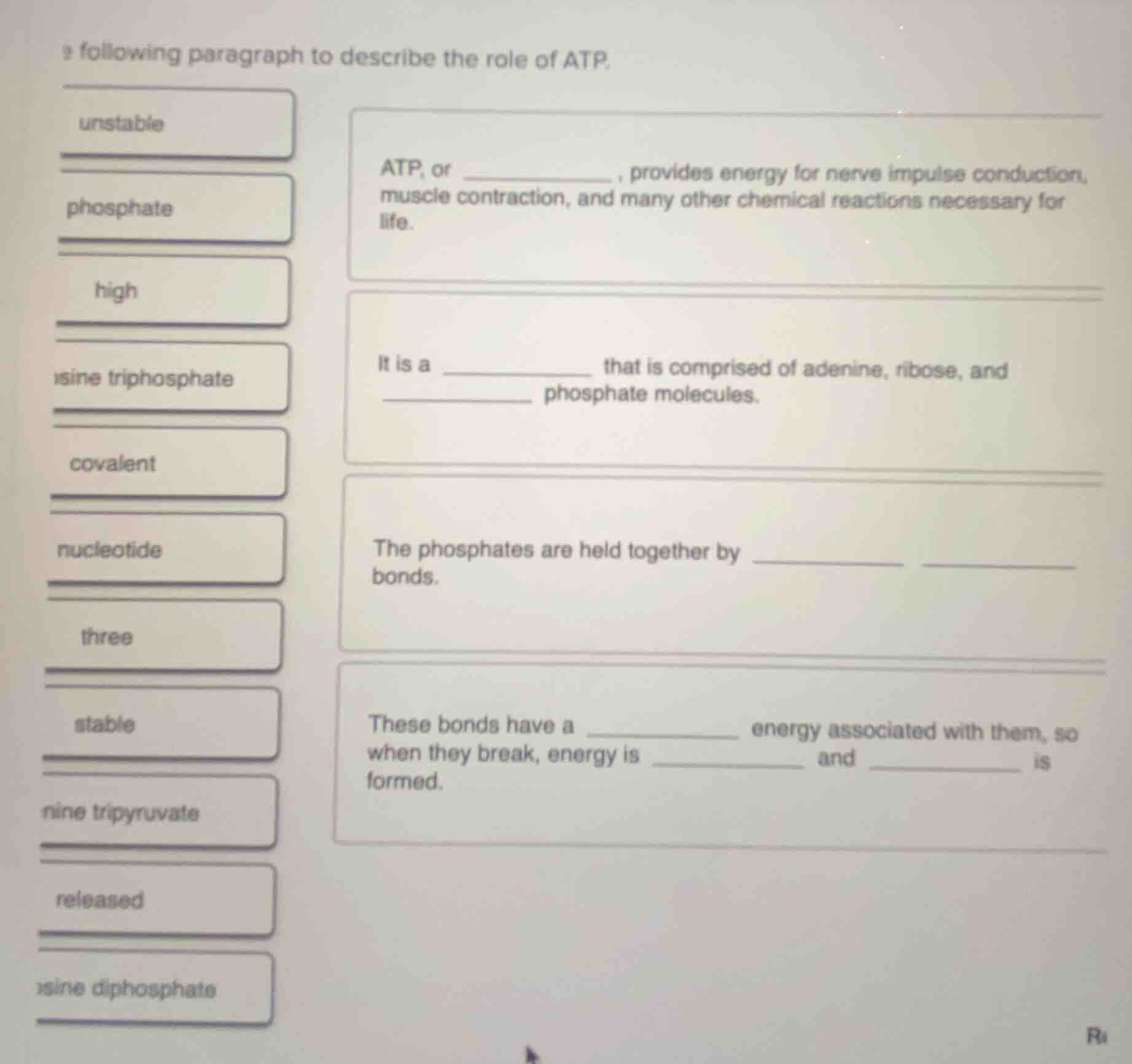
following paragraph to describe the role of atp.
atp, or __________, provides energy for nerve impulse conduction, muscle contraction, and many other chemical reactions necessary for life.
it is a ________ that is comprised of adenine, ribose, and ________ phosphate molecules.
the phosphates are held together by ________ ________ bonds.
these bonds have a ________ energy associated with them, so when they break, energy is ______ and ________ is formed.
options (from left column):
unstable
phosphate
high
sine triphosphate
covalent
nucleotide
three
stable
nine tripyruvate
released
sine diphosphate
- First blank: ATP stands for Adenosine Triphosphate, so we choose "adenosine triphosphate".
- Second blank: ATP is a nucleotide (a type of molecule), so we choose "nucleotide".
- Third blank: ATP has three phosphate groups, so we choose "three".
- Fourth and fifth blanks: The bonds between phosphates in ATP are high - energy covalent bonds, so we choose "high" and "covalent" (in order).
- Sixth blank: The bonds in ATP are unstable (high - energy bonds are unstable), so we choose "unstable".
- Seventh blank: When these bonds break, energy is released, so we choose "released".
- Eighth blank: When ATP loses a phosphate, ADP (Adenosine Diphosphate) is formed, but looking at the word bank, we have "adenosine diphosphate" is not there, wait, no, when ATP's high - energy bond breaks, usually ADP is formed, but from the word bank, the relevant one for the product after energy release (when a phosphate is removed) - wait, the last blank: when the bond breaks (a phosphate is removed), ATP becomes ADP? No, the word bank has "adenosine diphosphate" no, wait the word bank has "adenosine triphosphate", "phosphate", "high", "covalent", "nucleotide", "three", "stable", "unstable", "released". Wait, maybe I made a mistake. Wait, when ATP hydrolyzes, it becomes ADP (Adenosine Diphosphate) and a phosphate group. But the word bank has "adenosine diphosphate" no, wait the original word bank (from the image) - let's re - check. The word bank has: unstable, phosphate, high, adenosine triphosphate, covalent, nucleotide, three, stable, nine tripyruvate, released, adenosine diphosphate. Wait, so after the bond breaks (a phosphate is removed), ATP (adenosine triphosphate) becomes ADP (adenosine diphosphate) and a phosphate. But in the last blank, the sentence is "when they break, energy is released and ____ is formed." So when a phosphate bond in ATP breaks, ADP (adenosine diphosphate) is formed? But the word bank has "adenosine diphosphate" as an option? Wait the user's image: the left - hand side word bank (after "three"): stable, nine tripyruvate, released, adenosine diphosphate. Oh right! So the last blank: when the bond breaks, ATP loses a phosphate, so adenosine diphosphate (ADP) is formed. But wait, the sentence structure: "when they break, energy is released and ____ is formed." So the answer for the last blank is "adenosine diphosphate"? Wait no, maybe I messed up. Wait, let's do step by step again:
First sentence: "ATP, or adenosine triphosphate, provides energy...".
Second sentence: "It is a nucleotide that is comprised of adenine, ribose, and three phosphate molecules."
Third sentence: "The phosphates are held together by high covalent bonds." (Wait, no: the bonds between phosphates in ATP are high - energy covalent bonds, so "high" and "covalent" in order for the two blanks here: "The phosphates are held together by high covalent bonds."
Fourth sentence: "These bonds have a high energy associated with them, so when they break, energy is released and unstable... Wait no, the sentence: "These bonds have a high energy associated with them, so when they break, energy is released and adenosine diphosphate is formed." Wait, no, when ATP's terminal phosphate bond breaks, ATP becomes ADP (adenosine diphosphate) and a phosphate. So the last blank: "adenosine diphosphate". But let's check the word bank again. The word bank includes "adenosine diphosphate" as an option (the last one in the left - hand list).
Wait, let's correct the steps:
- First blank: ATP is adenosine triphosphate, so "adenosine triphosphate".
- Second blank: ATP is a…

Snap & solve any problem in the app
Get step-by-step solutions on Sovi AI
Photo-based solutions with guided steps
Explore more problems and detailed explanations
- ATP, or \boxed{adenosine triphosphate}, provides energy for nerve impulse conduction, muscle contraction, and many other chemical reactions necessary for life.
- It is a \boxed{nucleotide} that is comprised of adenine, ribose, and \boxed{three} phosphate molecules.
- The phosphates are held together by \boxed{high} \boxed{covalent} bonds.
- These bonds have a \boxed{unstable} energy associated with them, so when they break, energy is \boxed{released} and \boxed{adenosine diphosphate} is formed.