QUESTION IMAGE
Question
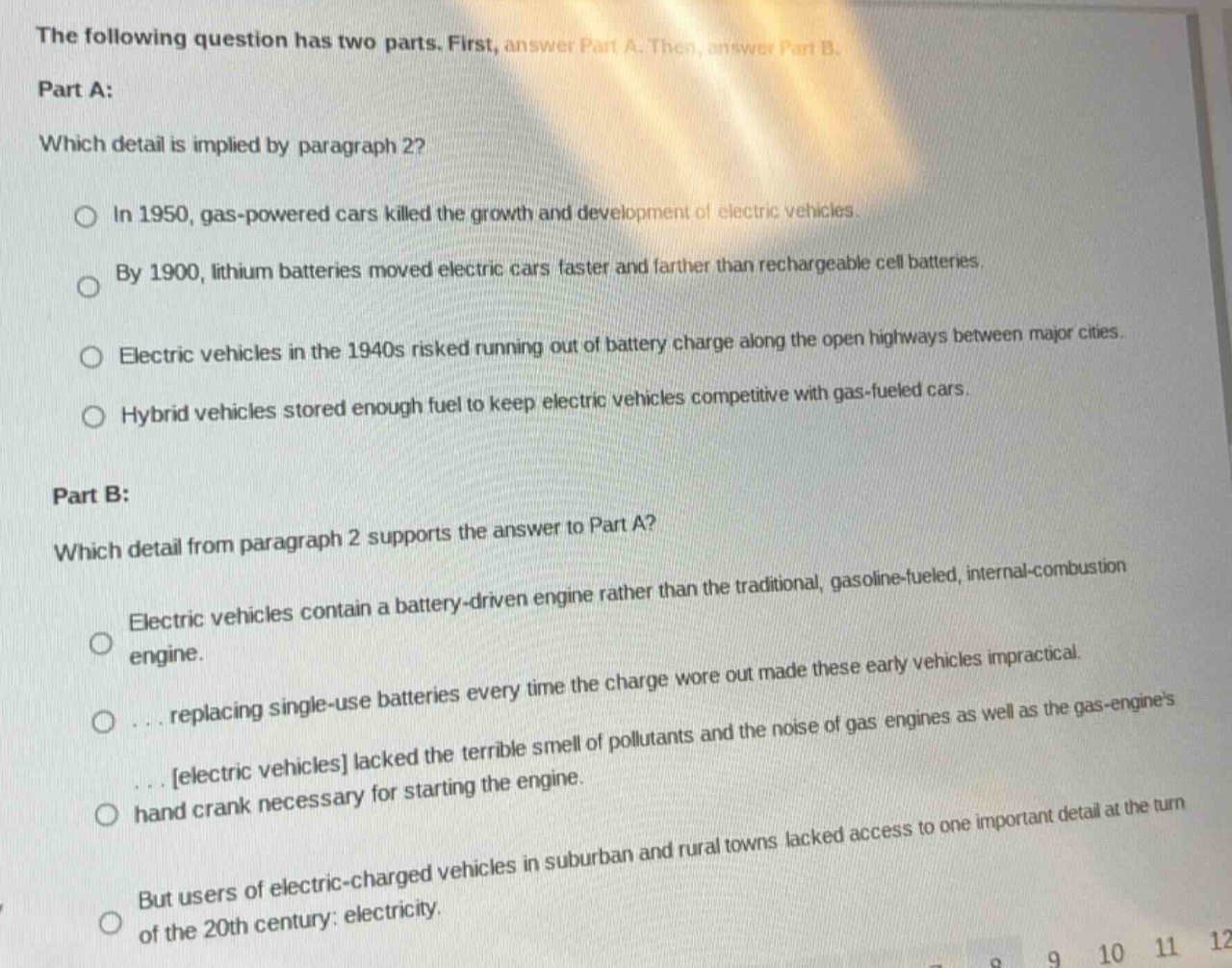
the following question has two parts. first, answer part a. then, answer part b.
part a:
which detail is implied by paragraph 2?
in 1950, gas - powered cars killed the growth and development of electric vehicles.
by 1900, lithium batteries moved electric cars faster and farther than rechargeable cell batteries.
electric vehicles in the 1940s risked running out of battery charge along the open highways between major cities.
hybrid vehicles stored enough fuel to keep electric vehicles competitive with gas - fueled cars.
part b:
which detail from paragraph 2 supports the answer to part a?
electric vehicles contain a battery - driven engine rather than the traditional, gasoline - fueled, internal - combustion engine.
... replacing single - use batteries every time the charge wore out made these early vehicles impractical.
... electric vehicles lacked the terrible smell of pollutants and the noise of gas engines as well as the gas - engines hand crank necessary for starting the engine.
but users of electric - charged vehicles in suburban and rural towns lacked access to one important detail at the turn of the 20th century: electricity.
Part A
To solve this, we analyze each option:
- Option 1: The statement about 1950 gas - powered cars killing electric vehicle growth is not implied (no info on 1950 impact).
- Option 2: Lithium batteries were not around by 1900 (lithium - ion batteries are a modern development), so this is incorrect.
- Option 3: In the 1940s, electric vehicles had limited battery range, so on open highways between cities, they risked running out of charge. This is a reasonable implication.
- Option 4: Hybrid vehicles' role in keeping electric vehicles competitive is not implied.
We need to find the detail that supports the answer in Part A (about electric vehicles in the 1940s risking battery depletion on highways). The option "But users of electric - charged vehicles in suburban and rural towns lacked access to one important detail at the turn of the 20th century: electricity" shows the infrastructure (electricity access) issue, which relates to the battery range problem (since without easy access to charge, running out of charge on highways is a risk). Other options talk about different aspects (battery type replacement, advantages over gas engines, engine type) not related to the battery range/running out of charge issue.

Snap & solve any problem in the app
Get step-by-step solutions on Sovi AI
Photo-based solutions with guided steps
Explore more problems and detailed explanations
Electric vehicles in the 1940s risked running out of battery charge along the open highways between major cities.