QUESTION IMAGE
Question
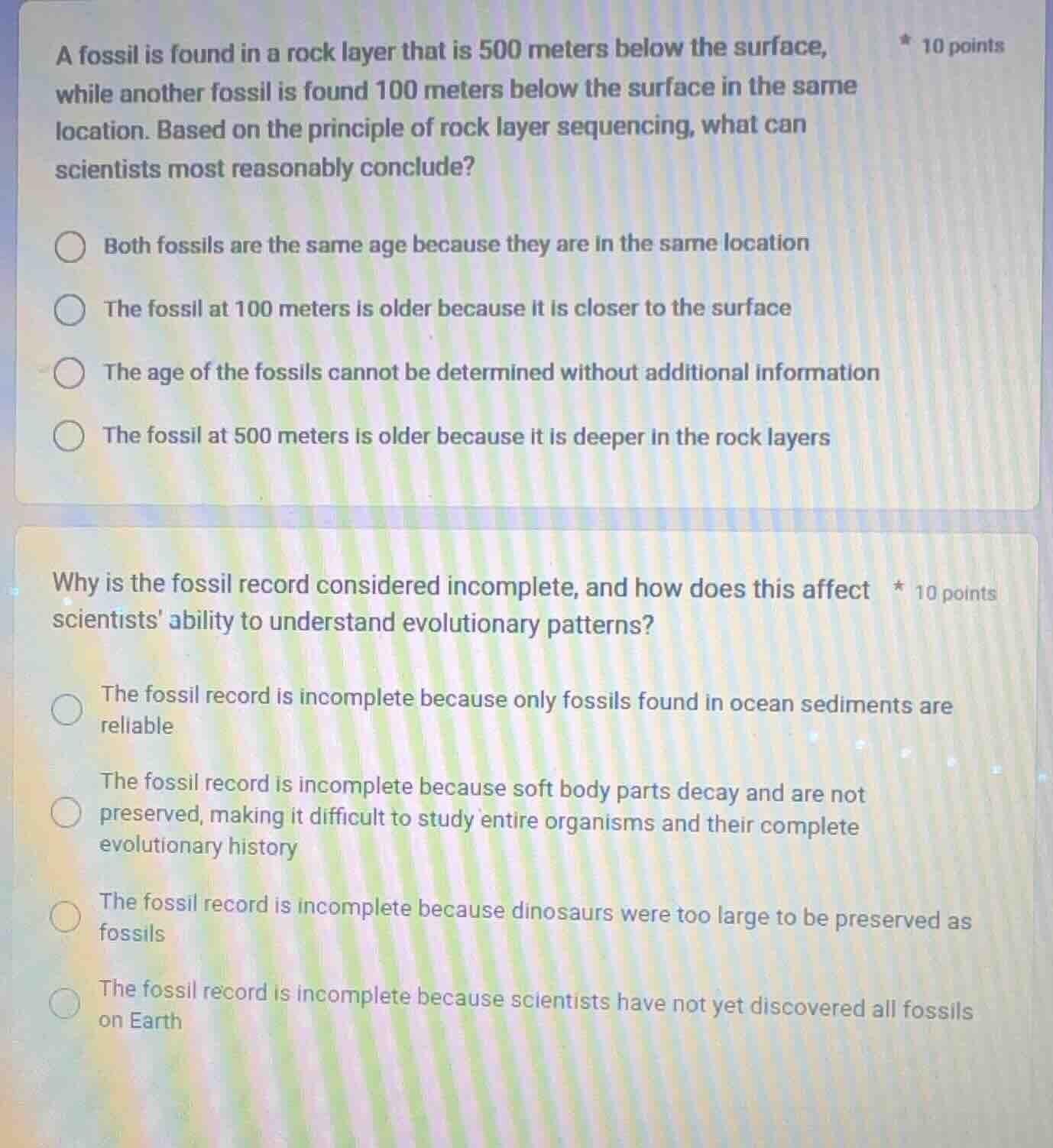
- a fossil is found in a rock layer that is 500 meters below the surface, while another fossil is found 100 meters below the surface in the same location. based on the principle of rock layer sequencing, what can scientists most reasonably conclude? 10 points○ both fossils are the same age because they are in the same location○ the fossil at 100 meters is older because it is closer to the surface○ the age of the fossils cannot be determined without additional information○ the fossil at 500 meters is older because it is deeper in the rock layers2. why is the fossil record considered incomplete, and how does this affect scientists ability to understand evolutionary patterns? 10 points○ the fossil record is incomplete because only fossils found in ocean sediments are reliable○ the fossil record is incomplete because soft body parts decay and are not preserved, making it difficult to study entire organisms and their complete evolutionary history○ the fossil record is incomplete because dinosaurs were too large to be preserved as fossils○ the fossil record is incomplete because scientists have not yet discovered all fossils on earth
Brief Explanations
For the first question: The principle of superposition (rock layer sequencing) states that in undisturbed rock layers, deeper layers are older, so the fossil in the deeper layer is older.
For the second question: The fossil record is incomplete primarily because soft body parts decay quickly and do not fossilize, leaving gaps in understanding full evolutionary histories of organisms.

Snap & solve any problem in the app
Get step-by-step solutions on Sovi AI
Photo-based solutions with guided steps
Explore more problems and detailed explanations
- The fossil at 500 meters is older because it is deeper in the rock layers
- The fossil record is incomplete because soft body parts decay and are not preserved, making it difficult to study entire organisms and their complete evolutionary history