QUESTION IMAGE
Question
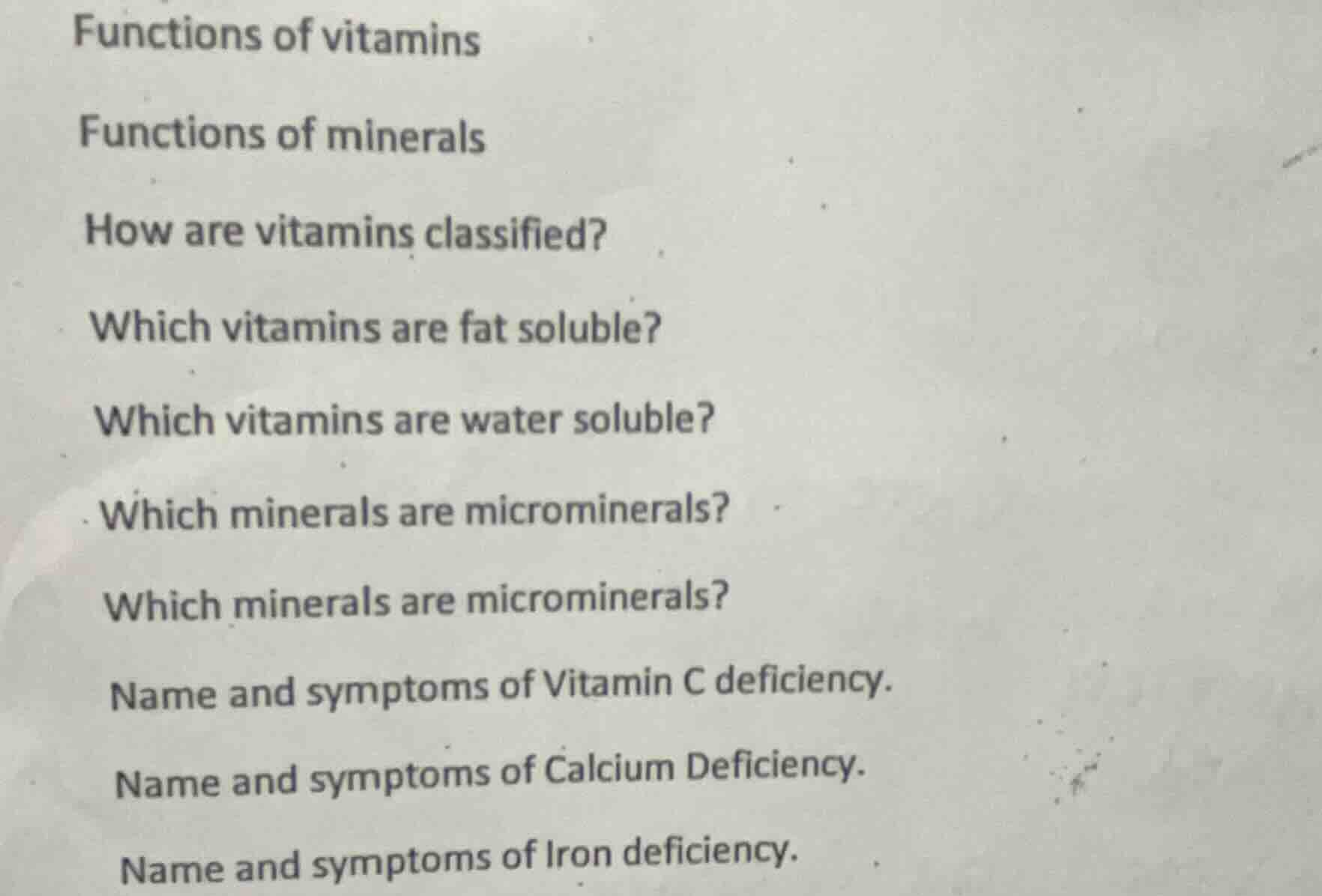
functions of vitamins
functions of minerals
how are vitamins classified?
which vitamins are fat soluble?
which vitamins are water soluble?
which minerals are microminerals?
which minerals are microminerals?
name and symptoms of vitamin c deficiency.
name and symptoms of calcium deficiency.
name and symptoms of iron deficiency.
Since the problem here is to answer these questions related to vitamins and minerals, which fall under the Natural Science discipline, specifically Biology (or Medicine and Health as a subfield). Let's take one of the questions, say "How are vitamins classified?" and answer it.
Vitamins are classified based on their solubility. They are divided into two main categories: fat - soluble vitamins and water - soluble vitamins. Fat - soluble vitamins (like A, D, E, K) dissolve in fat and are stored in the body's fatty tissues and liver. Water - soluble vitamins (like B - complex vitamins and vitamin C) dissolve in water and are not stored in large amounts in the body, so they need to be consumed regularly.
Fat - soluble vitamins are those that can dissolve in fat. The main fat - soluble vitamins are Vitamin A, Vitamin D, Vitamin E, and Vitamin K. These vitamins are absorbed along with dietary fats and can be stored in the body's adipose tissue and liver.
Water - soluble vitamins dissolve in water. The B - complex vitamins (such as thiamin, riboflavin, niacin, vitamin B6, folate, vitamin B12, biotin, pantothenic acid) and Vitamin C are water - soluble. They are not stored in large quantities in the body and are excreted in urine when consumed in excess.

Snap & solve any problem in the app
Get step-by-step solutions on Sovi AI
Photo-based solutions with guided steps
Explore more problems and detailed explanations
Vitamins are classified based on solubility into fat - soluble (e.g., A, D, E, K) and water - soluble (e.g., B - complex, C) vitamins.
For the question "Which vitamins are fat soluble?":