QUESTION IMAGE
Question
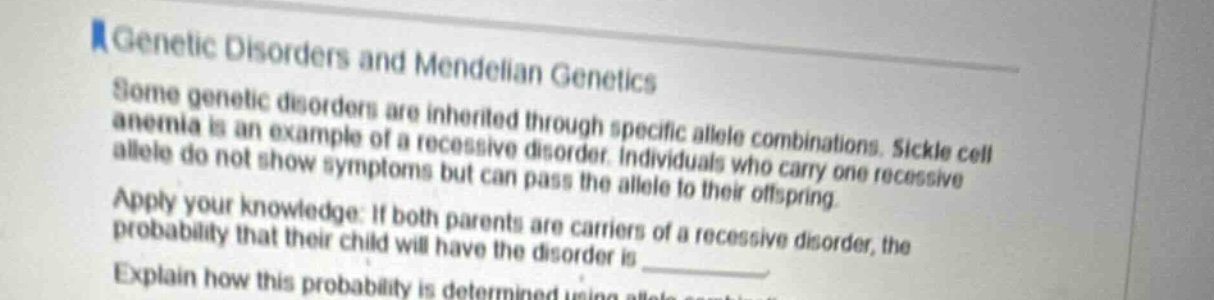
genetic disorders and mendelian genetics
some genetic disorders are inherited through specific allele combinations. sickle cell anemia is an example of a recessive disorder. individuals who carry one recessive allele do not show symptoms but can pass the allele to their offspring.
apply your knowledge: if both parents are carriers of a recessive disorder, the probability that their child will have the disorder is ________
explain how this probability is determined using allele
Step1: Define parental genotypes
Both parents are carriers, so their genotypes are $Aa$ (where $A$ = dominant normal allele, $a$ = recessive disorder allele).
Step2: Set up Punnett square
Create a Punnett square for the cross $Aa \times Aa$:
Step3: Count disorder genotypes
Identify the genotype that causes the disorder: $aa$. There is 1 such genotype out of 4 total possible combinations.
Step4: Calculate probability
Probability = $\frac{\text{Number of disorder genotypes}}{\text{Total genotypes}}$ = $\frac{1}{4}$

Snap & solve any problem in the app
Get step-by-step solutions on Sovi AI
Photo-based solutions with guided steps
Explore more problems and detailed explanations
The probability that their child will have the disorder is $\frac{1}{4}$ (or 25%).
To explain: Each parent can pass either the dominant normal allele ($A$) or the recessive disorder allele ($a$) to their offspring. Using a Punnett square to map all possible allele combinations from the carrier parents ($Aa \times Aa$), only the combination where the child inherits two recessive alleles ($aa$) results in the disorder. This combination occurs in 1 out of 4 total possible genetic outcomes, giving a 25% probability.