QUESTION IMAGE
Question
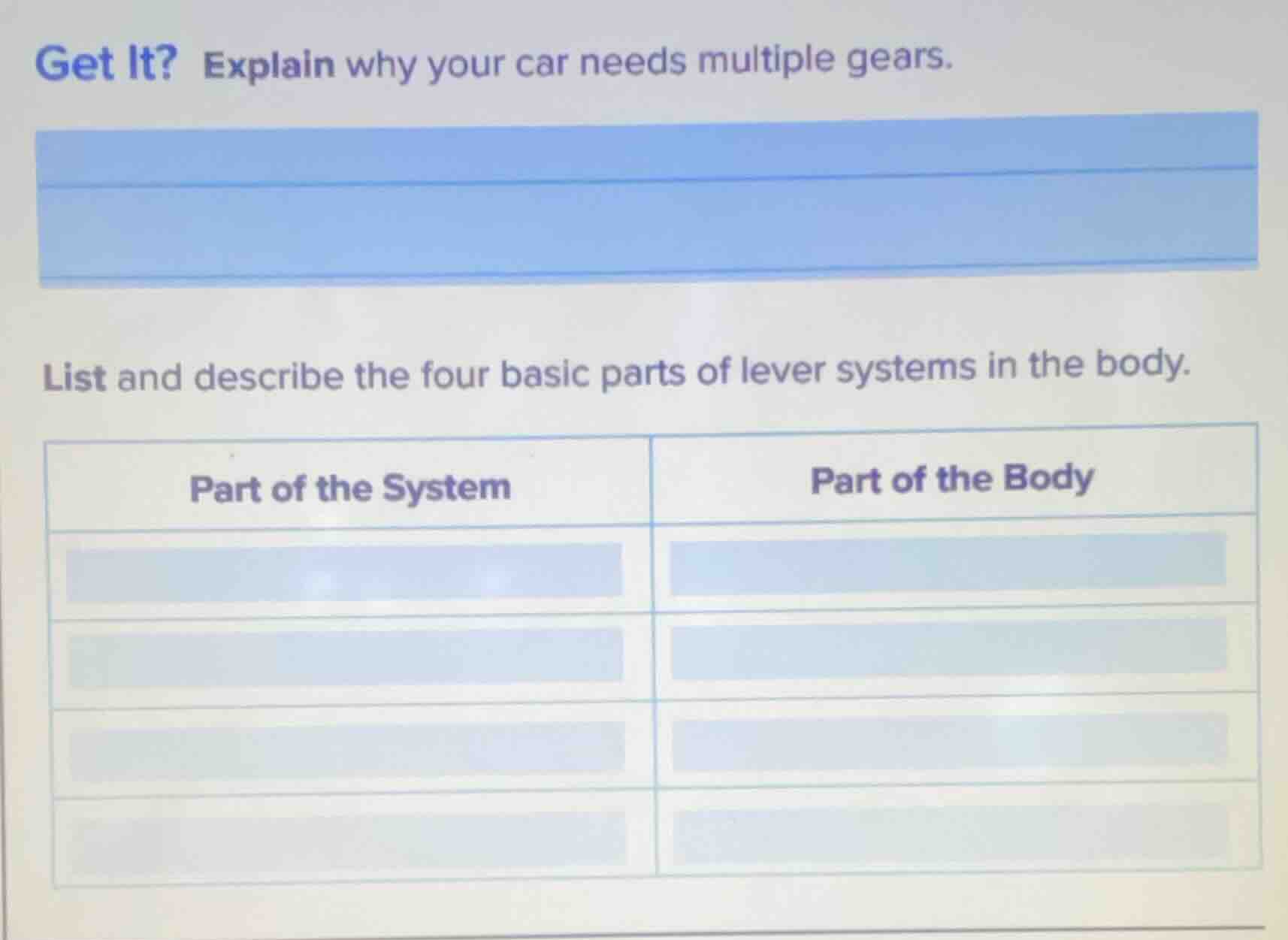
get it? explain why your car needs multiple gears.
list and describe the four basic parts of lever systems in the body.
part of the system | part of the body
First Sub - Question: Explain why your car needs multiple gears.
Cars need multiple gears to optimize power and speed. Lower gears (e.g., 1st, 2nd) provide more torque (rotational force) for tasks like starting from a stop or climbing hills, as they multiply the engine's torque. Higher gears (e.g., 3rd, 4th, 5th or more) allow the car to achieve higher speeds with less engine RPM (revolutions per minute), which improves fuel efficiency and reduces engine wear. Different driving situations (city driving with stops, highway driving) require different gear ratios to balance power, speed, and efficiency.
- Effort (Force) Application Point: In the body, this is where the muscle exerts force. For example, in the bicep - forearm lever system, the bicep muscle attaches to the radius (a bone in the forearm) and exerts a force to lift the forearm.
- Resistance (Load) Application Point: This is where the weight or resistance is applied. In the bicep - forearm example, the resistance could be the weight of the hand or an object held in the hand, acting at the hand (distal end of the forearm).
- Fulcrum (Axis of Rotation): In the body, this is a joint. For the bicep - forearm lever, the elbow joint is the fulcrum around which the forearm rotates.
- Lever Arm (Rigid Bar): In the body, bones act as the lever arms. In the bicep - forearm system, the forearm (radius and ulna) acts as the lever arm that rotates around the elbow (fulcrum) when the bicep (effort) contracts and lifts the hand (resistance).
We can summarize this in a table:
| Part of the System | Part of the Body |
|---|---|
| Resistance (Load) Application Point | Point where weight/resistance acts (e.g., hand in bicep - forearm lever) |
| Fulcrum (Axis of Rotation) | Joint (e.g., elbow joint) |
| Lever Arm (Rigid Bar) | Bone (e.g., forearm bones - radius, ulna) |

Snap & solve any problem in the app
Get step-by-step solutions on Sovi AI
Photo-based solutions with guided steps
Explore more problems and detailed explanations
Cars need multiple gears to balance power, speed, and efficiency. Lower gears provide high torque for starting/climbing, while higher gears enable high - speed, fuel - efficient driving by reducing engine RPM. They adapt to different driving situations (e.g., city vs. highway driving).