QUESTION IMAGE
Question
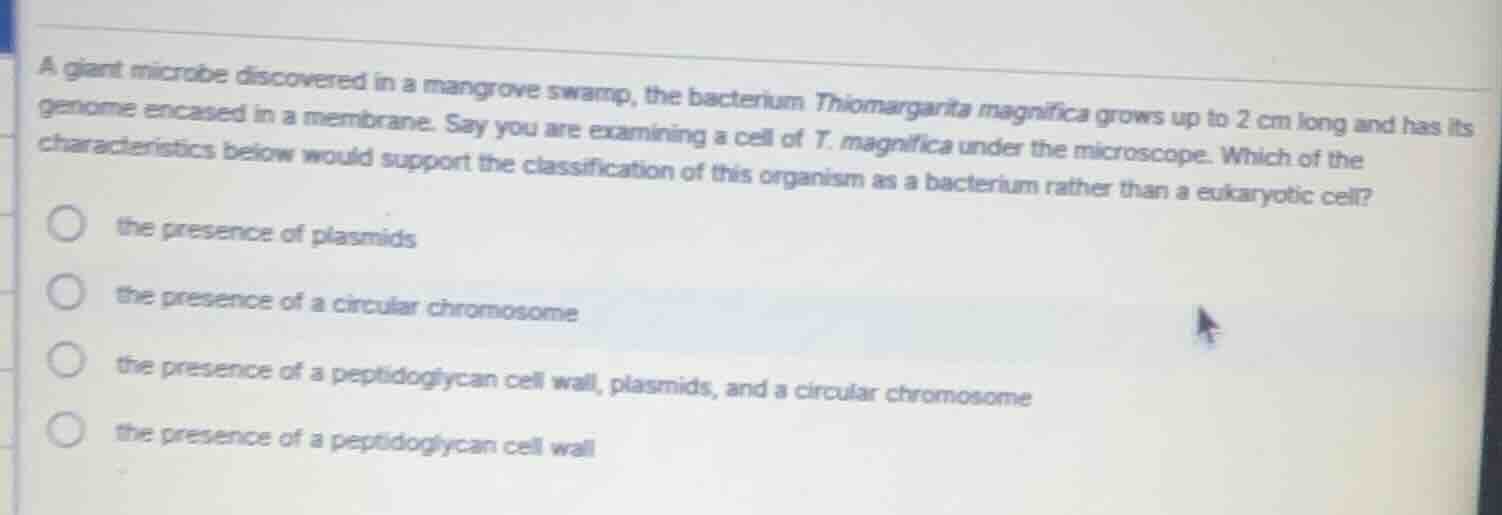
a giant microbe discovered in a mangrove swamp, the bacterium thiomargarita magnifica grows up to 2 cm long and has its genome encased in a membrane. say you are examining a cell of t. magnifica under the microscope. which of the characteristics below would support the classification of this organism as a bacterium rather than a eukaryotic cell?
- the presence of plasmids
- the presence of a circular chromosome
- the presence of a peptidoglycan cell wall, plasmids, and a circular chromosome
- the presence of a peptidoglycan cell wall
Brief Explanations
To determine which characteristic supports classifying \( T. magnifica \) as a bacterium (prokaryote) rather than a eukaryote:
- Plasmids: Some eukaryotes (e.g., yeast) can have plasmids, so this alone is not unique to bacteria.
- Circular chromosome: Some eukaryotic organelles (e.g., mitochondria) have circular DNA, so this alone is not definitive.
- Peptidoglycan cell wall: Bacteria have peptidoglycan cell walls, while eukaryotes (plants/fungi have different cell wall components, animals have none). However, combining peptidoglycan, plasmids, and circular chromosome (all prokaryotic traits) is more conclusive.
- The option with peptidoglycan, plasmids, and circular chromosome includes all key prokaryotic features, distinguishing it from eukaryotes.

Snap & solve any problem in the app
Get step-by-step solutions on Sovi AI
Photo-based solutions with guided steps
Explore more problems and detailed explanations
the presence of a peptidoglycan cell wall, plasmids, and a circular chromosome