QUESTION IMAGE
Question
grammar passage
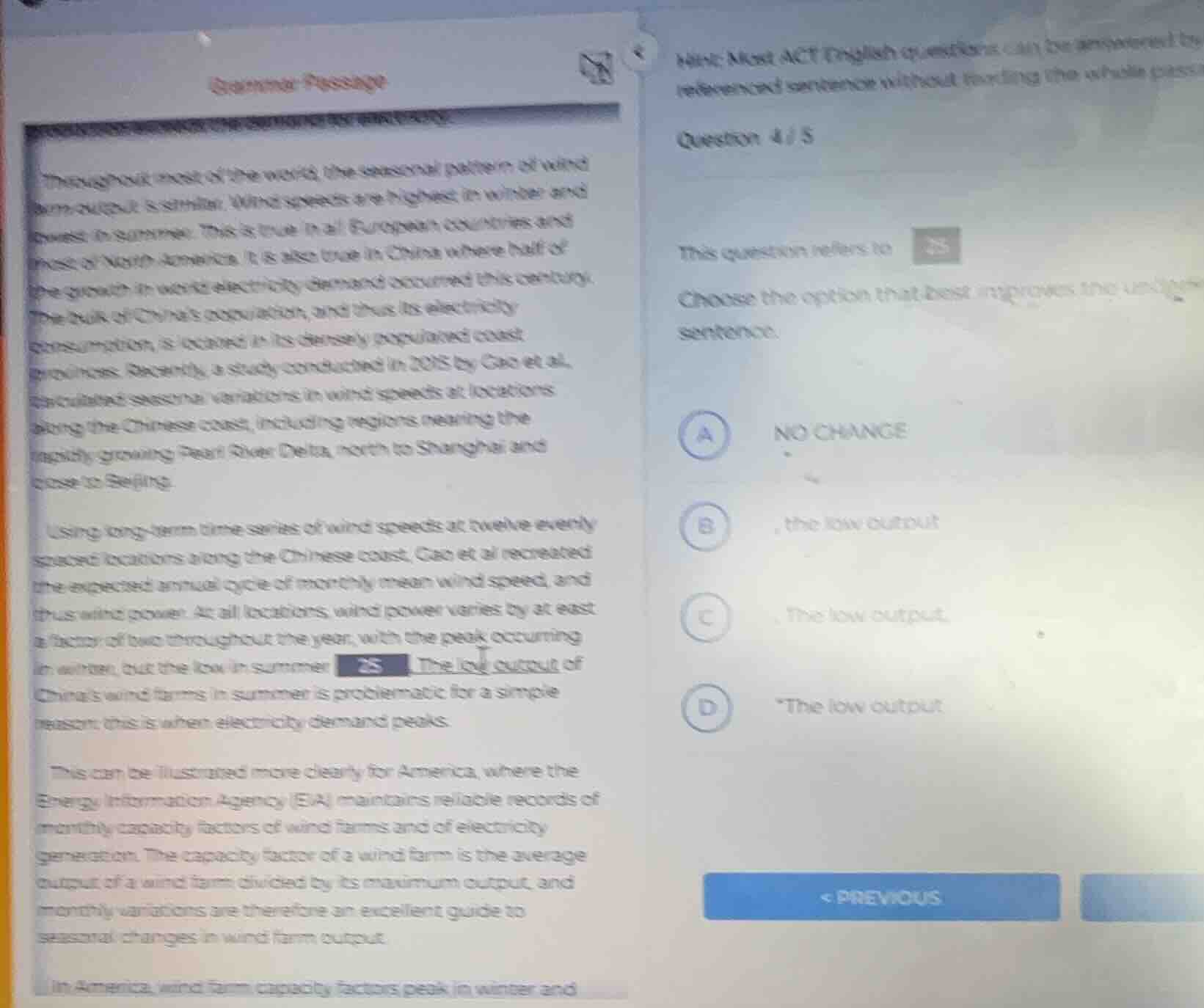
throughout most of the world, the seasonal pattern of wind farm output is similar. wind speeds are highest in winter and lowest in summer. this is true in all european countries and most of north america. it is also true in china where half of the growth in world electricity demand occurred this century. the bulk of china’s population, and thus its electricity consumption, is located in its densely populated coastal provinces. recently, a study conducted in 2015 by cao et al. calculated seasonal variations in wind speeds at locations along the chinese coast, including regions near the rapidly growing pearl river delta, north to shanghai and close to beijing.
using long - term time series of wind speeds at twelve evenly spaced locations along the chinese coast, cao et al recreated the expected annual cycle of monthly mean wind speed, and thus wind power. at all locations, wind power varies by at least a factor of two throughout the year, with the peak occurring in winter, and the low in summer 25. the low output of china’s wind farms in summer is problematic for a simple reason: this is when electricity demand peaks.
this can be illustrated more clearly for america, where the energy information agency (eia) maintains reliable records of monthly capacity factors of wind farms and of electricity generation. the capacity factor of a wind farm is the average output of a wind farm divided by its maximum output, and monthly variations are therefore an excellent guide to seasonal changes in wind farm output.
in america, wind farm capacity factors peak in winter and
hint: most act english questions can be answered by referencing the sentence without reading the whole pass
question 4 / 5
this question refers to 25
choose the option that best improves the underlined sentence.
a no change
b, the low output
c. the low output,
d \the low output
To determine the correct option, we analyze the sentence structure. The previous part of the text (before the underlined portion) ends with "with the peak occurring in winter, and the low in summer". The underlined sentence starts a new independent clause, so it should begin with a capital letter and no unnecessary punctuation like a comma before or quotation marks. Option A would leave a comma splice (incorrectly joining two independent clauses with just a comma). Option B uses a comma which is incorrect as it's a new sentence. Option D uses quotation marks which are unnecessary here. Option C starts with a capital letter and has the correct punctuation (a period before would be wrong, but wait—wait, actually, the original structure: the prior sentence ends with "summer", and the next sentence is "The low output...". Wait, no, looking at the original text: "with the peak occurring in winter, and the low in summer 25 The low output...". Wait, the number 25 is the reference, so the sentence after "summer" should be a new sentence. So the correct way is that after "summer", we start a new sentence, so "The low output..." should be a new sentence, so the previous part ends with "summer", then the next sentence starts with "The low output...", so there should be a period after "summer" (but in the options, we are choosing the start of the underlined sentence). Wait, the options are for the underlined sentence (the one starting with "The low output..."). Wait, the original text before the underlined part: "with the peak occurring in winter, and the low in summer". Then the underlined sentence is "The low output of China's wind farms in summer is problematic...". Wait, no—maybe the original has a comma after "summer" and then the underlined part. Wait, the options are:
A. NO CHANGE (so the sentence starts with "The low output..." after a comma? No, that would be a comma splice. Wait, no—let's re-express. The prior clause is "with the peak occurring in winter, and the low in summer"—this is a prepositional phrase? No, "with..." is a prepositional phrase, so the main clause is "At all locations, wind power varies by at least a factor of two throughout the year, with the peak occurring in winter, and the low in summer." Then the next sentence is "The low output of China's wind farms in summer is problematic...". So the transition from the previous sentence (ending with "summer") to the new sentence ("The low output...") should have a period after "summer", but in the options, we are choosing the start of the underlined sentence. Wait, the options are for how to start the underlined sentence. Let's analyze each option:
- Option A: NO CHANGE. If the previous part ends with "summer" (a prepositional phrase end) and then "The low output..." starts, but if there's a comma before, that's wrong. Wait, maybe the original text has a comma after "summer" and then the underlined part. So "with the peak occurring in winter, and the low in summer, The low output..."—no, that's a comma splice. So A is wrong.
- Option B: ", the low output"—this would make it a dependent clause, but it's an independent clause, so wrong.
- Option C: ". The low output"—this correctly ends the previous sentence with a period and starts a new sentence with a capital letter. Wait, but the previous sentence is "At all locations, wind power varies by at least a factor of two throughout the year, with the peak occurring in winter, and the low in summer." So after "summer", we need to end that sentence (with a period) and start a new sentence. So the underlined part should start…

Snap & solve any problem in the app
Get step-by-step solutions on Sovi AI
Photo-based solutions with guided steps
Explore more problems and detailed explanations
C. The low output