QUESTION IMAGE
Question
graph the equation shown below by transforming the given graph of the parent function.
$y = (x - 4)^2 + 5$
Step1: Identify the parent function
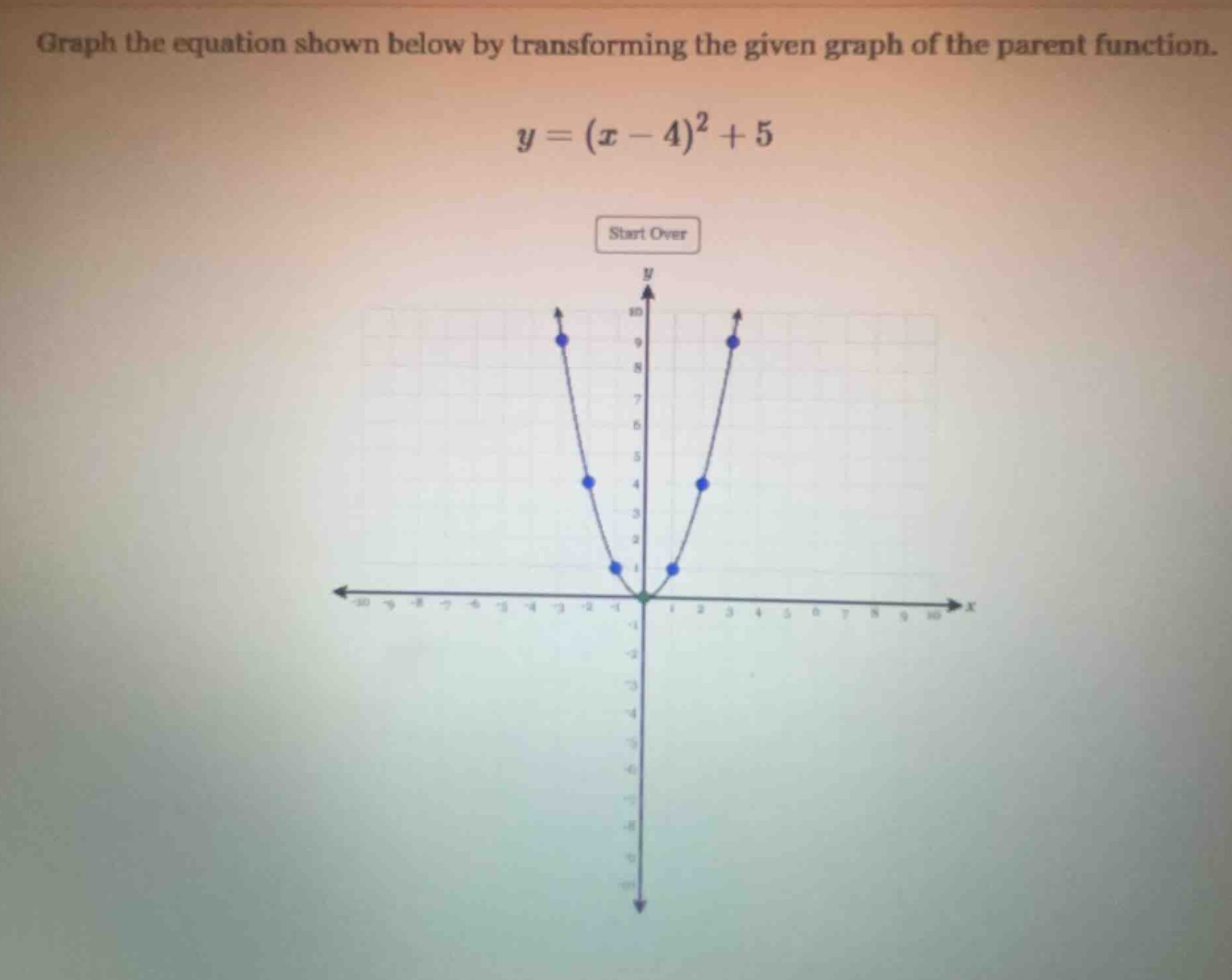
The parent function of \( y=(x - 4)^{2}+5 \) is \( y = x^{2} \), which is a parabola with vertex at \( (0,0) \), opening upwards.
Step2: Analyze horizontal shift
For a function of the form \( y=(x - h)^{2}+k \), the horizontal shift is determined by \( h \). Here, \( h = 4 \), so we shift the graph of \( y = x^{2} \) 4 units to the right.
Step3: Analyze vertical shift
The vertical shift is determined by \( k \). Here, \( k = 5 \), so we shift the graph (after horizontal shift) 5 units up.
Step4: Determine the new vertex
The vertex of the parent function \( y = x^{2} \) is \( (0,0) \). After shifting 4 units right and 5 units up, the new vertex is \( (4,5) \). The parabola will have the same shape (since the coefficient of \( x^{2} \) is 1, same as parent function) and open upwards.
To graph, we can also take points from the parent function, apply the shifts:
- For example, a point on \( y = x^{2} \) like \( (1,1) \): shift 4 right: \( x=1 + 4=5 \), shift 5 up: \( y = 1+5 = 6 \), so the point \( (5,6) \) is on \( y=(x - 4)^{2}+5 \).
- Another point \( (- 1,1) \) on \( y = x^{2} \): shift 4 right: \( x=-1 + 4 = 3 \), shift 5 up: \( y=1 + 5=6 \), so \( (3,6) \) is on the new graph.
- The vertex is \( (4,5) \), so plotting the vertex and these shifted points (and others) will give the graph of \( y=(x - 4)^{2}+5 \).

Snap & solve any problem in the app
Get step-by-step solutions on Sovi AI
Photo-based solutions with guided steps
Explore more problems and detailed explanations
To graph \( y=(x - 4)^{2}+5 \), shift the graph of \( y = x^{2} \) (vertex at \((0,0)\), opening up) 4 units to the right and 5 units up. The new vertex is \((4,5)\), and the parabola has the same shape as \( y = x^{2} \) (opens upwards). Points from the parent function can be shifted (e.g., \((1,1)\) on \( y = x^{2} \) becomes \((5,6)\) on \( y=(x - 4)^{2}+5 \), \((-1,1)\) becomes \((3,6)\)) to help plot the graph, with the vertex at \((4,5)\) and opening upwards.